 |
| þ |
ANNUAL
REPORT PURSUANT TO SECTION 13 OR 15(d) OF THE SECURITIES EXCHANGE ACT
OF 1934
|
| o |
TRANSITION
REPORT PURSUANT TO SECTION 13 OR 15(d) OF THE SECURITIES EXCHANGE ACT OF
1934
|
| Ecosphere Technologies, Inc. | ||
| (Exact name of registrant as specified in its charter) |
|
Delaware
|
|
20-3502861
|
|
(State or
Other Jurisdiction
|
|
(I.R.S.
Employer
|
|
of
Incorporation or Organization)
|
|
Identification
No.)
|
|
3515
S.E. Lionel Terrace, Stuart, Florida
|
|
34997
|
|
(Address
of Principal Executive Office)
|
|
(Zip
Code)
|
|
|
|
|
|
Large
accelerated filer
|
o |
Accelerated
filer
|
o |
|
Non-accelerated
filer
|
o |
Smaller
reporting company
|
þ |
| Page | ||
| Part I. | ||
| Item 1. | Business. | 1 |
| Item 1A. | Risk Factors. | 11 |
| Item 1B. | Unresolved Staff Comments. | 12 |
| Item 2. | Properties. | 12 |
| Item 3. | Legal Proceedings. | 12 |
| Item 4. | Submission of Matters to a Vote of Security Holders. | 12 |
| Part II. | ||
| Item 5. | Market for Registrant’s Common Equity, Related Stockholder Matters and Issuer Purchases of Equity Securities. | 13 |
| Item 6. | Selected Financial Data. | 14 |
| Item 7. | Management’s Discussion and Analysis of Financial Condition and Results of Operations. | 14 |
| Item 7A. | Quantitative and Qualitative Disclosures About Market Risk. | 32 |
| Item 8. | Financial Statements and Supplementary Data. | 33 |
| Item 9. | Changes in and Disagreements With Accountants on Accounting and Financial Disclosure. | 33 |
| Item 9A. | Controls and Procedures. | 33 |
| Item 9A(T) | Controls and Procedures. | 33 |
| Item 9B. | Other Information. | 34 |
| Part III. | ||
| Item 10. | Directors, Executive Officers and Corporate Governance. | 35 |
| Item 11. | Executive Compensation. | 42 |
| Item 12. | Security Ownership of Certain Beneficial Owners and Management and Related Stockholder Matters. | 47 |
| Item 13. | Certain Relationships and Related Transactions, and Director Independence. | 49 |
| Item 14. | Principal Accounting Fees and Services. | 50 |
| Part IV. | ||
| Item 15. |
Exhibits,
FinancialSstatement Schedules.
|
52 |
| SIGNATURES | 54 | |
|
●
|
in
treating water used to fracture natural gas wells in an environmentally
friendly manner;
|
|
●
|
in
eliminating the use of chemicals to treat bacteria and reduce scaling in
the fracturing process;
|
|
●
|
in
eliminating the need to dispose of contaminated water which flows back
after fracturing wells, which reduces environmental regulatory issues;
and
|
|
●
|
improving
the efficiency and productivity of natural gas
wells.
|
|
|
|
●
|
Surface
water (and EcosBrine™ water if the energy company uses it) is put through
an EcosFrac™ tank, undergoing a chemical free process
whereby divalent cations as well as aerobic and anaerobic bacteria
are removed.
|
|
●
|
The
completions solution, which is chemical free, is then pumped through the
pumper trucks and into the well head. This eliminates the need
to purchase expensive and environmentally unfriendly biocides and
scale inhibitors to mix with completions
fluid.
|
|
●
|
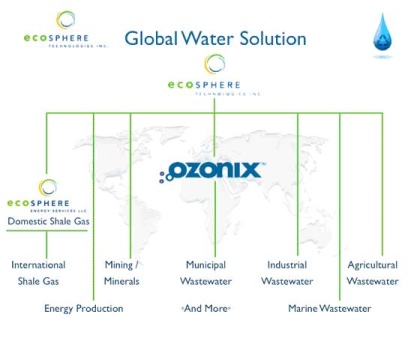
Beyond
oil and gas drilling, our patented technology has applications in other
parts of the energy business including conventional and nuclear power
plants and coal mining operations.
|
|
●
|
Mining Minerals –
Water-pollution problems caused by mining include acid mine drainage,
metal contamination and increased sediment levels in
streams. The EPA estimates that there are more than 600,000
mines, most of which are abandoned, have polluted over 180,000 acres of
reservoirs and lakes, and 12,000 miles of streams. Without
remediation and reclamation of these mines, they will continue to
discharge toxic metals in water and
sediment.
|
|
●
|
Municipal Wastewater –
Wastewater discharged into municipal wastewater systems travels to local
wastewater treatment plants where it is treated before being discharged
into the environment. According to the U.S. Census, in 2000,
there were 15,591 wastewater treatment facilities in the U.S. with a total
capacity of 42.225 billion gallons per
day.
|
|
●
|
Commercial Wastewater –
Diminishing quality water supplies, increasing water purchase costs and
strict environmental standards are forcing industries to target increased
water-efficiency and reuse.
|
|
●
|
Agricultural Wastewater
– As reported by the EPA, agriculture nonpoint source pollution is the
leading source of water quality impacts on surveyed rivers and lakes as
surveyed in the 2000 National Water Quality Inventory provided to
Congress. Agriculture is a highly intensified industry in many
parts of the world, producing a range of wastewaters including sediment
and nutrient runoffs, pesticides and animal wastes requiring a variety of
treatment technologies. The disposal of many of these wastes
can pose serious health problems.
|
|
|
●
|
U.S. Patent (awaiting assignment of patent number) -
The Ecosphere Ozonix® process
for enhanced water treatment for reclamation of waste
fluids.
|
|
|
●
|
U.S. Patent (awaiting assignment of patent number) -
The Ecos Frac™ tank, real-time processing of water for hydraulic fracture
treatments using a transportable frac
tank.
|
|
|
●
|
U.S. Patent 6,287,389 -
Method of robotic automobile paint stripping – dated September 11,
2001.
|
|
|
●
|
U.S. Patent 6,745,108 -
Expansion of 3D robotic auto paint stripping patent to include any object
– dated June 1, 2004.
|
|
|
●
|
U .S. Patent 7,100,844 –
High Impact Waterjet Nozzle is constructed to infuse fluid into a high
velocity stream of liquid passing through a nozzle to create a bubble rich
waterjet that causes the bubbles to implode when the waterjet strikes the
surface amplifying the impact of the water – dated September 5,
2006.
|
|
|
●
|
U.S. Patent Pending -
Mobile Emergency Water Filtration System for Homeland Security and other
applications.
|
|
|
●
|
U.S. Patent Pending -
Business Model to provide response and training to public and private
suppliers of water resources in the event of an act of terrorism or a
natural disaster that contaminates a water
supply.
|
|
Bid
Prices
|
||||||||
|
Year
|
Quarter
Ended
|
High
|
Low
|
|||||
|
($)
|
($)
|
|||||||
|
2009
|
March 31
|
0.35 | 0.14 | |||||
|
June 30
|
0.52 | 0.13 | ||||||
|
September 30
|
0.52 | 0.31 | ||||||
|
December 31
|
0.49 | 0.33 | ||||||
|
2008
|
March 31
|
0.25 | 0.10 | |||||
|
June 30
|
0.62 | 0.11 | ||||||
|
September 30
|
0.78 | 0.36 | ||||||
|
December 31
|
0.68 | 0.26 | ||||||
|
Name
of Class
|
Date
Sold
|
No. of
Securities
|
Reason
for Issuance
|
|
Holder
of Convertible Debentures
|
October
8, 2009
|
629,554
|
Conversion
of convertible debenture
|
|
Holder
of Convertible Debentures
|
October
8, 2009
|
944
|
In
lieu of cash interest
|
|
Debt
holder
|
October
16, 2009
|
20,000
|
Extension
of debt
|
|
Debt
holder
|
October
16, 2009
|
7,500
|
Satisfaction
of debt
|
|
Warrant
Holder
|
October
26, 2009
|
112,500
five-year warrants exercisable at $0.25 per share
|
In
connection with a new convertible note
|
|
Series
B holder
|
November
23, 2009
|
16,700
|
Conversion
of Series B Preferred Stock
|
|
Consultants
|
December
22, 2009
|
100,000
five-year warrants exercisable at $0.43 per share
|
Consulting
services
|
|
Employee
|
December
22, 2009
|
50,000
five-year stock options exercisable at $0.43 per share
|
Service
as employee
|
|
●
|
In
July 2009, the Corporation Commission of Oklahoma approved a permit
application by Newfield to build and operate a water recycling plant
utilizing the Ecosphere Ozonix®
water treatment system to treat frac flowback water for two
years.
|
|
●
|
In
July 2009, the Company entered into a Master Service Agreement with
two subsidiaries of Southwestern Energy and received a work order for the
deployment of EcosFrac™
Tanks to pretreat water used to fracture natural gas wells in the
Fayetteville Shale.
|
|
●
|
The
Master Service Agreement and work order demonstrate that the
EcosFrac™ tank
will be an important part of our product line to service the oil and gas
industry.
|
|
●
|
In
August 2009, the EES entered into an agreement to process frac flowback
water in the Woodford shale in Oklahoma. The term of the
agreement is one year with the option for two additional
years.
|
|
●
|
Ecosphere
manufactured and EES delivered the majority of the EcosFrac™
tanks to Southwestern Energy in 2009 and the balance of the units in
the first few days of 2010.
|
|
●
|
EES
completed two pilots for BP in Wyoming and one in
Oklahoma.
|
|
●
|
Ecosphere
completed two significant financings related to EES as detailed
below.
|
|
For
the Years Ended December 31,
|
||||||||||||||||
|
Change
|
||||||||||||||||
|
2009
|
2008
|
$ | % | |||||||||||||
|
|
|
|
|
|||||||||||||
|
Revenues
|
$ | 1,760,129 | $ | 247,202 | $ | 1,512,927 | 612 | % | ||||||||
|
Cost
of revenues
|
924,789 | 163,169 | 761,620 | 467 | % | |||||||||||
|
Gross
profit (loss)
|
835,340 | 84,033 | 751,307 | 894 | % | |||||||||||
|
Operating
expenses
|
||||||||||||||||
|
Salaries
and employee benefits
|
6,833,304 | 3,255,835 | 3,577,469 | 110 | % | |||||||||||
|
Administrative
and selling
|
1,211,662 | 1,314,418 | (102,756 | ) | -8 | % | ||||||||||
|
Professional
fees
|
1,162,772 | 1,227,810 | (65,038 | ) | -5 | % | ||||||||||
|
Depreciation
and amortization
|
686,309 | 259,642 | 426,667 | 164 | % | |||||||||||
|
Research
and development
|
97,389 | 24,951 | 72,438 | 290 | % | |||||||||||
|
Total
selling general and administrative
|
9,991,436 | 6,082,656 | 3,908,780 | 64 | % | |||||||||||
|
Restructuring
charge
|
548,090 | - | 548,090 | 100 | % | |||||||||||
|
Asset
impairment
|
- | 6,601 | (6,601 | ) | -100 | % | ||||||||||
|
Total
oerating expenses
|
10,539,526 | 6,089,257 | 4,450,269 | 73 | % | |||||||||||
|
Loss
from operations
|
(9,704,186 | ) | (6,005,224 | ) | (3,698,962 | ) | 62 | % | ||||||||
|
Other
income (expense):
|
||||||||||||||||
|
Other
income (expense)
|
1,758 | (12,599 | ) | 14,357 | 114 | % | ||||||||||
|
Gain
(loss) on conversion
|
(716,783 | ) | (256,271 | ) | (460,512 | ) | -180 | % | ||||||||
|
Interest
expense
|
(5,184,747 | ) | (5,419,562 | ) | 234,815 | 4 | % | |||||||||
|
Change
in fair value of derivative instruments
|
(3,446,612 | ) | - | (3,446,612 | ) | -100 | % | |||||||||
|
Total
other income (expense)
|
(9,346,384 | ) | (5,688,432 | ) | (3,657,952 | ) | 64 | % | ||||||||
|
Net
loss
|
(19,050,570 | ) | (11,693,656 | ) | (7,356,914 | ) | -63 | % | ||||||||
|
Preferred
stock dividends
|
118,750 | 138,250 | 19,500 | -14 | % | |||||||||||
|
Net
income (loss) applicable to common stock
|
(19,169,320 | ) | (11,831,906 | ) | (7,337,414 | ) | -62 | % | ||||||||
|
Net
loss applicable to noncontrolling interest of consolidated
subsidiary
|
743,417 | - | 743,417 | 100 | % | |||||||||||
|
Net
loss applicable to Ecosphere Technologies common stock
|
$ | (18,425,903 | ) | $ | (11,831,906 | ) | $ | (6,593,997 | ) | -56 | % | |||||
|
●
|
Continued
generation of revenue by EES from our existing long term
Agreements;
|
|
●
|
A
new EES long-term Agreement from an existing or new customer through which
Ecosphere generates manufacturing
profits;
|
|
●
|
Favorable
financing terms to enable Ecosphere to finance the manufacturing of new
units needed for a new long-term
Agreement;
|
|
●
|
New
paid pilots throughout the 12
months;
|
|
●
|
Conversion
of debt, as described below;
|
|
●
|
2010
distributions of profits and priority distributions from
EES.
|
|
|
●
|
Our
ability to convince customers to use our
services;
|
|
|
●
|
Our
ability to finance the units;
|
|
|
●
|
Our
ability to operate units that are built;
and
|
|
|
●
|
Our
ability to manage the operations of our Ecosphere Ozonix® systems
at multiple locations.
|
|
|
●
|
Our
receipt of orders from existing and new
customers;
|
|
|
●
|
The
availability of components from our suppliers for Ecosphere Ozonix®
systems;
|
|
|
●
|
Operating
results from our Ecosphere Ozonix® units and
the announcement of future agreements for our Ecosphere Ozonix®
units;
|
|
|
●
|
Our
raising necessary working capital and any associated costs which will be
charged as expenses to our future results of
operations;
|
|
|
●
|
Our
continuing to develop new
technologies;
|
|
|
●
|
Pricing
pressures;
|
|
|
●
|
General
economic and political conditions;
|
|
|
●
|
Our
sales of assets similar to the October 2007 sale of the intellectual
property and related assets of our ship stripping
technology;
|
|
|
●
|
Our
ability to develop a working prototype of our Ecos LifeLink and market it
in third world countries; and
|
|
|
●
|
Our
sales or licensing of our technologies in
inventory.
|
|
|
●
|
Changes
in laws or regulations resulting in more burdensome governmental controls,
tariffs, restrictions, embargoes or export license
requirements;
|
|
|
●
|
Laws
which require that local citizens or residents own a majority of a
business;
|
|
|
●
|
Difficulties
in obtaining required export
licenses;
|
|
|
●
|
Volatility
in currency exchange rates;
|
|
|
●
|
Political
and economic instability;
|
|
|
●
|
Extended
payment terms beyond those customarily offered in the United
States;
|
|
|
●
|
Difficulties
in managing distributors or representatives outside the United States;
and
|
|
|
●
|
Potentially
adverse tax consequences.
|
|
|
●
|
Pending
and future patent applications will result in issued
patents;
|
|
|
●
|
Patents
we own or which are licensed by us will not be challenged by
competitors;
|
|
|
●
|
The
patents will be found to be valid or sufficiently broad to protect our
technology or provide us with a competitive advantage;
and
|
|
|
●
|
We
will be successful in defending against future patent infringement claims
asserted against our products.
|
|
|
●
|
Our
failure to generate increasing
revenues;
|
|
|
●
|
Short
selling activities;
|
|
|
●
|
Our
failure to achieve and maintain
profitability;
|
|
|
●
|
Actual
or anticipated variations in our quarterly results of
operations;
|
|
|
●
|
Announcements
by us or our competitors of significant contracts, new products,
acquisitions, commercial relationships, joint ventures or capital
commitments;
|
|
|
●
|
The
loss of major customers or product or component
suppliers;
|
|
|
●
|
The
loss of significant business
relationships;
|
|
|
●
|
Our
failure to meet financial analysts’ performance
expectations;
|
|
|
●
|
Changes
in earnings estimates and recommendations by financial analysts;
or
|
|
|
●
|
Changes
in market valuations of similar
companies.
|
|
(i)
|
we
are current in our filings,
|
|
(ii)
|
certain
manner of sale provisions,
|
|
(iii)
|
filing
of Form 144, and
|
|
Name
|
Age
|
|||
|
Charles
Vinick
|
63
|
Chairman
of the Board
|
||
|
Joe
Allbaugh
|
57
|
Director
|
||
|
Gene
Davis
|
56
|
Director
|
||
|
Michael
Donn, Sr.
|
62
|
Director
|
||
|
D.
Stephen Keating
|
54
|
Director
|
||
|
George
Sterner
|
69
|
Director
|
||
|
Thomas
Wolfe
|
62
|
Director
|
|
Name
|
Age
|
|||
|
Dennis
McGuire
|
59
|
Chief
Executive Officer and President
|
||
|
Adrian
Goldfarb
|
52
|
Chief
Financial Officer
|
||
|
Michael
Donn, Sr.
|
62
|
Chief
Operating Officer
|
||
|
Jacqueline
McGuire
|
47
|
Senior
Vice President of Administration and
Secretary
|
|
Name
|
Age
|
Position(s)
|
||
|
Sanjeev
Jahkete
|
41
|
Senior
Vice President of Engineering
|
||
|
Aaron
Horn
|
31
|
President
of EES
|
||
|
Robert
Cathey
|
33
|
Chief
Operating Officer of EES
|
|
Name
|
|
Independent
|
Audit
|
Compensation
|
||
|
Joe
Allbaugh
|
P
|
P
|
||||
|
Gene
Davis
|
P
|
P
|
||||
|
Michael
Donn, Sr.
|
||||||
|
D.
Stephen Keating
|
P
|
Chairman
|
||||
|
George
Sterner
|
P
|
P
|
||||
|
Charles
Vinick
|
P
|
Chairman
|
||||
|
Thomas
Wolfe
|
P
|
P
|
|
Name
|
Number
of
Late
Reports
|
Number
of
Late
Transactions
|
Number
of
Known
Failures to File
|
|||||||||
|
D.
Stephen Keating
|
1 | 1 | — | |||||||||
|
Thomas
Wolfe
|
1 | 1 | — | |||||||||
|
George
Sterner
|
1 | 1 | — | |||||||||
|
Name
and
Principal
Position
(a)
|
Year
(b)
|
Salary
($)(c)
|
Bonus
($)(c)
|
Stock
Awards
($)(e)(1)
|
Option
Awards
($)(f)(1)
|
Non-Equity
Incentive Plan Compensation ($)(g)
|
All
Other
Compensation
($)(i)
|
Total
($)(j)
|
|||||||||||
|
Dennis
McGuire
|
2009
|
250,000 | 250,000 | (2) | --- | 1,221,599 | (3) | 92,916 | --- | 1,814,515 | |||||||||
|
Chief
Executive Officer
|
2008
|
306,561 | --- | 37,000 | 2,558,017 | (4) | — | --- | 2,901,578 | ||||||||||
|
Patrick
Haskell
|
2009
|
281,459 | --- | 50,000 | (5) | 539,578 | (5) | — | --- | 871,037 | |||||||||
|
Former
Chief Executive Officer
|
2008
|
63,700 | --- | 59,177 | (5) | 2,998,998 | (5) | — | 288,000 | (5) | 3,409,875 | ||||||||
|
Michael
Donn, Sr.
|
2009
|
160,854 | 5,000 | (6) | --- | 64,250 | (6) | — | --- | 230,104 | |||||||||
|
Chief
Operating Officer
|
2008
|
212,143 | --- | 29,600 | (7) | 170,357 | (7) | — | --- | 412,100 | |||||||||
|
Adrian
Goldfarb
|
2009
|
142,531 | 5,000 | (8) | --- | 432,108 | (9) | — | --- | 579,639 | |||||||||
|
Chief
Financial Officer
|
2008
|
86,631 | --- | --- | 277,341 | (10) | — | --- | 363,972 |
|
(1)
|
The
amounts in these columns represent the fair value of the award as of the
grant date as computed in accordance with FASB ASC Topic 718 and the
recently revised SEC disclosure rules. These rules also require
prior years amounts to be recalculated in accordance with the rule and
therefore any number previously disclosed in our Form 10-K regarding NEO
compensation on this table or any other table may not
reconcile. These amounts represent awards that are paid in
shares of common stock or options to purchase shares of our common stock
and do not reflect the actual amounts that may be realized by the Named
Executive Officers.
|
|
(2)
|
On
November 12, 2009, the Board awarded Mr. McGuire a $150,000 bonus and on
December 22, 2009, Mr. McGuire was awarded a $100,000
bonus.
|
|
(3)
|
On
July 1, 2009, Mr. McGuire was granted 2,500,000 stock options vesting
annually over a three year period (beginning July 1, 2010) exercisable at
$0.49 per share. On December 22, 2009, Mr. McGuire was granted
1,500,000 stock options vesting semi-annually in six equal increments
(beginning June 30, 2010) exercisable at $0.43 per
share. Non-Equity Incentive Plan Compensation represents a cash
payment for commissions received. See the description of Mr.
McGuire’s compensation arrangement
below.
|
|
(4)
|
On
May 20, 2008, Mr. McGuire was granted 7,000,000 options exercisable at
$0.30 per share. Additionally, Mr. McGuire was granted
3,300,000 stock options exercisable at $0.50 per share on June 17,
2008. All of these options have fully vested. The stock award
represents stock issued in lieu of a cash
bonus.
|
|
(5)
|
Effective
June 17, 2008, Mr. Haskell was granted 8,250,000 stock options exercisable
at $0.50 per share. Of the options, 2,750,000 were subject to
both performance and time based vesting. The remaining options
were to vest ratably over a three-year period, subject to continued
employment with us on each applicable vesting date. On July 1,
2009, Mr. Haskell was granted 1,500,000 stock options exercisable at $0.49
per share which vested upon his resigning as Chief Executive Officer and
agreeing to waive the vesting of all his unvested options from the June
17, 2008 grant date. On July 31, 2009, Mr. Haskell resigned as
Chief Executive Officer. On December 22, 2009, Mr. Haskell was
granted 50,000 fully-vested stock options exercisable at $0.43 per
share. The stock award for 2009 represents a bonus. The stock
award for 2008 represents shares issued in lieu of salary. All Other
Compensation represents the value of shares issued to Mr. Haskell as a
finders’ fee for arranging a financing prior to becoming a director or
officer of Ecosphere.
|
|
(6)
|
On
December 22, 2009, Mr. Donn received a $5,000 bonus and was granted
250,000 stock options vesting on June 22, 2010, exercisable at $0.43 per
share.
|
|
(7)
|
On
June 30, 2008, Mr. Donn was granted 500,000 stock options exercisable at
$0.47 per share. Of the options, 350,000 have vested and the
remaining vest on June 30, 2010. The stock award represents stock issued
in lieu of a cash bonus.
|
|
(8)
|
On
December 22, 2009, Mr. Goldfarb received a $5,000
bonus.
|
|
(9)
|
On
July 1, 2009, Mr. Goldfarb was granted 1,100,000 stock options vesting
annually over a three year period (beginning July 1, 2010) exercisable at
$0.49 per share. On December 22, 2009, Mr. Goldfarb was granted
250,000 stock options vesting on June 22, 2010, exercisable at $0.43 per
share.
|
|
(10)
|
On
November 22, 2008, Mr. Goldfarb was granted 400,000 stock options vesting
annually over three years exercisable at $0.27 per share. On
December 20, 2008, Mr. Goldfarb was granted 500,000 stock options vesting
semi-annually over a three years beginning December 31, 2008 exercisable
at $0.45 per share.
|
| OUTSTANDING EQUITY AWARDS AT 2009 FISCAL YEAR-END | |||||||||||||
|
OPTION
AWARDS
|
|||||||||||||
|
Name
(a)
|
Number of
Securities
Underlying
Unexercised
Options
(#)
Exercisable
(b)
|
Number of
Securities
Underlying
Unexercised
Options
(#)
Unexercisable
(c)
|
Option
Exercise
Price
($)
(e)
|
Option
Expiration
Date
(f)
|
|||||||||
|
Dennis
McGuire
|
|||||||||||||
| 618,750 | 0 | 0.83 |
5/25/11
|
||||||||||
| 2,990,000 | 0 | 1.00 |
11/8/15
|
||||||||||
| 1,247,000 | (1) | 0 | 0.15 |
10/9/12
|
|||||||||
| 1,200,000 | 0 | 0.28 |
1/31/11
|
||||||||||
| 800,000 | 0 | 0.28 |
1/31/11
|
||||||||||
| 4,750,000 | 0 | 0.30 |
5/20/13
|
||||||||||
| 2,000,000 | 0 | 0.30 |
5/20/13
|
||||||||||
| 3,300,000 | 0 | 0.50 |
6/17/13
|
||||||||||
| 0 | 2,500,000 | (2) | 0.47 |
7/1/14
|
|||||||||
| 0 | 1,500,000 | (3) | 0.43 |
12/22/14
|
|||||||||
|
Patrick
Haskell
|
|||||||||||||
| 2,750,000 | 0 | 0.50 |
6/17/13
|
||||||||||
| 81,081 | 0 | 0.15 |
7/31/12
|
||||||||||
| 1,500,000 | 0 | 0.49 |
7/1/14
|
||||||||||
| 50,000 | 0 | 0.43 |
12/22/14
|
||||||||||
|
Michael
Donn, Sr.
|
|||||||||||||
| 200,000 | 0 | 1.10 |
12/31/14
|
||||||||||
| 309,375 | 0 | 0.83 |
5/25/11
|
||||||||||
| 50,000 | 0 | 0.44 |
12/18/11
|
||||||||||
| 515,667 | 0 | 0.15 |
7/31/13
|
||||||||||
| 200,000 | 0 | 0.28 |
1/31/11
|
||||||||||
| 375,000 | 125,000 | (4) | 0.47 |
6/30/13
|
|||||||||
| 0 | 250,000 | (3) | 0.43 |
12/22/14
|
|||||||||
|
Adrian
Goldfarb
|
133,333 | 266,667 | (5) | 0.27 |
11/22/13
|
||||||||
| 250,000 | 250,000 | (6) | 0.45 |
7/3/13
|
|||||||||
| 0 | 1,100,000 | (2) | 0.47 |
7/1/14
|
|||||||||
| 0 | 250,000 | (3) | 0.43 |
12/22/14
|
|||||||||
|
Name
(a)
|
Stock
Awards
($)(c)(1)
|
Option
Awards
($)(d)
(1)
|
Total
($)(j)
|
||||
|
George
Sterner
|
— |
68,248
|
68,248
|
||||
|
Joe
Allbaugh
|
33,571
|
23,887
|
57,458
|
||||
|
Charles
Vinick
|
75,000
|
112,523
|
187,523
|
||||
|
D.
Stephen Keating
|
38,367
|
27,299
|
65,666
|
||||
|
Gene
Davis
|
33,571
|
23,887
|
57,458
|
||||
|
Thomas
Wolfe
|
33,571
|
23,887
|
57,458
|
||||
|
Options
|
Restricted
Stock
|
|||||||
|
Initial
appointment as Chairman of the Board
|
$ | 75,000 | $ | 75,000 | ||||
|
Initial
election or appointment of a non-employee director
|
$ | 40,000 | $ | 40,000 | ||||
|
Initial
appointment as a director advisor
|
$ | 15,000 | $ | 10,000 | ||||
|
Options
|
Restricted
Stock
|
|||||||
|
Chairman
of the Board
|
$ | 40,000 | $ | 40,000 | ||||
|
Non-employee
director
|
$ | 25,000 | $ | 25,000 | ||||
|
Director
advisor
|
$ | 10,000 | $ | 5,000 | ||||
|
Initial
appointment of and annual grant to a non-employee director serving as Lead
Director or Chairman of the following: Audit Committee,
Compensation
Committee and other committees at the discretion of the Compensation
Committee
|
$ | 15,000 | $ | 15,000 | ||||
|
Initial
appointment of and annual grant to a non-employee director serving on the
following: Audit Committee, Compensation Committee
and
other committees at the discretion of the Compensation
Committee
|
$ | 10,000 | $ | 10,000 | ||||
|
Name
Of Plan
|
Number
of
securities
to be issued upon exercise of outstanding options, warrants and
rights(1)
|
Weighted-average
exercise price of outstanding options, warrants and rights
|
Number
of securities
remaining
available for future issuance under equity compensation plans (excluding
securities reflected in column (a))
|
||||||
|
Equity
compensation plans approved by security holders
|
|||||||||
|
2000
Long Term Incentive Program and 2003 Equity Incentive Plan(2)
|
175,500
|
$0.91
|
3,824,500
|
||||||
|
2003
Stock Option Plan for Outside Directors and Advisory Board Members
(2)
|
1,803,000
|
$0.66
|
2,197,000
|
||||||
|
2006
Equity Incentive Plan
|
9,490,235
|
$0.57
|
509,765
|
(3)
|
|||||
|
Equity
compensation plans not approved by security holders
(4)
|
36,919,155
|
$0.46
|
N/A
|
||||||
|
Total
|
48,387,890
|
N/A
|
|||||||
|
(1)
|
Consists
of stock options.
|
|
(2)
|
Ecosphere
does not intend to issue options under these plans in the
future.
|
|
(3)
|
The
Plan was approved by our shareholders at our 2008 annual meeting held on
November 13, 2008. We may issue a
total of 10,000,000 shares under the Plan, which includes restricted
stock, options, restricted stock units and stock appreciation
rights. Because Ecosphere has issued shares of restricted
stock, the number of securities available for grant has been
reduced.
|
|
(4)
|
Represents
outstanding options which have been granted in conjunction with directors
and employee compensation and consulting arrangements. These
options vest over a three year period and are generally exercisable over
periods ranging from five to 10 years. The exercise price of
the options granted ranges from $0.15 to $3.00 per share. Includes
1,488,000 options issued to directors, with exercise prices between
$0.28 and $1.00 and expiring through March 31, 2011 and
26,737,333 options issued to current and former executive officers,
with exercise prices between $0.15 and $1.10 and expiring through
December 31, 2014.
|
|
Title
of Class
|
Name
and Address of Beneficial Owner
|
Amount
Beneficially
Owned(1)
|
Percent of
Class (1)
|
|||||||
| Named Executive Officers | ||||||||||
|
Common
Stock
|
Dennis
and Jacqueline McGuire
3515
S.E. Lionel Terrace
Stuart,
FL 34997
(2)
|
17,874,810 | 12.6 | % | ||||||
|
Common
Stock
|
Patrick
Haskell
45
East 89th
Street, Apt. 27A
New
York, NY 10129 (3)
|
12,931,241 | 9.9 | % | ||||||
|
Common
Stock
|
Adrian
Goldfarb
3515
S.E. Lionel Terrace
Stuart,
FL 34997
(4)
|
508,333 | * | |||||||
|
Common
Stock
|
Michael
Donn, Sr.
3515
S.E. Lionel Terrace
Stuart,
FL 34997
(5)
|
1,799,842 | 1.4 | % | ||||||
|
Directors
|
||||||||||
|
Common
Stock
|
Charles
Vinick
2323
Foothill Lane
Santa
Barbara, CA 93105
(6)
|
724,965 | * | |||||||
|
Common
Stock
|
Joe
Allbaugh
400
North Capitol Street, NW, Ste. 475 Washington, DC 20001 (7)
|
1,375,238 | 1.1 | % | ||||||
|
Common
Stock
|
Gene
Davis
27
S. Monroe Street
Denver,
CO 80209
(8)
|
140,873 | * | |||||||
|
Common
Stock
|
D.
Stephen Keating
65
Kensington Road
Garden
City, NY 11530
(9)
|
1,429,638 | 1.2 | % | ||||||
|
Common
Stock
|
George
Sterner
2708
Hatmark Street
Vienna,
VA 22181
(10)
|
1,760,339 | 1.4 | % | ||||||
|
Common
Stock
|
Thomas
Wolfe
P.O.
Box 190
Rough
and Ready, CA 95975
(11)
|
140,874 | * | |||||||
|
Common
Stock
|
All
directors and executive officers
as
a group (10 persons)
|
25,727,911 | 17.5 | % | ||||||
|
5%
Shareholder
|
||||||||||
|
Common
Stock
|
Kevin
Grady
3515
S.E. Lionel Terrace
Stuart,
FL 34997 (12)
|
8,026,010 | 6.4 | % | ||||||
|
(1)
|
Applicable percentages
are based on 123,708,277 shares outstanding as of adjusted as
required by rules of the SEC. Beneficial ownership is
determined under the rules of the SEC and generally includes voting or
investment power with respect to securities. Shares of common
stock subject to options, warrants and convertible notes currently
exercisable or convertible, or exercisable or convertible within 60 days
after the date of this report are deemed outstanding for computing
the percentage of the person holding such securities but are not
deemed outstanding for computing the percentage of any other
person. Unless otherwise indicated in the footnotes to this
table, Ecosphere believes that each of the shareholders named in the table
has sole voting and investment power with respect to the shares of common
stock indicated as beneficially owned by them.
|
|
(2)
|
Includes:
|
|
●
|
155,000
shares of common stock owned by
Mrs. McGuire,
|
|
●
|
302,372
shares owned jointly,
|
|
●
|
16,105,750
shares issuable upon exercise of vested options owned by
Mr. McGuire,
|
|
●
|
484,688
shares issuable upon exercise of vested options owned by
Mrs. McGuire, and
|
|
●
|
800,000
shares issuable upon exercise of jointly owned
options.
|
|
●
|
4,000,000
options not exercisable within 60 days of this report held by Mr. McGuire,
and
|
|
●
|
200,000
options not exercisable within 60 days of this report held by Mrs.
McGuire.
|
|
(3)
|
Mr.
Haskell is our former Chief Executive Officer. Includes:
4,381,081 shares of common stock issuable upon the exercise of options,
1,935,000 shares of common stock issuable upon exercise of warrants,
308,642 shares of common stock issuable upon conversion of convertible
notes.
|
| (4) |
Includes 508,333
shares of common stock issuable upon the exercise of
options. Does not include 1,741,667 options which are not
exercisable within 60 days of this report.
|
|
(5)
|
Mr.
Donn is also a director. Includes 1,625,042 shares of common
stock issuable upon exercise of options. Does not include
400,000 options which are not exercisable within 60 days of this
report.
|
|
(6)
|
Includes
209,092 shares of common stock issuable upon exercise of
options. Does not include 337,684 options which are not
exercisable within 60 days of this report.
|
|
(7)
|
Includes
1,245,834 shares of common stock issuable upon exercise of
options. Does not include 71,428 options which are not
exercisable within 60 days of this report.
|
|
(8)
|
Includes
69,445 shares of common stock issuable upon exercise of
options. Does not include 210,317 options which are not
exercisable within 60 days of this report.
|
|
(9)
|
Includes
888,889 shares issuable upon the conversion of a convertible
note. Also includes 100,000 shares issuable upon exercise of
warrants and 76,389 shares issuable upon exercise of
options. Does not include 234,410 options which are not
exercisable within 60 days of this report.
|
|
(10)
|
Includes
1,218,334 shares of common stock issuable upon exercise of
options. Does not include 204,080 options which are not
exercisable within 60 days of this report.
|
|
(11)
|
Includes
69,445 shares of common stock issuable upon exercise of
options. Does not include 210,318 options which are not
exercisable within 60 days of this report.
|
|
(12)
|
Mr. Grady
is an employee. Includes 1,200,000 shares of common stock
issuable upon exercise of options. Does not include 225,000
options which are not exercisable within 60 days of this
report.
|
|
Name
|
December
31, 2008
|
December
31, 2009
|
March
31, 2010
|
|||||||||
|
Dennis
McGuire
|
$ | 29,207 | $ | --- | $ | --- | ||||||
|
James
Rushing III
|
$ | 24,015 | $ | --- | $ | --- | ||||||
|
Michael
Donn, Sr.
|
$ | 16,226 | $ | --- | $ | --- | ||||||
|
Jacqueline
McGuire
|
$ | --- | $ | --- | $ | --- | ||||||
|
Adrian
Goldfarb
|
$ | --- | $ | --- | $ | --- | ||||||
|
Stephen
Johnson
|
$ | 10,625 | $ | --- | $ | --- | ||||||
|
No.
of
Options/Warrants
Cancelled
|
No.
of
Options
Issued
|
|||||||
|
Dennis
McGuire (1)
|
3,000,000 | 1,200,000 | ||||||
|
Jacqueline
McGuire (1)
|
199,999 | 80,000 | ||||||
|
Dennis
and Jacqueline McGuire (2)
|
2,000,000 | 800,000 | ||||||
|
Michael
Donn, Sr.
|
500,000 | 200,000 | ||||||
|
James
Rushing, III (3)
|
1,315,000 | 526,000 | ||||||
|
Vice-Admiral
George Sterner
|
1,275,000 | 510,000 | ||||||
|
Barry
Hechtman (3)
|
105,000 | 42,000 | ||||||
|
(1)
|
All
directors and officers exchanged only options, except Mr. and Mrs. McGuire
who also exchanged warrants.
|
|
(2)
|
Warrants
jointly owned by Mr. Dennis McGuire and Mrs. Jacqueline
McGuire.
|
|
(3)
|
Messrs.
Rushing and Hechtman resigned from the Board in August
2008.
|
|
2009
|
2008
|
|||||||
|
Audit
Fees (1)
|
$ | 94,000 | $ | 90,000 | ||||
|
Audit
Related Fees (2)
|
$ | 600 | $ | 8,000 | ||||
|
Tax
Fees (3)
|
$ | 0 | $ | 0 | ||||
|
All
Other Fees
|
$ | 0 | $ | 0 | ||||
|
(1)
|
Audit
fees – these fees relate to the audit of our annual financial statements
and the review of our interim quarterly financial
statements.
|
|
(2)
|
Audit
related fees – these fees relate primarily to the auditors’ review of our
registration statements and audit related
consulting.
|
|
(3)
|
Tax
fees – no fees of this sort were billed by Salberg & Company P.A., our
principal accountant during 2009 and
2008.
|
|
(1)
|
Financial
Statements. See Index to Consolidated Financial Statements,
which appears on page F-1 hereof. The financial statements
listed in the accompanying Index to Consolidated Financial Statements are
filed herewith in response to this
Item.
|
|
(2)
|
Financial
Statements Schedules. All schedules are omitted because they
are not applicable or because the required information is contained in the
consolidated financial statements or notes included in this
report.
|
|
(3)
|
Exhibits. |
|
Exhibit
|
Incorporated
by Reference
|
Filed
or Furnished
|
|||||||||
|
No.
|
Exhibit
Description
|
Form
|
Date
|
Number
|
Herewith
|
||||||
| 3.1 |
Certificate
of Incorporation
|
10-QSB
|
12/11/06
|
3.1 | |||||||
| 3.2 |
Certificate
of Amendment
|
10-K |
3/25/09
|
3.2 | |||||||
| 3.3 |
Certificate
of Correction
|
10-K |
3/25/09
|
3.3 | |||||||
| 3.4 |
Bylaws
|
10-QSB
|
12/11/06
|
3.2 | |||||||
| 3.5 |
Amendment
to the Bylaws
|
10-Q |
11/13/08
|
3.3 | |||||||
| 10.1 |
2006
Equity Incentive Plan*
|
10-QSB
|
12/11/06
|
10.3 | |||||||
| 10.2 |
First
Amendment to the 2006 Equity Incentive Plan*
|
10-Q |
11/13/08
|
10.9 | |||||||
| 10.3 |
Second
Amendment to the 2006 Equity Incentive Plan*
|
10-Q |
11/13/08
|
10.10 | |||||||
| 10.4 |
Summary
of Employment Arrangement –McGuire*
|
10-Q |
8/14/09
|
10.2 | |||||||
| 10.5 |
Summary
of Employment Arrangement – Goldfarb*
|
10-K |
3/25/09
|
10.18 | |||||||
| 10.6 |
Summary
of Employment Arrangement –Haskell*
|
10-Q |
8/14/08
|
10.3 | |||||||
| 10.7 |
Summary
of Employment Arrangement –Donn*
|
10-Q |
8/14/08
|
10.6 | |||||||
| 10.8 |
Form
of Stock Option – Exchange Offer*
|
10-KSB | 4/15/00 | 10.13 |
|
||||||
| 10.9 |
G3PRA,
LLC Secured Line of Credit Agreement*
|
10-Q |
11/16/09
|
10.1 | |||||||
| 10.10 |
G3PRA,
LLC Secured Note*
|
10-Q |
11/16/09
|
10.2 | |||||||
| 10.11 | WSR Agreement* | 10-KSB | 4/15/08 | 10.17 | |||||||
| 10.12 |
Amendment
to WSR Agreement*
|
10-K |
3/25/09
|
10.21 | |||||||
| 10.13 |
Form
of Warrant dated May 5, 2009 – Note holders Extension
|
10-Q |
8/14/09
|
4.1 | |||||||
| 10.14 |
Bledsoe
Credit Agreement dated May 16, 2008
|
10-Q |
11/13/08
|
10.13 | |||||||
| 10.15 |
Bledsoe
Credit Agreement dated November 12, 2008
|
10-K |
3/25/09
|
10.15 | |||||||
| 10.16 |
Bledsoe
Credit Agreement dated April 14, 2009
|
10-Q |
8/14/09
|
10.3 | |||||||
| 10.17 |
Amended
and Restated Bledsoe Credit Agreement dated July 15, 2009
|
10-Q |
11/16/09
|
10.5 | |||||||
| 10.18 |
Bledsoe
Contribution Agreement dated July 15, 2009
|
10-Q |
11/16/09
|
10.6 | |||||||
| 10.19 |
Amended
and Restated EES Limited Liability Company Agreement
|
10-Q |
11/16/09
|
10.4 | |||||||
| 10.20 |
First
Amendment to the Amended and Restated EES Limited Liability Company
Agreement (Exhibit A to the Fidelity Unit Purchase Agreement dated
November 9, 2009 filed in this report as Exhibit 10.21)
|
Filed
|
|||||||||
| 10.21 |
Fidelity
Unit Purchase Agreement dated November 9, 2009**
|
Filed
|
|||||||||
| 10.22 |
EES
Amended and Restated Replacement Secured Note dated November 1, 2009
(Exhibit C to the Fidelity Unit Purchase Agreement dated November 9, 2009
filed in this report as Exhibit 10.21)
|
Filed
|
|||||||||
| 10.23 |
Secured
Line of Credit Agreement dated May 12, 2008
|
10-Q |
11/13/08
|
10.1 | |||||||
| 10.33 |
Secured
Line of Credit Agreement dated August 28, 2008
|
10-Q |
11/13/08
|
10.2 | |||||||
| 21.1 |
List
of Subsidiaries
|
Filed
|
|||||||||
| 23.1 |
Consent
of Salberg & Co. PA
|
Filed
|
|||||||||
| 31.1 |
Certification
of Principal Financial Officer (Section 302)
|
Filed
|
|||||||||
| 31.2 |
Certification
of Principal Financial Officer (Section 302)
|
Filed
|
|||||||||
| 32.1 |
Certification
of Principal Executive Officer and Principal Financial Officer
(Section 906)
|
Furnished
|
|||||||||
|
(i)
|
the
representations and warranties contained in any agreements filed with this
report were made for the purposes of allocating contractual risk between
the parties and not as a means of establishing
facts;
|
|
(ii)
|
the
agreement may have different standards of materiality than standards of
materiality under applicable securities
laws;
|
|
(iii)
|
the
representations are qualified by a confidential disclosure schedule that
contains nonpublic information that is not material under applicable
securities laws;
|
|
(iv)
|
facts
may have changed since the date of the agreements;
and
|
|
(v)
|
only
parties to the agreements and specified third-party beneficiaries have a
right to enforce the agreements.
|
|
|
Ecosphere
Technologies, Inc.
|
|
|
|
||
|
By:
|
/s/
DENNIS
McGUIRE
|
|
|
Dennis
McGuire
|
||
|
Chief
Executive Officer
(Principal
Executive Officer)
|
||
|
/s/ Adrian Goldfarb
|
Chief
Financial Officer (Principal Financial Officer and Chief Accounting
Officer)
|
March 31,
2010
|
||
|
Adrian
Goldfarb
|
||||
|
/s/ Joe Allbaugh
|
Director
|
March 31,
2010
|
||
|
Joe
Allbaugh
|
||||
|
/s/ Gene Davis
|
Director
|
March 31,
2010
|
||
|
Gene
Davis
|
||||
|
/s/ Michael Donn, Sr.
|
Director
|
March 31,
2010
|
||
|
Michael
Donn, Sr.
|
||||
|
/s/ D.
Stephen
Keating
|
Director
|
March 31,
2010
|
||
|
D.
Stephen Keating
|
||||
|
/s/ George Sterner
|
Director
|
March 31,
2010
|
||
|
George
Sterner
|
||||
|
/s/ Charles Vinick
|
Director
|
March 31,
2010
|
||
|
Charles
Vinick
|
||||
|
/s/ Thomas Wolfe
|
Director
|
March 31,
2010
|
||
|
Thomas
Wolfe
|
|
Page
|
||
|
Report
of Independent Registered Public Accounting Firm
|
F-2
|
|
|
Consolidated
Balance Sheets
|
F-3
|
|
|
Consolidated
Statements of Operations
|
F-4
|
|
|
Consolidated
Statements of Changes in Stockholders’ Deficit
|
F-5
|
|
|
Consolidated
Statements of Cash Flows
|
F-6
|
|
|
Notes
to Consolidated Financial Statements
|
F-8
|
|
ECOSPHERE
TECHNOLOGIES, INC. AND SUBSIDIARIES
|
||||||||
|
CONSOLIDATED
BALANCE SHEETS
|
||||||||
|
December
31,
|
||||||||
|
2009
|
2008
|
|||||||
|
Current
Assets
|
||||||||
|
Cash
|
$ | 1,089,238 | $ | 461,514 | ||||
|
Restricted
cash
|
425,000 | - | ||||||
|
Accounts
receivable
|
701,999 | 123,728 | ||||||
|
Inventories
|
- | 32,426 | ||||||
|
Prepaid
expenses and other current assets
|
30,656 | 72,101 | ||||||
|
Total
current assets
|
2,246,893 | 689,769 | ||||||
|
Property
and equipment, net
|
7,174,919 | 1,875,891 | ||||||
|
Construction
in progress
|
764,229 | 319,975 | ||||||
|
Patents,
net
|
37,891 | 41,165 | ||||||
|
Debt
issue costs, net
|
- | 276,055 | ||||||
|
Deposits
|
22,205 | 55,998 | ||||||
|
Total
assets
|
$ | 10,246,137 | $ | 3,258,853 | ||||
|
Liabilities,
Redeemable Convertible Cumulative Preferred Stock and
|
||||||||
|
Stockholders’
Deficit
|
||||||||
|
Current
Liabilities
|
||||||||
|
Accounts
payable
|
$ | 1,759,308 | $ | 1,009,467 | ||||
|
Accounts
payable - related parties
|
- | 5,485 | ||||||
|
Accrued
liabilities
|
705,510 | 1,457,497 | ||||||
|
Insurance
premium finance contract
|
- | 42,270 | ||||||
|
Vehicle
financing
|
41,339 | - | ||||||
|
Capital
lease obligations
|
13,080 | 38,249 | ||||||
|
Due
to affiliate
|
2,000 | 2,000 | ||||||
|
Deferred
revenue
|
672,000 | - | ||||||
|
Notes
payable – related parties (net of discount) – current
portion
|
1,795,376 | 1,370,141 | ||||||
|
Notes
payable – third parties (net of discount) – current
portion
|
1,616,078 | 5,994,435 | ||||||
|
Fair
value of liability for warrant derivative instruments
|
6,315,631 | - | ||||||
|
Fair
value of liability for embedded conversion option derivative
instruments
|
1,084,908 | - | ||||||
|
Total
current liabilities
|
14,005,230 | 9,919,544 | ||||||
|
Capital
lease obligations – less current portion
|
- | 13,721 | ||||||
|
Deferred
rent
|
- | 4,126 | ||||||
|
Restructuring
reserve
|
123,436 | - | ||||||
|
Notes
payable - related parties - less current portion
|
2,000,000 | 115,818 | ||||||
|
Notes
payable to third parties – less current portion
|
- | 25,400 | ||||||
|
Total
Liabilities
|
16,128,666 | 10,078,609 | ||||||
|
Redeemable
convertible cumulative preferred stock series A
11
shares authorized; 7 shares issued and outstanding, $25,000 per share
redemption
amount plus dividends in arrears ($1,137,556 at December 31,
2009)
|
1,137,556 | 1,111,306 | ||||||
|
|
||||||||
|
Redeemable
convertible cumulative preferred stock series B
484
shares authorized; 355 and 424 shares issued and outstanding,
respectively, $2,500
per
share redemption amount plus dividends in arrears ($2,742,239 at December
31, 2009)
|
2,742,239 | 2,822,239 | ||||||
|
Commitments and
Contingencies (Note 14)
|
||||||||
|
Ecosphere
Technologies, Inc. Stockholders’ Deficit
|
||||||||
|
Common stock, $0.01 par
value; 300,000,000 shares authorized; 116,830,850
and
83,791,919 shares issued and outstanding at December 31, 2009 and 2008,
respectively
|
1,168,308 | 837,914 | ||||||
|
Common stock issuable,
$0.01 par value, 630,089
and
286,000 issuable at December 31, 2009 and 2008,
respectively
|
6,301 | 2,860 | ||||||
|
Additional
paid-in capital
|
66,349,999 | 53,399,704 | ||||||
|
Accumulated
deficit
|
(87,893,515 | ) | (64,993,779 | ) | ||||
|
Total
Ecosphere Technologies, Inc. stockholders’ deficit
|
(20,368,907 | ) | (10,753,301 | ) | ||||
|
Noncontrolling
interest in consolidated subsidiary
|
10,606,583 | - | ||||||
|
Total
stockholder' deficit
|
(9,762,324 | ) | (10,753,301 | ) | ||||
|
Total
liabilities, redeemable convertible cumulative preferred
stock,
|
$ | 10,246,137 | $ | 3,258,853 | ||||
|
and
stockholders’ deficit
|
||||||||
|
ECOSPHERE
TECHNOLOGIES, INC. AND SUBSIDIARIES
|
||||||||
|
CONSOLIDATED
STATEMENTS OF OPERATIONS
|
||||||||
|
For
the Year Ended
December
31,
|
||||||||
|
2009
|
2008
|
|||||||
|
Revenues
|
$ | 1,760,129 | $ | 247,202 | ||||
|
Cost
of revenues
|
924,789 | 163,169 | ||||||
|
Gross
profit
|
835,340 | 84,033 | ||||||
|
Operating
expenses
|
||||||||
|
Selling,
general and administrative
|
9,991,436 | 6,082,656 | ||||||
|
Impairment
of assets
|
- | 6,601 | ||||||
|
Restructuring
charge
|
548,090 | - | ||||||
|
Total
operating expenses
|
10,539,526 | 6,089,257 | ||||||
|
Loss
from operations
|
(9,704,186 | ) | (6,005,224 | ) | ||||
|
Other
income (expense):
|
||||||||
|
Other
income
|
1,758 | - | ||||||
|
Other
expense
|
- | (12,599 | ) | |||||
|
Loss
on conversion
|
(716,783 | ) | (256,271 | ) | ||||
|
Interest
expense
|
(5,184,747 | ) | (5,419,562 | ) | ||||
|
Change
in fair value of derivative instruments
|
(3,446,612 | ) | - | |||||
|
Total
other income (expense)
|
(9,346,384 | ) | (5,688,432 | ) | ||||
|
Net loss
|
(19,050,570 | ) | (11,693,656 | ) | ||||
|
Preferred
stock dividends
|
(118,750 | ) | (138,250 | ) | ||||
|
Net
loss applicable to common stock
|
(19,169,320 | ) | (11,831,906 | ) | ||||
|
Less:
Net loss applicable to noncontrolling interest in consolidated
subsidiary
|
743,417 | - | ||||||
|
Net
(loss) applicable to Ecosphere Technologies, Inc. common
stock
|
$ | (18,425,903 | ) | $ | (11,831,906 | ) | ||
|
Net
income (loss) per common share applicable to common stock
|
||||||||
|
Basic
and diluted
|
$ | (0.19 | ) | $ | (0.16 | ) | ||
|
|
||||||||
|
Weighted
average number of common shares outstanding
|
||||||||
|
Basic
and diluted
|
99,627,077 | 73,158,831 | ||||||
|
ECOSPHERE
TECHNOLOGIES, INC. AND SUBSIDIARIES
|
||||||||||||||||||||
|
CONSOLIDATED
STATEMENTS OF CHANGES IN STOCKHOLDERS' DEFICIT
|
||||||||||||||||||||
|
For
the Years Ended December 31, 2009 and 2008
|
||||||||||||||||||||
|
|
|
|
|
|
||||||||||||||||
|
Common Stock |
Common Stock |
Common Stock |
Common Stock |
Additional Paid In |
Accumulated Deficit |
Total
|
||||||||||||||
|
Balance
at December 31, 2007
|
63,927,180
|
$
|
639,266
|
297,763
|
$
|
2,978
|
$
|
45,214,073
|
$
|
(53,300,123)
|
|
$
|
(7,443,806)
|
|||||||
|
Shares
issued for services
|
559,524
|
5,595
|
250,000
|
2,500
|
375,905
|
—
|
384,000
|
|||||||||||||
|
Shares
issued in connection with debt offerings, renewals
|
881,622
|
8,817
|
(297,763)
|
|
(2,978)
|
|
113,266
|
—
|
119,105
|
|||||||||||
|
Conversions
of notes and debentures to common stock
|
12,599,112
|
125,991
|
—
|
—
|
1,754,055
|
—
|
1,880,046
|
|||||||||||||
|
Shares
issued for interest
|
431,848
|
4,319
|
—
|
—
|
113,906
|
—
|
118,225
|
|||||||||||||
|
Conversion
of Series A Preferred Stock to common stock
|
12,000
|
120
|
36,000
|
360
|
49,520
|
—
|
50,000
|
|||||||||||||
|
Conversion
of Series B Preferred Stock to common stock
|
4,170
|
41
|
—
|
—
|
12,459
|
—
|
12,500
|
|||||||||||||
|
Vesting
of Restricted Stock
|
1,093,050
|
10,931
|
—
|
—
|
210,932
|
—
|
221,863
|
|||||||||||||
|
Exercise
of warrants for cash
|
1,285,000
|
12,850
|
—
|
—
|
176,450
|
—
|
189,300
|
|||||||||||||
|
Cashless
exercise of warrants
|
2,998,413
|
29,984
|
—
|
—
|
(29,984)
|
—
|
—
|
|||||||||||||
|
Warrants
and options granted for services
|
—
|
—
|
—
|
—
|
541,886
|
—
|
541,886
|
|||||||||||||
|
Beneficial
conversion features of debt offerings
|
—
|
—
|
—
|
—
|
1,374,636
|
—
|
1,374,636
|
|||||||||||||
|
Warrants
issued in connection with debt offerings
|
—
|
—
|
—
|
—
|
2,253,062
|
—
|
2,253,062
|
|||||||||||||
|
Stock
options granted and vested to employees, directors
and
advisors |
—
|
—
|
—
|
—
|
1,377,788
|
—
|
1,377,788
|
|||||||||||||
|
Redeemable
preferred stock dividends
|
—
|
—
|
—
|
—
|
(138,250)
|
—
|
(138,250)
|
|||||||||||||
|
Net
loss, 2008
|
—
|
—
|
—
|
—
|
—
|
(11,693,656)
|
|
(11,693,656)
|
||||||||||||
|
Balance
at December 31, 2008
|
83,791,919
|
|
837,914
|
286,000
|
|
2,860
|
|
53,399,704
|
|
(64,993,779)
|
|
|
(10,753,301)
|
|||||||
|
Cumulative
effect adjustment of a change in
accounting
principle |
-
|
-
|
-
|
|
-
|
(5,240,525)
|
(4,592,583)
|
(9,833,108)
|
||||||||||||
|
Common
stock issued for conversion of debentures
|
7,679,166
|
76,796
|
-
|
-
|
1,075,083
|
-
|
1,151,879
|
|||||||||||||
|
Common
stock issued for conversion of debenture interest
|
229,340
|
2,293
|
-
|
-
|
96,870
|
-
|
99,163
|
|||||||||||||
|
Common
stock issued for conversion of convertible notes
|
16,350,006
|
163,500
|
-
|
-
|
2,341,500
|
-
|
2,505,000
|
|||||||||||||
|
Common
stock issued for conversion of convertible
note
interest |
2,158,000
|
21,580
|
-
|
-
|
954,140
|
-
|
975,720
|
|||||||||||||
|
Common
stock issued for options and warrants exercised
for
cash |
2,000,635
|
20,007
|
-
|
-
|
446,050
|
-
|
466,057
|
|||||||||||||
|
Common
stock issued for cashless warrant exercises
|
3,080,714
|
30,807
|
-
|
-
|
(30,807)
|
-
|
-
|
|||||||||||||
|
Common
stock issued for the conversion of Series B
preferred
stock |
57,615
|
576
|
-
|
-
|
171,924
|
-
|
172,500
|
|||||||||||||
|
Common
stock issued /issuable for restricted stock vesting
|
61,696
|
|
617
|
773,810
|
8,785
|
825,015
|
-
|
834,417
|
||||||||||||
|
Issuance
of issuable shares, net of cancellations
|
493,456
|
4,935
|
(546,000)
|
(5,460)
|
525
|
-
|
-
|
|||||||||||||
|
Common
stock issued for salary
|
252,627
|
2,526
|
-
|
-
|
75,788
|
-
|
78,314
|
|||||||||||||
|
Common
stock issued for liability
|
675,676
|
6,757
|
-
|
-
|
243,243
|
-
|
250,000
|
|||||||||||||
|
Common
stock issued as severance
|
-
|
-
|
116,279
|
116
|
49,884
|
-
|
50,000
|
|||||||||||||
|
Stock
options granted and vested to employees, directors
and
advisors |
-
|
-
|
-
|
-
|
3,382,633
|
-
|
3,382,633
|
|||||||||||||
|
Options
issued for services
|
-
|
-
|
-
|
-
|
45,738
|
-
|
45,738
|
|||||||||||||
|
Reclassification
of embedded conversion option
derivative
liability to equity for note conversions/repayments |
-
|
-
|
-
|
-
|
7,138,569
|
-
|
7,138,569
|
|||||||||||||
|
Reclassification
of warrant derivative liability to equity
for
warrrant exercises |
-
|
-
|
-
|
-
|
1,493,415
|
-
|
1,493,415
|
|||||||||||||
|
Preferred
stock dividends
|
-
|
-
|
-
|
-
|
(118,750)
|
-
|
(118,750)
|
|||||||||||||
|
Net
loss, 2009
|
-
|
(18,307,153)
|
(18,307,153)
|
|||||||||||||||||
|
Balance
at December 31, 2009
|
116,830,850
|
$
|
1,168,308
|
630,089
|
$
|
6,301
|
$
|
66,349,999
|
$
|
(87,893,515)
|
|
$
|
(20,368,907)
|
|||||||
|
ECOSPHERE
TECHNOLOGIES, INC. AND SUBSIDIARIES
|
||||||||
|
CONSOLIDATED
STATEMENTS OF CASH FLOWS
|
||||||||
|
For
the Year Ended December 31,
|
||||||||
|
2009
|
2008
|
|||||||
|
OPERATING
ACTIVITIES:
|
||||||||
|
Net
(loss) before preferred dividends and after noncontrolling
interest
|
$ | (18,307,153 | ) | $ | (11,693,656 | ) | ||
|
Adjustments
to reconcile net income (loss) to net cash used in operating
activities
|
. | |||||||
|
Depreciation
and amortization
|
688,177 | 259,642 | ||||||
|
Amortization
of debt issue costs
|
276,055 | 515,363 | ||||||
|
Provision
for asset impairment
|
- | 6,601 | ||||||
|
Accretion
of discount on notes payable
|
2,631,289 | 4,294,206 | ||||||
|
Loss
on conversion of accrued interest to stock
|
716,783 | 208,500 | ||||||
|
Non-cash
stock-based compensation expense
|
4,305,292 | 1,583,972 | ||||||
|
Interest
expense for warrant derivative liability related to new
warrants
|
684,381 | - | ||||||
|
Interest
expense for embedded conversion option derivative liabilty of new
convertible debt
|
983,871 | - | ||||||
|
Non-cash
expense to renew/extend loans
|
- | 12,500 | ||||||
|
Warrants issued
for services
|
- | 17,969 | ||||||
|
Options
issued for services
|
7,500 | 33,170 | ||||||
|
Option/warrant
exchange program expense
|
- | 15,679 | ||||||
| Increase in fair value of derivative liability | 3,446,612 | - | ||||||
| Noncontrolling interest in consolidated subsidiary | (743,417 | ) | - | |||||
|
Changes
in operating assets and liabilities
|
- | |||||||
|
Decrease
(increase) in accounts receivable
|
(578,271 | ) | (119,928 | ) | ||||
|
(Increase)
in inventories
|
- | (32,426 | ) | |||||
|
(Increase)
decrease in prepaid expenses and other current assets
|
35,296 | 122,975 | ||||||
|
(Increase)
in debt issue costs and other non-current assets
|
- | (180,001 | ) | |||||
|
Increase in
accounts payable
|
749,841 | 67,652 | ||||||
|
Increase
(decrease) in accounts payable - related parties
|
(5,485 | ) | (1,389 | ) | ||||
|
Increase
in restructuring reserve
|
198,912 | - | ||||||
|
Increase
in deferred rent
|
3,094 | 4,126 | ||||||
|
Increase
in deferred revenue
|
672,000 | - | ||||||
|
(Decrease)
Increase in accrued expenses
|
(106,920 | ) | 505,874 | |||||
|
Net
cash used in operating activities
|
(4,342,143 | ) | (4,379,171 | ) | ||||
|
INVESTING
ACTIVITIES:
|
||||||||
|
Proceeds
from sale of investment
|
- | 250,000 | ||||||
|
Construction
in process purchases
|
(6,212,776 | ) | (319,975 | ) | ||||
|
Investment
in restricted cash
|
(425,000 | ) | - | |||||
|
Purchase
of property and equipment
|
(184,389 | ) | (1,585,315 | ) | ||||
|
Net
cash (used in) investing activities
|
(6,822,165 | ) | (1,655,290 | ) | ||||
|
FINANCING
ACTIVITIES:
|
||||||||
|
Proceeds
from noncontrolling interest investment
|
11,350,000 | - | ||||||
|
Proceeds
from issuance of notes payable and warrants
|
700,000 | 5,627,500 | ||||||
|
Proceeds
from issuance of notes payable
|
45,500 | - | ||||||
|
Proceeds
from issuance of notes payable and warrants to related
parties
|
80,000 | 1,080,000 | ||||||
|
Proceeds
from issuance of notes payable to related parties
|
- | 41,856 | ||||||
|
Proceeds
from warrant and option exercises
|
466,055 | 189,300 | ||||||
|
Proceeds
from vehicle financing
|
41,339 | - | ||||||
|
Repayments
of notes payable and insurance financing
|
(800,565 | ) | (390,646 | ) | ||||
|
Repayments
of notes payable to related parties
|
(51,407 | ) | (347,445 | ) | ||||
|
Principal
payments on capital leases
|
(38,890 | ) | (34,238 | ) | ||||
|
Net
cash provided by financing activities
|
11,792,032 | 6,166,327 | ||||||
|
Net
(decrease) increase in cash
|
627,724 | 131,666 | ||||||
|
Cash,
beginning of year
|
461,514 | 329,848 | ||||||
| Cash, end of year | $ | 1,089,238 | $ | 461,514 | ||||
|
ECOSPHERE
TECHNOLOGIES, INC. AND SUBSIDIARIES
|
||||||||
|
CONSOLIDATED
STATEMENTS OF CASH FLOWS
|
||||||||
|
SUPPLEMENTAL
CASH FLOW INFORMATION
|
||||||||
|
For
the Year Ended
December
31,
|
||||||||
|
|
||||||||
| 2009 | 2008 | |||||||
|
Cash
paid for interest
|
$ | 364,739 | $ | 229,750 | ||||
|
Cash
paid for income taxes
|
$ | — | $ | 0 | ||||
|
Non-cash investing and financing
activities:
|
||||||||
|
Accrued
preferred stock dividends
|
$ | 118,750 | $ | 138,250 | ||||
|
Beneficial
conversion features of convertible notes and debentures
|
$ | — | $ | 1,374,636 | ||||
|
Warrants
issued in connection with financing
|
$ | — | $ | 2,253,062 | ||||
|
Common
stock issued for services
|
$ | — | $ | 88,000 | ||||
|
Common
stock issued for debt issue costs
|
$ | — | $ | 288,000 | ||||
|
Conversion
of convertible debentures to common stock
|
$ | 1,151,879 | $ | 1,880,046 | ||||
|
Conversion
of convertible notes to common stock
|
$ | 1,455,000 | $ | |||||
|
Conversion
of related party debt to common stock
|
$ | 1,050,000 | $ | — | ||||
|
Reduction
of derivative liability for embedded conversion options from conversion of
convertible debentures
|
$ | 1,480,985 | $ | — | ||||
|
Reduction
of derivative liability for embedded conversion options from conversion of
convertible notes
|
$ | 4,947,750 | $ | — | ||||
|
Common
stock issued as payment of accrued interest
|
$ | 1,074,884 | $ | 118,225 | ||||
|
Common
stock issued in payment of services or accounts payable
|
$ | 328,314 | $ | — | ||||
|
Series
A Redeemable Convertible Cumulative Preferred Stock converted to common
stock
|
$ | — | $ | 50,000 | ||||
|
Series
B Redeemable Convertible Cumulative Preferred Stock converted to common
stock
|
$ | 172,500 | $ | 12,500 | ||||
|
Conversion
of accrued interest to notes payable
|
$ | — | $ | 145,383 | ||||
|
Convertible
Debt
|
||||||||
|
Conversion
Rate
|
Principal
Amount
|
|||||||
|
2006
Convertible Debentures
|
$ | 0.15 | $ | 1,151,876 | ||||
|
2008
Secured Convertible Notes
|
$ | 0.15 | 2,415,000 | |||||
|
2008
Secured Convertible Original Issue Discount Notes
|
$ | 0.36 | 1,851,111 | |||||
|
Total
|
$ | 5,417,987 | ||||||
|
Warrants
|
||||||||
|
Exercise
Price
|
Number
of
Warrants
|
||||
|
Warrants
attached to 2006 Convertible Debentures
|
$
|
0.15
|
10,162,602
|
||
|
Warrants
attached to 2008 Secured Convertible Notes
|
$
|
0.15
|
4,985,000
|
||
|
Warrants
issued as Finder's Fee for 2008 Secured Convertible Notes
|
$
|
0.15
|
2,415,000
|
||
|
Warrants
issued along with $1 million of Secured Promissory Notes
|
$
|
0.15
|
1,000,000
|
||
|
Warrants
issued along with $2 million of Secured Promissory Notes
|
$
|
0.25
|
666,667
|
||
|
Total
|
19,229,269
|
||||
|
Table
1
|
Black
Scholes Inputs for the Three Months Ended March 31,
2009
|
|||||
|
Warrants
|
|
|
|
|||
|
Issuance
of Warrants
|
As
of December 31, 2008
|
As
of March 31, 2009
|
||||
|
Volatility
|
92.54%
- 140.96%
|
135.81% |
133.81%
|
|||
|
Expected
Term
|
3 -
5 years
|
2.37
- 4.5 years
|
2.13
- 4.3 years
|
|||
|
Risk
Free Interest Rate
|
1.15%
- 4.21%
|
0.75%
- 1.40%
|
0.85%
- 1.47%
|
|||
|
Embedded
Conversion Options
|
||||||
|
|
Issuance
of Convertible Note
|
As
of December 31, 2008
|
As
of March 31, 2009
|
|||
|
Volatility
|
94.9%
- 140.96%
|
135.81%
|
133.81%
|
|||
|
Expected
Term
|
1 -
2.19 years
|
.21
- .96 years
|
.001
- .71 years
|
|||
|
Risk
Free Interest Rate
|
0.45%
- 4.15%
|
0.10%
- 0.37%
|
0.01%
- 0.47%
|
|||
|
Table
2
|
Black
Scholes Inputs for the Three Months Ended June 30,
2009
|
|||||
|
Warrants
|
||||||
|
Issuance
of New Warrants
|
As
of June 30, 2009
|
|||||
|
Volatility
|
132.91%
- 133.73%
|
132.91%
|
||||
|
Expected
Term
|
5
years
|
1.88
- 5 years
|
||||
|
Risk
Free Interest Rate
|
1.65%
- 2.70%
|
1.11%
- 2.54%
|
||||
|
Embedded
Conversion Options
|
||||||
|
Notes
Converted During the Three
Months Ended June 30, 2009 |
Issuance
of New Convertible Notes
|
As
of June 30, 2009
|
||||
|
Volatility
|
132.91%
- 146.31%
|
132.91%
- 133.63%
|
132.91%
|
|||
|
Expected
Term
|
0.001
- 0.67 years
|
1
year
|
0.16
- 1.0 years
|
|||
|
Risk
Free Interest Rate
|
0.0013%
- 0.60%
|
0.49%
- 0.51%
|
0.09%
- 0.51%
|
|||
|
Table
3
|
Black
Scholes Inputs for the Three Months Ended September 30,
2009
|
|||||
|
Warrants
|
||||||
|
Issuance
of New Warrants
|
As
of September 30, 2009
|
|||||
|
Volatility
|
133.05%
|
125.17%
|
||||
|
Expected
Term
|
5
years
|
3.25
- 4.78 years
|
||||
|
Risk
Free Interest Rate
|
2.22%
- 2.33%
|
1.56%
- 2.27%
|
||||
|
Embedded
Conversion Options
|
||||||
|
Notes
Converted During the Three
Months Ended September 30, 2009 |
Issuance
of New Convertible Notes
|
As of September 30, 2009
|
||||
|
Volatility
|
132.67%
- 133.05%
|
125.7%
- 133.05%
|
125.17%
|
|||
|
Expected
Term
|
0.14
- 0.29 years
|
1
year
|
0.001
- 0.78 years
|
|||
|
Risk
Free Interest Rate
|
0.07%
- 0.16%
|
0.40%
- 0.47%
|
0.001%
- 0.31%
|
|||
|
Table
4
|
Black
Scholes Inputs for the Three Months Ended December 31,
2009
|
|||||||||||
|
Warrants
|
||||||||||||
|
|
Warrants
Exercised During
the Three Months Ended December 31, 2009
|
Issuance
of New Warrants
|
As
of December 31, 2009
|
|||||||||
|
Volatility
|
105.08 - 116.29% | 116.29% | 103.40% | |||||||||
|
Expected
Term
|
2.08
- 2.15 years
|
5
years
|
1.95
- 4.71 years
|
|||||||||
|
Risk
Free Interest Rate
|
0.78% - 0.95% | 2.53% | 0.51% - 2.45% | |||||||||
|
Embedded
Conversion Options
|
||||||||||||
|
|
Notes
Converted During the Three Months Ended December 31,
2009
|
Issuance
of New Convertible Note
|
As
of December 31, 2009
|
|||||||||
|
Volatility
|
115% | 116.40% | 103.40% | |||||||||
|
Expected
Term
|
0.19
years
|
1 year |
0.001
- 0.82 years
|
|||||||||
|
Risk
Free Interest Rate
|
0.08% | 0.41% | 0.001% - 2.53% | |||||||||
|
Convertible
Debt
|
||||||||
|
Conversion
Rate
|
Principal
Amount
|
|||||||
|
Secured
Convertible Original Issue Discount Notes
|
$ | 0.36 | 361,111 | |||||
|
Total
|
$ | 361,111 | ||||||
|
Warrants
|
||||||||
|
Exercise
Price
|
Number
of
Warrants
|
|||||||
|
Warrants
issued to extend 2008 Secured Convertible Notes
|
$ | 0.15 | 665,000 | |||||
|
Warrants
issued to extend 2008 Secured Convertible Original Issue
Discount
Notes
|
$ | 0.25 | 1,228,500 | |||||
|
Warrants
issued in connection with new Secured Original Issue
Discount
Notes
|
$ | 0.25 | 325,000 | |||||
|
Total
|
2,218,500 | |||||||
|
Convertible
Debt
|
||||||||
|
Conversion
Rate
|
Principal
Amount
|
|||||||
|
Secured
Convertible Original Issue Discount Notes
|
$ | 0.36 | 393,273 | |||||
|
Total
|
$ | 393,273 | ||||||
|
Warrants
|
||||||||
|
Exercise
Price
|
Number
of
Warrants
|
|||||||
|
Warrants
issued to extend 2008 Secured Convertible Original Issue
Discount
Notes
|
$ | 0.25 | 22,500 | |||||
|
Warrants
issued in connection with new or renewed Secured Convertible Original
Issue
Discount
Notes
|
$ | 0.25 | 353,945 | |||||
|
Total
|
376,445 | |||||||
|
Convertible
Debt
|
||||||||
|
Conversion
Rate
|
Principal
Amount
|
|||||||
|
Secured
Convertible Original Issue Discount Notes
|
$ | 0.36 | 125,000 | |||||
|
Total
|
$ | 125,000 | ||||||
|
Warrants
|
||||||||
|
Exercise
Price
|
Number
of
Warrants
|
|||||||
|
Warrants
issued in connection with new Secured Convertible Original
Issue
Discount
Note
|
$ | 0.25 | 112,500 | |||||
|
Total
|
112,500 | |||||||
| Level 1: | Observable inputs such as quoted prices (unadjusted) in active markets for identical assets or liabilities. | |
| Level 2: |
Inputs
other than quoted prices that are observable, either directly or
indirectly. These include quoted prices for similar assets or
liabilities in active markets and quoted prices for identical or similar
assets or liabilities in markets that are not
active.
|
|
| Level 3: |
Unobservable
inputs in which little or no market data exists, therefore developed using
estimates and assumptions developed by us, which reflect those
that a market participant would
use.
|
|
Balance
at December 31, 2009
|
Quoted
Prices in Active Markets for Identical Assets
|
Significant
Other Observable Inputs
|
Significant
Unobservable Inputs
|
|||||||||||||
| Liabilities |
(Level
1)
|
(Level
2)
|
(Level
3)
|
|||||||||||||
|
Fair
value of liabilities for warrant derivative instruments
|
$ | 6,315,631 | $ | - | $ | - | $ | 6,315,631 | ||||||||
|
Fair
value of liability for embedded conversion option derivative
instruments
|
1,084,908 | - | - | 1,084,908 | ||||||||||||
|
Total
Financial Liabilities
|
$ | 7,400,539 | $ | - | $ | - | $ | 7,400,539 | ||||||||
|
Fair Value of Liability For Warrant Derivative
Instruments
|
Fair Value of Liability For Embedded Conversion Option
Derivative Instruments
|
|||||||
|
Balance
December 31, 2008
|
$ | - | $ | - | ||||
|
Cumulative
effect of adoption of accounting principle
|
5,093,141 | 5,125,017 | ||||||
|
Balance
at January 1, 2009
|
5,093,141 | 5,125,017 | ||||||
|
Fair
value of new warrants and embedded conversion options
|
952,165 | (1,415,578 | ) | |||||
|
Fair
value of warrants exercised or embedded conversion options
converted
|
(1,493,415 | ) | (7,138,569 | ) | ||||
|
Change
in fair value included in other (income) loss
|
1,763,740 | 1,682,882 | ||||||
|
Balance
at December 31, 2009
|
$ | 6,315,631 | $ | 1,084,908 | ||||
|
December 31,
2009
|
December 31,
2008
|
|||||||
|
Vendor
deposits
|
$ | — | $ | 14,351 | ||||
|
Prepaid
insurance
|
14,847 | 55,750 | ||||||
|
Other
|
15,709 | 2,000 | ||||||
|
Total
prepaid expenses and other current assets
|
$ | 30,656 | $ | 72,101 | ||||
|
Est.
Useful
Lives
|
December 31,
2009
|
December 31,
2008
|
||||||||
|
Plant
and machinery
|
5
years
|
$ | 7,383,345 | $ | 1,526,330 | |||||
|
Water
filtration equipment
|
5
years
|
865,375 | 865,375 | |||||||
|
Furniture
and fixtures
|
5-
7 years
|
300,360 | 286,694 | |||||||
|
Automobile
and trucks
|
5
years
|
153,815 | 56,047 | |||||||
|
Leasehold
improvements
|
5
years
|
234,718 | 234,718 | |||||||
|
Office
equipment
|
5
years
|
450,275 | 436,859 | |||||||
| 9,387,888 | 3,406,023 | |||||||||
|
Less
total accumulated depreciation
|
(2,212,969 | ) | (1,530,132 | ) | ||||||
|
Property
and equipment, net
|
$ | 7,174,919 | $ | 1,875,891 | ||||||
|
December 31,
2009
|
December 31,
2008
|
|||||||
|
Accrued
payroll and related benefits
|
$ | 217,004 | $ | 441,342 | ||||
|
Accrued
interest
|
210,147 | 476,753 | ||||||
|
Other
accrued expenses
|
278,359 | 539,402 | ||||||
|
Total
accrued expenses
|
$ | 705,510 | $ | 1,457,497 | ||||
|
December 31,
2009
|
December 31,
2008
|
|||||
|
Unsecured
notes payable to Director, interest at prime plus 2% (9.25% at
December 31, 2007). Effective January 1, 2007, the Company and
Director modified the note whereby the Company agreed to pay Director
$40,000 per quarter beginning on March 31, 2007, until all amounts
currently owed to Director (this $240,000 note, plus accrued interest and
commissions earned, totaling $341,412) are paid in full. Per the
agreement, payments will first be applied to accrued interest, then
accrued commissions and then the principal balance of the note. After no
payments were made under the January 1, 2007 terms, the Company and the
Director entered into a new agreement in June 2008 whereby the Company
made a payment of $31,080 to the Director and signed a new note agreement
for the balance of all amounts due under the prior agreement plus accrued
interest, $374,423. The new agreement calls for quarterly
principal and interest payments of $50,000 and a fixed interest rate of
7%. As of December 31, 2008, the Company has made one
payment of $50,000 under new terms. During 2009, the Company
made two payments of totaling $50,000 consisting of principal in the
amount of $24,843 and interest of $25,157. In December 2009, the holder
agreed to receive quarterly payments of $25,000.
|
$
|
310,871
|
$
|
335,714
|
||
|
Secured
12 % one year notes convertible at $0.15 per share of common stock payable
to the Company’s former Chief Executive Officer with principal amounts of
$650,000. The holder received 1,300,000 three year warrants
exercisable at $0.15 per share. The Company recorded a note
discount related to the warrants and the beneficial conversion of $318,307
which is being amortized over the life of the notes. As of
December 31, 2008 the unamortized amount of this these discounts is
$48,419. The notes were due in varying amounts from March 2009
to May 2009. As of December 31, 2008, the Company owes accrued
interest of $57,317 on these notes. $325,000 of these notes
were reclassified to related party in 2008. During the year
ended December 31, 2009, The holder received an additional
385,000 five year warrants at an exercise price of $0.15 per share as
inducement to extend the terms of notes with a principal
balance of $385,000 for six months. The holder subsequently
converted all amounts due under these convertible notes into 4,333,333
shares of common stock and converted accrued interest
of $101,100 on these notes into 674,000 shares of common stock
resulting in a loss on conversion of $201,660. This individual
resigned as Chief Executive Officer effective July 31,
2009.
|
—
|
601,581
|
||||
|
Secured
one year original issue discount note convertible at $0.36 per share of
common stock payable to the Company’s former Chief Executive Officer with
a principal amount of $111,111. The holder funded $100,000 to
the Company. As such the Company recognized an original issue
discount of $11,111 which is being amortized over the term of the
note. In addition, the Company recorded a note discount related
to the beneficial conversion feature of $24,691 which is being amortized
over the life of the note. As of December 31, 2009 the
unamortized amount of these discounts is $-0-. The note
was due in August 2009 and is technically in default as of
December 31, 2009. In March 2010, the Company issued 308,642
shares of the Company’s common stock to the holder upon conversion of the
note payable.
|
111,111
|
87,668
|
||||
|
December 31,
2009
|
December 31,
2008
|
|||||
|
Secured
12 % one year note convertible at $0.15 per share of common stock payable
to a Director with a principal amount of $50,000. The holder
received 100,000 three year warrants exercisable at $0.15 per
share. The Company recorded a note discount related to the
warrants and the beneficial conversion of $33,299 which has been fully
amortized as of December 31, 2008, since the note was exchanged in
2008. During the year ended December 31, 2009, The
holder received an additional 50,000 five year warrants at an exercise
price of $0.15 per share as inducement to extend the term
of note for six months. The holder subsequently
converted all amounts due under the note into 333,333 shares of common
stock and converted accrued interest of $9,000 on the note into
60,000 shares of common stock resulting in a loss on conversion of
$18,600.
|
—
|
50,000
|
||||
|
Secured
one year original issue discount note convertible at $0.36 per share of
common stock payable to a Director with a principal amount of
$200,000. The holder funded $180,000 to the
Company. As such the Company recognized an original issue
discount of $20,000 which is being amortized over the term of the
note. In addition, the Company recorded a note discount related
to the beneficial conversion feature of $166,667 which is being amortized
over the life of the note. As of December 31, 2009 the
unamortized amount of these discounts is $-0-. In
September 2009, the Company issued 180,000 five year warrants exercisable
at $0.25 per share to extend the due date of this note until March
2010.
|
200,000
|
70,622
|
||||
|
Secured
12 % one year notes convertible at $0.15 per share of common stock payable
to the Company’s former Senior Vice President of Business Development with
principal amounts of $300,000. The holder received 600,000
three year warrants exercisable at $0.15 per share. The Company
recorded a note discount related to the warrants and the beneficial
conversion of $221,882 which is being amortized over the life of the
debt. During the year ended December 31, 2009, the
holder received an additional 25,000 five year warrants at an exercise
price of $0.15 per share as inducement to extend the term of one of the
notes with a principal balance of $25,000 for six months. The
holder subsequently converted all amounts due under these notes into
2,000,000 shares of common stock and converted accrued interest
of $37,500 on the note into 250,000 shares of common stock
resulting in a loss on conversion of $75,900.
|
—
|
217,706
|
||||
|
Secured
one year original issue discount note convertible at $0.36 per share of
common stock payable to the Company’s former Senior Vice President of
Business Development with a principal amount of $111,111. The
holder funded $100,000 to the Company. As such the Company
recognized an original issue discount of $11,111 which is being amortized
over the term of the note. In addition, the Company recorded a
note discount related to the beneficial conversion feature of $24,691
which is being amortized over the life of the note. As of
December 31, 2009 the unamortized amount of this discount is
$-0-. The note was due in September 2009 and is technically in
default as of December 31, 2009. In March 2010, the Company issued 308,642
shares of the Company’s common stock to the holder upon conversion of the
note payable.
|
111,111
|
87,668
|
||||
|
December 31,
2009
|
December 31,
2008
|
|||||
|
Secured
12 % one year note convertible at $0.15 per share of common stock payable
to an Employee with a principal amount of $35,000. The holder
received 70,000 three year warrants exercisable at $0.15 per
share. The Company recorded a note discount related to the
warrants and the beneficial conversion of $15,592 which has been fully
amortized as of December 31, 2008, since the note was exchanged in
2008. During the year ended December 31, 2009, the
holder received an additional 35,000 five year warrants at an exercise
price of $0.15 per share as inducement to extend the term of one of the
notes with a principal balance of $35,000 notes for six
months. The holder subsequently converted all amounts due under
these notes into 233,333 shares of common stock and converted accrued
interest of $6,300 on the note into 42,000 shares of common
stock resulting in a loss on conversion of $13,020.
|
—
|
35,000
|
||||
|
Secured
six month original issue discount note due to a company then controlled by
the Chief Financial Officer of the Company. In February 2009,
the Company received $50,000 in exchange for the note with a principal
amount of $54,945. The note was due in August and was secured
by the Company’s original EcosFrac unit. The original issue
discount of $4,945 was amortized over the original term of the
note. In July, the Company repaid $1,000 of the note. Further,
in July 2009 this debt was transferred to EES along with the transfer of
the asset securing the debt. In August 2009, the holder agreed to extend
the term of the note for 12 months in exchange for receiving five year
warrants to purchase 53,945 shares of the Company’s common stock for $0.25
per share. The new note was convertible at $0.36 per share and had a
principal balance of $59,939. The Company recorded an original issue
discount of $5,994 and a discount of $35,532 related to the warrants ,
both of which are being amortized over the term of the new
note. In November 2009, the Company prepaid $20,497 of the note
which resulted in a reduction of the discount and principal of $2,946 and
$22,213. As such the remaining balance of principal and
unamortized discount as of December 31, 2009 amounted to $37,726 and
$28,095, respectively. In January 2010, the holder
converted the remaining principal balance into 104,794 shares of the
Company’s common stock.
|
9,631
|
—
|
||||
|
Secured
$1 million, one year line of credit agreement bearing interest of 10% and
secured by the initial pilot project Ozonix unit. The Company issued
warrants to purchase 1,000,000 shares of the Company’s common stock at an
exercise price of $0.15 per share expiring in five years. The
Company recorded a debt discount for the relative fair market value of the
warrants, $182,567 and is amortizing the discount over the term of the
notes. As of December 31, 2008, the balance of unamortized
discount was $54,168. Principal and interest were due
under this agreement on May 21, 2009. In May 2009, the
term of the note was extended to December 31, 2009. This note
holder became a related party in July 2009 when the holder became an
investor in EES and this note became an obligation of EES. In
November 2009, the note was converted into a one year installment note
bearing of 9.056% with monthly payment of principal and interest of
$100,546. Accrued interest as of December 31, 2009 amounted to
$8,772.
|
1,052,652
|
—
|
||||
|
Secured
$2 million, notes payable bearing interest of 15% and secured by the
second and third EcosBrine Ozonix units. Amounts under this
agreement are due in November and December 2009. The Company issued
warrants to purchase 666,667 shares of the Company’s common stock at an
exercise price of $0.38 per share expiring in five years. The
Company recorded a debt discount for the relative fair market value of the
warrants, $190,076 and is amortizing the discount over the term of the
notes. As of December 31, 2008, the balance of unamortized
discount was $166,316. Accrued interest as of December 31, 2008 amounted
to $25,274. This note holder became a related party in July 2009 when the
holder became an investor in EES and this note became an obligation of
EES. In connection with the investment, the annual interest
rate was reduced to 12% and the due date of the note was extended to
December 2011.
|
2,000,000
|
—
|
||||
|
Total
|
3,795,376
|
1,485,959
|
||||
|
Less:
current portion
|
1,795,376
|
1,370,141
|
||||
|
Related
party notes payable – net of current portion
|
$
|
2,000,000
|
$
|
115,818
|
|
December 31,
2009
|
December 31,
2008
|
|||||
|
Unsecured,
convertible, three year, 9% debentures (December 2006 Convertible
Debenture Financing), with a principal amount of $5,595,238 at
December 31, 2006, issued at an original discount, with warrants.
During 2007, the debentures were replaced by new debentures that are
convertible into common stock at $0.15 per share and the original warrants
were replaced by warrants exercisable at $0.15 per share, as a result of
the closing of the UES asset sale on October 9, 2007. In addition,
principal in the amount of $4,000,000 was repaid and principal in the
amount of $14,706 was converted into 97,410 shares of common stock,
resulting in a principal balance of $1,580,532 at December 31, 2007.
The debt modification and repayment has been treated as a debt
extinguishment under EITF 96-19 and accordingly, all pre-extinguishment
discounts were written-off, resulting in a loss on extinguishment of debt
in 2007 in the amount of $2,648,534, and the new discounts have been
recorded. The Company recorded a discount in the amount of $1,045,260
related to the warrants and a discount of $535,273 related to the
beneficial conversion feature. At December 31, 2009 and 2008,
unamortized discounts totaled $-0- and $503,655,
respectively. During the year ended December 31, 2008, the
holders converted $428,657 of principal into 2,857,713 shares of common
stock. During the year ended December 31, 2009, the holders
converted the remaining principal balance of $1,151,876 into 7,679,166
shares of common stock. In addition, the holders received
229,340 shares of common stock in payment of accrued interest resulting in
a loss on conversion of $62,545. As of December 31, 2009, the
Company owes accrued interest of $47,643 on these
debentures.
|
$
|
—
|
$
|
648,221
|
||
|
Unsecured
notes payable, interest at prime plus 2% (5.25% at December 31,
2008), due as follows: $1,297,870 on July 13, 2008. The
principal amount of these notes as of December 31, 2008 and 2007 was
$504,652 and $772,870, respectively. On February 13, 2007
the maturity date was extended to July 13, 2007 in exchange for a
principal payment of $50,000, payment of accrued interest of $38,684 and
payment of an extension fee and expenses totaling $51,500 which has been
expensed as of September 30, 2007. On July 13, 2007, the Company
entered into a second extension agreement with the lender in which, it
paid the lender $525,000 in principal, accrued interest from
February 22, 2007, a $50,000 extension fee (one-half in cash and
one-half in common stock) and $3,500 of the lender’s attorney fees. In
July 2008, the maturity date was extended until October 2008 with the
payment of $100,000 of principal, $15,510 of accrued interest and $25,000
of extension fees (50% in cash and 50% in stock) and expenses of
$2,500. In October 2008, the due date was further extended
until January 2009 by the payment of $168,218 of principal and $14,275 of
accrued interest. The remaining principal balance is currently due. As of
December 31, 2008, the Company owes accrued interest of $6,444 on this
note. During the year ended December 31, 2009, the Company
repaid the full amount of this loan and no further obligations remain as
of December 31, 2009.
|
—
|
504,652
|
||||
|
December 31,
2009
|
December 31,
2008
|
|||||
|
Unsecured
convertible notes in the principal amount of $355,000, convertible into
common stock at the rate of $0.15 per share. In addition, holders received
two warrants for each $1 of principal, net of unamortized discount of
$161,880 at December 31, 2007. The warrants expire in 2012 and have
an exercise price of $0.15 and $0.20. A beneficial conversion feature,
related to the conversion feature of the notes, was recorded in the amount
of $73,861. In March 2008, the notes were exchanged for secured
convertible line of credit agreements bearing interest of 12%, changing
the $0.20 warrant exercise price to $0.15 and securing the agreements with
the Company’s Water Filtration Truck demonstration unit. In
2008, $325,000 of these notes were reclassified to related party
debt. As of December 31, 2008, the Company owes accrued
interest of $3,381 on this note. During the year ended December
31, 2009, the holder converted this note into 200,000 shares of common
stock. In addition, the holder received 36,000 shares of common
stock in exchange for accrued interest of $5,400 resulting in a loss on
conversion of $11,160.
|
—
|
30,000
|
||||
|
Secured
12% convertible notes in the principal amount of $1,350,000, convertible
into common stock at the rate of $0.15 per share. In addition, holders
received two warrants for each $1 of principal. The warrants
expire in 2012 and have an exercise price of $0.15 per share. A
debt discount of $1,283,203 was recorded related to the relative fair
value of the warrants and the beneficial conversion feature of the
notes. Unamortized discount as of December 31, 2008 was
$293,919. These notes are secured with Company’s Water
Filtration Truck demonstration unit and are due in varying amounts from
March 2009 to June 2009. As of December 31, 2009 and 2008
accrued interest under these notes amounted to $6,000 and $194,060,
respectively. During the year ended December 31, 2009, the
holders converted these notes into 9,000,000 shares of common
stock. In addition, the holders received 1,080,000 shares of
common stock in exchange for accrued interest of $156,000 resulting in a
loss on conversion of $269,600.
|
|
—
|
1,056,081
|
|
Secured
$1 million, one year line of credit agreement bearing interest of 10% and
secured by the initial pilot project Ozonix unit. The Company issued
warrants to purchase 1,000,000 shares of the Company’s common stock at an
exercise price of $0.15 per share expiring in five years. The
Company recorded a debt discount for the relative fair market value of the
warrants, $182,567 and is amortizing the discount over the term of the
notes. As of December 31, 2008, the balance of unamortized
discount was $54,168. Principal and interest are due
under this agreement on May 21, 2009. Accrued interest as of
December 31, 2008 amounted to $61,507. This note was
reclassified to related party debt in 2009.
|
—
|
945,832
|
||||
|
Secured
$2 million, notes payable bearing interest of 15% and secured by the
Newfield and Williams project Ozonix units. Amounts under this
agreement are due in November and December 2009. The Company issued
warrants to purchase 666,667 shares of the Company’s common stock at an
exercise price of $0.38 per share expiring in five years. The
Company recorded a debt discount for the relative fair market value of the
warrants, $190,076 and is amortizing the discount over the term of the
notes. As of December 31, 2008, the balance of unamortized
discount was $166,316. Accrued interest as of December 31, 2008 amounted
to $25,274. This note was reclassified to related party debt in
2009.
|
—
|
1,833,684
|
| December 31,
2009
|
December 31,
2008
|
|||||
|
Secured
one year original issue discount notes convertible at $0.36 per share of
common stock payable to various holders with a principal amount of
$1,428,889. The holders funded $1,286,000 to the
Company. As such the Company recognized an original issue
discount of $142,889 which is being amortized over the term of the
note. In addition, the Company recorded a note discount related
to the beneficial conversion feature of $737,856 which is being amortized
over the life of the notes. As of December 31, 2008 the
unamortized amount of these discounts is $629,993. The notes
are due in various amounts from September through December
2009. During the year ended December 31, 2009, the
Company issued additional one year original issue discount notes
convertible at $0.36 per share in the amount of $763,889, plus five year
warrants to purchase 462,500 shares of common stock at an exercise price
of $0.25 per share in exchange for $687,500. The Company
recorded an original issue discount of $76,389 and a discount related to
the warrants in the amount of $284,394, a discount related to the
beneficial conversion option of the notes of $408,092 and recorded
interest expense of $121,708 related to the excess of the fair value of
the beneficial conversion options, warrants and original issue discounts
over the aggregate face value of the notes. The discounts are
being amortized over the term of the notes. During the year
ended December 31, 2009, the Company issued five year warrants to purchase
1,228,550 shares of the Company’s common stock in exchange for extending
the terms of notes with an aggregate principal amount of $1,365,000 for an
additional six months. The Company recorded a note discount in
the amount of $547,885 related to the warrants which is being amortized
over the remaining term of the notes. During the year ended
December 31, 2009 notes with an aggregate principal amount of $91,667 were
repaid and notes with an aggregate principal amount of $90,000 were
converted into 250,000 shares of commons stock. As of December
31, 2009. the balance of unamortized discount amounted to
$502,930.
|
1,508,181
|
798,896
|
||||
|
Unsecured
convertible notes payable, convertible into common stock at a fixed rate
equal to the closing price of the Company’s common stock the day before
the investment was made which was $0.56. Interest at 12%, due 12 months
from the respective issues dates through August 2007. As of December
31, 2008, the due date of the note has been extended until December
2009. As of December 31, 2008, the Company owes accrued
interest of $3,025 on this note. During the year ended December
31, 2009, the Company repaid this note in full.
|
—
|
100,000
|
||||
|
Secured
original issue discount note in the principal amount of $50,000 with a
term of six months in exchange for receipt of $45,000. The note
was secured by the EcosFrac prototype unit. The Company
recorded an original issue discount of $5,000 which was amortized over the
term of the note. In September 2009, the holder exchanged the
note for a new one year secured convertible original issue discount note
in the amount of $55,556, convertible at $0.36 per share plus the holder
received 50,000 warrants to purchase shares of the Company’s common stock
at an exercise price of $0.25 per share. The Company recorded
an original issue discount of $5,556, a note discount of $15,761 related
to the warrants issued and a discount of $9,428 related to the beneficial
conversion option. These discounts are being amortized over the
term of the note. As of December 31,2009, the unamortized
discount amounted to $23,058.
|
32,498
|
—
|
||||
|
Unsecured
note payable of $50,000 at December 31, 2009 and 2008 issued with one
restricted common share for each dollar invested interest at 8%, due 12
months from the issue date through November 2007. At
December 31, 2009 and 2008, $50,000 was in default with a resultant
interest rate of 18%. As of December 31, 2009, the Company owes accrued
interest of $13,238 on this note.
|
50,000
|
50,000
|
||||
|
Unsecured
notes payable to a group of shareholders with original principal of
$156,882, originally requiring 58 monthly payments of $15,067 at an
interest rate of 26%, payable through
September 2010. During 2008 two note holders converted the
balance of principal and accrued interest into new unsecured convertible
notes bearing interest of 10%. As of December 31, 2009, only
one note holder remains outstanding.
|
25,399
|
52,469
|
||||
|
Total
|
1,616,078
|
6,019,835
|
||||
|
Less
current portion
|
1,616,078
|
5,994,435
|
||||
|
Long-term
debt
|
$
|
—
|
$
|
25,400
|
|
Principal
|
Unamortized
Discount
|
Debt,
Net of Discount
|
||||||||||
|
Unrelated
parties
|
||||||||||||
|
Convertible
& non-convertible notes payable
|
$
|
2,142,066
|
$
|
(525,988
|
)
|
$
|
1,616,078
|
|||||
|
Less
current portion
|
2,142,066
|
(525,988
|
)
|
1,616,078
|
||||||||
|
Convertible
& non-convertible notes payable, net of current
portion
|
$
|
—
|
$
|
—
|
$
|
—
|
||||||
|
Related
parties
|
||||||||||||
|
Convertible
& non-convertible notes payable
|
$
|
3,823,471
|
$
|
(28,095
|
)
|
$
|
3,795,376
|
|||||
|
Less
current portion
|
1,823,471
|
(28,095
|
)
|
1,795,376
|
||||||||
|
Convertible
& non-convertible notes payable, net of current
portion
|
$
|
2,000,000
|
$
|
—
|
$
|
2,000,000
|
||||||
|
Year
ending December 31,
|
||||
|
2010
|
$ | 3,965,537 | ||
|
2011
|
2,000,000 | |||
|
2012
and later
|
— | |||
|
Total
|
$ | 5,965,537 | ||
|
Restructuring
reserve
|
||||
|
Balance
June 1, 2009
|
$ | 548,090 | ||
|
Severance
paid
|
(283,310 | ) | ||
|
Rents
paid
|
(74,340 | ) | ||
|
Sublease
commission paid
|
(60,468 | ) | ||
|
Sublease
deposit
|
27,900 | |||
|
Offset
agianst security deposit
|
(41,656 | ) | ||
|
Reversal
of deferred rent
|
7,220 | |||
|
Balance
December 31, 2009
|
$ | 123,436 | ||
|
Shares
|
Weighted
Average
Grant-Date
Fair-Value
|
|||||||
|
Non-vested
at January 1, 2009
|
742,506 | $ | 0.40 | |||||
|
Granted
|
656,559 | $ | 0.44 | |||||
|
Vested
|
(851,506 | ) | $ | 0.40 | ||||
|
Forfeited
|
— | $ | 0.82 | |||||
|
Non-vested
at December 31, 2009
|
547,559 | $ | 0.47 | |||||
|
For
the Year Ended
December 31,
|
|||||
|
2009
|
2008
|
||||
|
Expected
volatility
|
104.6 – 137.1%
|
92.5
– 148.3%
|
|||
|
Expected
lives
|
2.5
- 5 yrs
|
2.5
- 5 yrs.
|
|||
|
Risk-free
interest rate
|
1.22
– 2.95%
|
1.22
-3.35%
|
|||
|
Expected
dividend yield
|
None
|
None
|
|||
|
|
CURRENT
|
FORMER
|
||||||||||
|
Qualifying
Event
|
Options(1)
|
Restricted
Stock(1)(2)(3)
|
Restricted
Stock(3)
|
|||||||||
|
Initial
appointment as Chairman of the Board
|
$
|
75,000
|
$
|
75,000
|
$
|
150,000
|
||||||
|
Initial
election or appointment of non-employee director
|
$
|
40,000
|
$
|
40,000
|
$
|
40,000
|
||||||
|
Initial
appointment as an Advisory Board member
|
$
|
15,000
|
$
|
10,000
|
$
|
12,000
|
||||||
|
Annual
grant to Chairman of the Board
|
$
|
40,000
|
$
|
40,000
|
$
|
75,000
|
||||||
|
Annual
grant to non-employee director
|
$
|
25,000
|
$
|
25,000
|
$
|
15,000
|
||||||
|
Annual
grant to Advisory Board Member
|
$
|
10,000
|
$
|
5,000
|
$
|
3,000
|
||||||
|
Initial
appointment and annual grant of and to a non-employee director as Lead
Director(4) or Chairman of a member of the following: Audit Committee,
Compensation Committee and other committees at the discretion of
the Compensation Committee
|
$
|
15,000
|
$
|
15,000
|
$
|
10,000
|
||||||
|
Initial
appointment of and annual grant to a non-employee director to the
following: Audit Committee, Compensation Committee and other
committees at the discretion of the Compensation Committee
|
$
|
10,000
|
$
|
10,000
|
$
|
5,000
|
||||||
|
(1)
|
In
the event that the Company does not have authorized capital, these persons
will receive grants of cash settled SARs
..
|
|
(2)
|
The
director or director advisor may elect options instead of restricted stock
in order to defer income taxes.
|
|
(3)
|
The
director or director advisor may at their option receive restricted stock
units in lieu of restricted stock.
|
|
(4)
|
The
Board may, when the Chairman is an employee, appoint a director to act as
Lead Director who will have all of the authority customarily associated
with such a position. Our board has appointed a Lead
Director.
|
|
For
the Year Ended December 31, 2009
|
For
the Year Ended December 31, 2008
|
|||||||||||||||
|
Shares
|
Weighted
Average Exercise Price
|
Shares
|
Weighted
Average Exercise Price
|
|||||||||||||
|
Outstanding
at beginning of year
|
6,741,796 | $ | 0.69 | 7,565,625 | $ | 0.93 | ||||||||||
|
Granted
|
4,726,939 | $ | 0.45 | 2,400,920 | $ | 0.39 | ||||||||||
|
Exercised
|
- | $ | - | - | $ | - | ||||||||||
|
Forfeited
|
- | $ | - | (3,224,749 | ) | $ | 1.05 | |||||||||
|
Expired
|
- | $ | - | - | $ | - | ||||||||||
|
Outstanding
at end of year
|
11,468,735 | $ | 0.58 | 6,741,796 | $ | 0.69 | ||||||||||
|
Exercisable
at end of year
|
6,741,796 | $ | 0.69 | 5,913,669 | $ | 0.72 | ||||||||||
|
Outstanding
|
||||||||||||||||
|
Weighted
average remaining contractual term
|
3.93 | 4.77 | ||||||||||||||
|
Aggregate
intrinsic value
|
$ | 434,178 | $ | 70,620 | ||||||||||||
|
Weighted
average grant date fair value
|
$ | 0.27 | $ | 0.20 | ||||||||||||
|
Exercisable
|
||||||||||||||||
|
Weighted
average remaining contractual term
|
3.27 | 4.22 | ||||||||||||||
|
Aggregate
intrinsic value
|
$ | 283,978 | $ | 70,620 | ||||||||||||
|
For
the Year Ended December 31, 2009
|
For
the Year Ended December 31, 2008
|
|||||||||||||||
|
Shares
|
Weighted
Average Exercise Price
|
Shares
|
Weighted
Average Exercise Price
|
|||||||||||||
|
Outstanding
at beginning of year
|
33,216,667 | $ | 0.45 | 11,316,667 | $ | 0.69 | ||||||||||
|
Granted
|
6,950,000 | $ | 0.48 | 24,400,000 | $ | 0.44 | ||||||||||
|
Exercised
|
(551,253 | ) | $ | 0.15 | - | $ | - | |||||||||
|
Forfeited
|
(6,500,000 | ) | $ | 0.57 | (2,500,000 | ) | $ | 1.07 | ||||||||
|
Expired
|
- | $ | - | - | $ | - | ||||||||||
|
Outstanding
at end of year
|
33,115,414 | $ | 0.45 | 33,216,667 | $ | 0.47 | ||||||||||
|
Exercisable
at end of year
|
23,458,746 | $ | 0.44 | 14,625,000 | $ | 0.48 | ||||||||||
|
Outstanding
|
||||||||||||||||
|
Weighted
average remaining contractual term
|
3.65 | 4.77 | ||||||||||||||
|
Aggregate
intrinsic value
|
$ | 3,210,732 | $ | 1,093,433 | ||||||||||||
|
Weighted
average grant date fair value
|
$ | 0.32 | $ | 0.31 | ||||||||||||
|
Exercisable
|
||||||||||||||||
|
Weighted
average remaining contractual term
|
3.57 | 4.47 | ||||||||||||||
|
Aggregate
intrinsic value
|
$ | 1,726,315 | $ | 998,433 | ||||||||||||
|
For
the Year Ended December 31, 2009
|
For
the Year Ended December 31, 2008
|
|||||||||||||||
|
Shares
|
Weighted
Average Exercise Price
|
Shares
|
Weighted
Average Exercise Price
|
|||||||||||||
|
Outstanding
at beginning of year
|
3,803,741 | $ | 0.59 | 5,495,000 | $ | 1.20 | ||||||||||
|
Granted
|
500,000 | $ | 0.44 | 2,353,741 | $ | 0.32 | ||||||||||
|
Exercised
|
- | $ | - | - | $ | - | ||||||||||
|
Forfeited
|
(500,000 | ) | $ | 0.42 | (4,045,000 | ) | $ | 1.23 | ||||||||
|
Expired
|
- | $ | - | - | $ | - | ||||||||||
|
Outstanding
at end of year
|
3,803,741 | $ | 0.59 | 3,803,741 | $ | 0.59 | ||||||||||
|
Exercisable
at end of year
|
3,532,880 | $ | 0.60 | 3,242,000 | $ | 0.62 | ||||||||||
|
Outstanding
|
||||||||||||||||
|
Weighted
average remaining contractual term
|
1.44 | 2.37 | ||||||||||||||
|
Aggregate
intrinsic value
|
$ | 334,206 | $ | 64,720 | ||||||||||||
|
Weighted
average grant date fair value
|
$ | 0.39 | $ | 0.38 | ||||||||||||
|
Exercisable
|
||||||||||||||||
|
Weighted
average remaining contractual term
|
1.22 | 1.94 | ||||||||||||||
|
Aggregate
intrinsic value
|
$ | 325,664 | $ | 64,720 | ||||||||||||
|
Warrants
|
For
the Year December 31, 2009
|
For
the Year December 31, 2008
|
||||||||||||||
|
Shares
|
Weighted
Average Exercise Price
|
Shares
|
Weighted
Average Exercise Price
|
|||||||||||||
|
Outstanding
at beginning of year
|
39,132,197 | $ | 0.51 | 39,956,744 | $ | 0.61 | ||||||||||
|
Granted
|
2,807,445 | $ | 0.23 | 11,616,367 | $ | 0.22 | ||||||||||
|
Exercised
|
(4,530,096 | ) | $ | 0.19 | (5,500,833 | ) | $ | 0.15 | ||||||||
|
Forfeited
|
(1,927,014 | ) | $ | 0.15 | (6,251,501 | ) | $ | 1.12 | ||||||||
|
Expired
|
(2,894,325 | ) | $ | 0.86 | (688,580 | ) | $ | - | ||||||||
|
Outstanding
at end of year
|
32,588,207 | $ | 0.51 | 39,132,197 | $ | 0.51 | ||||||||||
|
Exercisable
at end of year
|
32,588,207 | $ | 0.52 | 39,132,197 | $ | 0.51 | ||||||||||
|
Outstanding
and exercisable
|
||||||||||||||||
|
Weighted
average remaining contractual term
|
2.29 | 2.89 | ||||||||||||||
|
Aggregate
intrinsic value
|
$ | 5,786,842 | $ | 3,752,420 | ||||||||||||
|
Shares
|
||||
|
Warrants
issued for financing
|
28,823,207
|
|||
|
Warrants
issued for services
|
3,765,000
|
|||
|
Outstanding
at December 31, 2009
|
32,588,207
|
|||
|
Year
ended December 31,
|
||||||||
|
2009
|
2008
|
|||||||
|
Tax
benefit at the United States statutory rate
|
$ | 4,935,991 | $ | 3,870,438 | ||||
|
State
income tax and other
|
844,941 | 662,540 | ||||||
|
Change
in valuation allowance
|
(5,780,932 | ) | (4,532,978 | ) | ||||
|
Income
tax benefits
|
$ | — | $ | — | ||||
|
Year
ended December 31,
|
||||||||
|
2009
|
2008
|
|||||||
|
Deferred
tax assets:
|
||||||||
|
Organizational
costs, accrued liabilities, and other
|
$ | 391,601 | $ | 460,668 | ||||
|
Net
operating loss carry forwards
|
22,078,703 | 18,545,724 | ||||||
|
Losses
on extinguishment of debt
|
1,037,660 | 1,037,660 | ||||||
|
Compensation
related to equity instruments issued for services
|
3,978,748 | 1,661,728 | ||||||
|
Valuation
allowance
|
(27,486,712 | ) | (21,705,780 | ) | ||||
|
Net
deferred tax asset
|
$ | — | $ | — | ||||
|
2009
|
2008
|
|||||
|
Income
tax loss at federal statutory rate
|
|
(34.00
|
)%
|
(34.00
|
)%
|
|
|
State
taxes, net of federal benefit
|
(2.81
|
)
|
(3.63
|
)
|
||
|
Nondeductible
items
|
6.47
|
(1.14
|
)
|
|||
|
Change
in valuation allowance
|
30.34
|
|
38.77
|
|||
|
—
|
%
|
—
|
%
|
|||
|
Year
|
Amount
|
|||
|
2010
|
225,911 | |||
|
2011
|
232,576 | |||
|
2012
|
230,742 | |||
|
2013
|
64,428 | |||
| $ | 753,657 | |||
|
|
·
|
A
business activity from which the Company may earn revenue and incur
expenses;
|
|
|
·
|
Whose
operating results are regularly reviewed by the chief operating decision
maker to make decisions about resources to be allocated to the segment and
assess its performance; and
|
|
|
·
|
For
which discrete financial information is
available.
|
|
|
·
|
ESI
which we organized in April 2005 to operate our non-Ozonix® water
filtration system business;
|
|
|
·
|
UES,
formerly UltraStrip Envirobotic Solutions, Inc., which we organized in
October 2005 to operate our coating removal business;
and,
|
|
|
·
|
EES,
Inc., which we organized in November 2006. EES, Inc. conducts our
water processing for the oil and gas industry using the Ozonix®
technology. In July 2009, the assets and liabilities of EES,
Inc. were contributed in the formation of EES. As of December
31, 2009, the Company has a 52.6% ownership position in EES. (See Note
19)
|
| Ecosphere | Ecosphere | Ecosphere | Ecosphere | |||||||||||||||||||||||||
| Systems, | Envirobotic | Energy | Energy | Segment | Consolidated | |||||||||||||||||||||||
| Inc. | Solutions, Inc. | Services, Inc. | Services LLC | Totals | Corporate | Totals | ||||||||||||||||||||||
|
Revenue
from external customers
|
$ | - | $ | - | $ | 394,830 | $ | 1,365,299 | $ | 1,760,129 | $ | - | $ | 1,760,129 | ||||||||||||||
|
Interest
expense and amortization of debt discount
|
$ | - | $ | - | $ | - | $ | (283,066 | ) | $ | (283,066 | ) | $ | (4,901,681 | ) | $ | (5,184,747 | ) | ||||||||||
|
Change
in fair value of liability for derivative instruments
|
$ | - | $ | - | $ | - | $ | - | $ | - | $ | (3,446,612 | ) | (3,446,612 | ) | |||||||||||||
|
Depreciation
and amortization
|
$ | (85,962 | ) | $ | (808 | ) | $ | (194,455 | ) | $ | (313,286 | ) | $ | (594,511 | ) | $ | (93,666 | ) | $ | (688,177 | ) | |||||||
|
Income
Tax Expense
|
$ | - | $ | - | $ | - | $ | - | $ | - | $ | - | $ | - | ||||||||||||||
|
Net
income (loss)
|
$ | (85,962 | ) | $ | (808 | ) | $ | (277,840 | ) | $ | (743,417 | ) | $ | (1,108,027 | ) | $ | (17,942,543 | ) | $ | (19,050,570 | ) | |||||||
|
Segment
fixed assets & construction in process
|
$ | 865,375 | $ | 25,824 | $ | - | $ | 7,413,962 | $ | 8,305,161 | $ | 1,847,156 | $ | 10,152,317 | ||||||||||||||
|
Fixed
asset additions (disposals) (net)
|
$ | - | $ | - | $ | (1,256,478 | ) | $ | 7,413,962 | $ | 6,157,484 | $ | 55,292 | $ | 6,212,776 | |||||||||||||
|
Total
Assets
|
$ | 192,887 | $ | 1,063 | $ | - | $ | 8,527,888 | $ | 8,721,838 | $ | 1,524,299 | $ | 10,246,137 | ||||||||||||||
| Ecosphere |
Ecosphere
|
Ecosphere
|
||||||||||||||||||||||
| Systems, |
Envirobotic
|
Energy
|
Consolidated | |||||||||||||||||||||
|
Inc.
|
Solutions, Inc. |
Services,
Inc.
|
Segment Totals
|
Corporate
|
Totals
|
|||||||||||||||||||
|
Revenue
from external customers
|
$ | — | $ | — | $ | 247,202 | $ | 247,202 | $ | - | $ | 247,202 | ||||||||||||
|
Interest
expense and amortization of debt discount
|
$ | — | $ | — | $ | (2,271 | ) | $ | (2,271 | ) | $ | (5,417,291 | ) | $ | (5,419,562 | ) | ||||||||
|
Depreciation
and amortization
|
$ | (111,552 | ) | $ | (5,722 | ) | $ | (104,479 | ) | $ | (221,753 | ) | $ | (37,889 | ) | $ | (259,642 | ) | ||||||
|
Income
Tax Expense
|
$ | - | $ | - | $ | - | $ | - | $ | - | $ | - | ||||||||||||
|
Net
Income (loss)
|
$ | (111,552 | ) | $ | (5,722 | ) | $ | (381,438 | ) | $ | (498,712 | ) | $ | (11,194,944 | ) | $ | (11,693,656 | ) | ||||||
|
Segment
fixed assets & construction in process
|
$ | 865,375 | $ | 25,824 | $ | 1,824,612 | $ | 2,715,811 | $ | 1,010,188 | $ | 3,725,999 | ||||||||||||
|
Fixed
asset additions (disposals) (net)
|
$ | (112 | ) | $ | 1,880 | $ | 1,504,637 | $ | 1,506,405 | $ | 78,910 | $ | 1,585,315 | |||||||||||
|
Total
Assets
|
$ | 309,848 | $ | 1,871 | $ | 1,883,508 | $ | 2,195,227 | $ | 1,063,626 | $ | 3,258,853 | ||||||||||||
|
Cash
contribution from CWP
|
$
|
2,500,000
|
||
|
Forgiveness
of loan advances from Bledsoe
|
|
1,000,000
|
||
|
Future
priority distribution to the Company of EES profits
|
2,500,000
|
|||
|
Other
possible future priority distributions to the Company
|
4,000,000
|
|||
|
Total
transaction amount
|
$
|
10,000,000
|