UNITED STATES
SECURITIES AND EXCHANGE COMMISSION
Washington, D.C. 20549
FORM 10-K
R ANNUAL REPORT PURSUANT TO SECTION 13 OR 15(d) OF THE SECURITIES EXCHANGE ACT OF 1934
For the fiscal year ended December 31, 2009
OR
|
£ |
TRANSITION REPORT PURSUANT TO SECTION 13 OR 15(d) OF THE SECURITIES EXCHANGE ACT OF 1934 |
For the Transition Period from ___ to ___
Commission File Number 1-14523
SKYPEOPLE FRUIT JUICE, INC.
(Exact name of registrant as specified in its charter)
| |
Florida |
|
98-0222013 |
|
| |
(State or other jurisdiction of |
|
(I.R.S. Employer |
|
| |
incorporation or organization) |
|
Identification Number) |
|
| |
|
|
|
|
| |
16F, National Development Bank Tower, |
|
|
|
| |
No. 2, Gaoxin 1st. Road, Xi’an, PRC |
|
710075 |
|
| |
(Address of principal executive offices) |
|
(Zip Code) |
|
Registrant's Telephone Number: 011-86-29-88377161
Securities registered pursuant to Section 12(b) of the Act: None
Securities registered pursuant to Section 12(g) of the Act: Common Stock, par value $.001 per share
Indicate by check mark if the registrant is a well-known seasoned issuer, as defined in rule 405 of the Securities Act.
£Yes R No
Indicate by check mark if the registrant is not required to file reports pursuant to Section 13 or Section 15(d) of the Act. £Yes R
No
Indicate by check mark whether the registrant (1) has filed all reports required to be filed by Section 13 or 15(d) of the Securities Exchange Act of 1934 during the preceding 12 months (or for such shorter period that the registrant was required to file such reports), and (2) has been subject to
such filing requirements for the past 90 days. R Yes £ No
Indicate by check mark if disclosure of delinquent filers pursuant to Item 405 of Regulation S-K is not contained herein, and will not be contained, to the best of Registrant’s knowledge, in definitive proxy statement or information statements incorporated by reference in Part III of this Form 10-K or any amendment to this Form 10-K. £
Indicate by check mark whether the registrant is a large accelerated filer, an accelerated filer, a non-accelerated filer or a smaller reporting company. See definition of “large accelerated filer” “accelerated filer” and “smaller reporting company” in Rule 12b-2 of the Exchange Act. (Check
one):
|
Large Accelerated Filer £ |
Accelerated Filer £ |
| |
|
|
Non-Accelerated Filer £ |
Smaller reporting company R |
|
(Do not check if a smaller reporting company) |
|
Indicate by check mark whether the registrant is a shell company (as defined in rule 12b-2 of the Exchange Act). £Yes RNo
The aggregate market value of voting stock held by non-affiliates of the registrant, based upon the closing price of $5.25 per share for shares of the registrant’s Common Stock on June 30, 2009, the last business day of the registrant’s most recently completed second fiscal quarter as reported by the OTC Bulletin Board, was
approximately $17.2 million. In calculating such aggregate market value, shares of Common Stock held by each officer, director and holder of 5% or more of the outstanding Common Stock (including outstanding shares with respect to which a holder has the right to acquire beneficial ownership within 60 days) were excluded because such persons may be deemed to be affiliates. This determination of affiliate status is not necessarily a conclusive determination for other purposes.
The number of shares of Common Stock outstanding as of March 25, 2010 was 19,768,901.
SKYPEOPLE FRUIT JUICE, INC.
INDEX
SKYPEOPLE FRUIT JUICE, INC.
NOTE CONCERNING FORWARD-LOOKING STATEMENTS
This Annual Report on Form 10-K for the fiscal year ended December 31, 2009 (“Annual Report”) of SkyPeople Fruit Juice, Inc. (together with our direct or indirect subsidiaries, “we,” “us,” “our” or “the Company”) includes forward-looking statements that involve risks and uncertainties
within the meaning of the Private Securities Litigation Reform Act of 1995. Other than statements of historical fact, all statements made in this Annual Report are forward-looking, including, but not limited to (a) our projected sales, profitability, and cash flows, (b) our growth strategies, (c) anticipated trends in our industry, (d) our future financing plans and (e) our anticipated needs for working capital. They are generally identifiable by use of the words "may," "will," "should," "anticipate," "estimate,"
"plans," “potential," "projects," "continuing," "ongoing," "expects," "management believes," "we believe," "we intend" or the negative of these words or other variations on these words or comparable terminology. Forward-looking statements involve risks and uncertainties that are inherently difficult to predict, which could cause actual outcomes and results to differ materially from our expectations, forecasts and assumptions. The following important factors, among others, could affect our future results
and could cause those results to differ materially from those expressed in such forward-looking statements:
|
· |
fluctuations in the supply of raw material |
|
· |
general economic conditions and conditions which affect the market for our products |
|
· |
changes in U.S. and global financial and equity markets, including market disruptions and significant interest rate fluctuations, which may impede our access to, or increase the cost of, external financing for our operations and investments |
|
· |
our success in implementing our business strategy or introducing new products |
|
· |
our ability to attract and retain customers |
|
· |
changes in tastes and preferences for, or the consumption of, our products |
|
· |
impact of competitive activities on our business |
|
· |
risks associated with conducting business internationally and especially in the People’s Republic of China (“PRC”, or China), including currency fluctuations and devaluation, currency restrictions, local laws and restrictions and possible social, political and economic instability |
|
· |
other economic, financial and regulatory factors beyond the Company’s control |
Any or all of our forward-looking statements in this report may turn out to be inaccurate. They can be affected by inaccurate assumptions we might make or by known or unknown risks or uncertainties. Consequently, no forward-looking statement can be guaranteed. Actual future results may vary materially as a result of various factors, including,
without limitation, the risks outlined under “Item 1A. Risk Factors” in this Form 10-K. In light of these risks and uncertainties, there can be no assurance that the forward-looking statements contained in this filing will in fact occur. You should not place undue reliance on these forward-looking statements.
We undertake no obligation to update forward-looking statements to reflect subsequent events, changed circumstances, or the occurrence of unanticipated events.
Overview
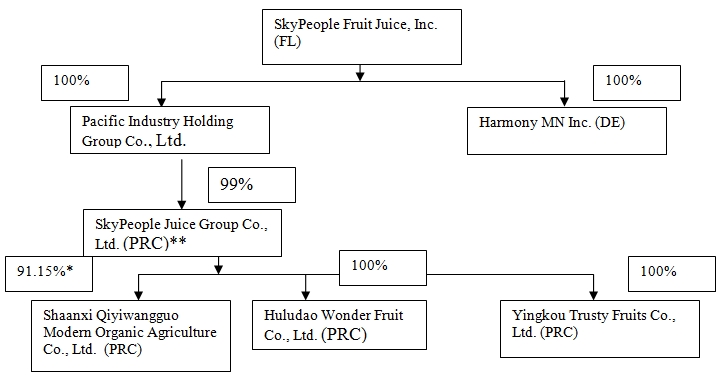
We are a holding company incorporated under the laws of Florida. We have two direct wholly-owned subsidiaries: Pacific Industry Holding Group Co., Ltd., or Pacific, a company incorporated under the laws of the Republic of Vanuatu, and Harmony MN Inc., or Harmony, a company organized under the laws of Delaware. Pacific
holds 99% equity interest of SkyPeople Juice Group Co., Ltd. (known as “Shaanxi Tianren Organic Food Co., Ltd.” as of December 18, 2009), or SkyPeople (China), a company incorporated under the laws of the PRC. SkyPeople (China) has three direct subsidiaries, all limited liability companies organized under the laws of the PRC: (i) Shaanxi Qiyiwanguo Modern Organic Agriculture Co., Ltd., or Shaanxi Qiyiwanguo, (ii) Huludao Wonder Fruit Co., Ltd., or Huludao Wonder, and (iii) Yingkou Trusty
Fruits Co., Ltd., or Yingkou.
Through our indirect subsidiaries in the PRC, we are engaged in the production and sales of fruit juice concentrates (including fruit purees, concentrated fruit purees, and concentrated fruit juices), fruit beverages (including fruit juice beverages and fruit cider beverages), and other fruit related products (including primarily organic
and non-organic fresh fruits, kiwifruit seeds and apple aroma) in and from the PRC. Our fruit juice concentrates, which include apple, pear and kiwifruit concentrates, are sold to domestic customers and exported directly or via distributors to North America, Europe, Russia, South Korea and the Middle East. We sell our Hedetang branded bottled fruit beverages domestically primarily to supermarkets in the PRC. In fiscal year 2009, sales of our fruit concentrates, fruit beverages and other
fruit related products represented 61%, 17%, and 22% of our revenue, respectively, compared to 78%, 13% and 9% in fiscal year 2008, respectively.
Specialty fruit juices, or small breed fruit juice, are juices squeezed from fruits that are grown in relatively small quantities such as kiwifruit juice, mulberry juice, and pomegranate juice. Currently, our specialty juice beverage offering includes kiwifruit juice and mulberry juice. We are in the process of applying for
a patent in the PRC for a technology to produce concentrated persimmon juice. We believe that we are currently one of the few companies able to produce specialty fruit juices on a large scale in the PRC and we believe we are a leading specialty fruit juice producer in the PRC.
Our revenue has increased significantly from 2006 to 2009 with revenue of approximately $17.4 million in 2006, approximately $29.4 million in 2007, approximately $41.7 million in 2008 and approximately $59.2 million in 2009, representing an average yearly growth rate of approximately 51%. We intend
to expand our current production facilities and consider acquisition opportunities in the fruit product industry, to increase our fruit processing capacity and our annual yield to meet increasing customer demand.
Our current structure is set forth in the diagram below:
*Xi’an Qinmei Food Co., Ltd., an entity which is not affiliated with the Company, owns the other 8.85% of the equity interest in Shaanxi Qiyiwangguo Modern Organic Agriculture Co., Ltd.
** Formerly known as Shaanxi Tianren Organic Food Co., Ltd.
We believe our competitive advantages include the modern equipment and technology employed at our production factories in Shaanxi and Liaoning Provinces and the strategic locations of our manufacturing facilities. Our equipment and technology help us ensure product quality, control costs and allow
us to meet international juice standards such as ISO9001, HACCP and Kosher. In addition, our manufacturing facilities are strategically located near regional fruit production centers. Our proximity to regional fruit production centers enables us to purchase directly from farmers and avoid the need to transport raw fruit over long distances to our processing facilities, reducing our transportation expenses and damage to raw fruit in transit and helping us maintain high quality products by preserving
freshness.
We own and operate four manufacturing facilities in the PRC. To take advantage of economies of scale and to enhance our production efficiency, each of our manufacturing facilities has a focus on juice products centering around one particular fruit according to the proximity of such manufacturing to the supply center of that fruit. All concentrated
juice products are manufactured using the same type of production line with slight variations in processing methods. We operated our pear juice products business out of our Jingyang Branch Office of SkyPeople (China). Our business involving apple juice products is operated out of Huludao Wonder Fruit Co., Ltd. (“Huludao Wonder”), and our business involving kiwifruit products is operated out of Shaanxi Qiyiwangguo, in which we have held a 91.15% ownership interest since June 2006.
Shaanxi Province, where two of our manufacturing facilities are located, abounds with apple and kiwifruit production. As reported by the Fruit Juice Segment of the PRC Food and Agriculture Export Association (www.Chinajuice.org), in the nine months ended September 30, 2009, concentrated apple juice exported from Shaanxi Province
was 382,000 tons, accounting for 59% of the total export volume of concentrated apple juice from all of the PRC. According to the same source, the kiwifruit planting area in Shaanxi Province was approximately 99 thousand acres in 2009, which is 30% of the kiwifruit planting area in the world, and 60% of the kiwifruit planting area in the PRC. According to the Ministry of Commerce of the PRC (www.fec.mofcom.gov.cn), at present, the output value and export volume of concentrated juice of Shaanxi Province
all rank first among other provinces and cities in the PRC.
On June 10, 2008, we acquired Huludao Wonder from Shaanxi Hede Investment Management Co., Ltd. (“Hede”) for a total purchase price of RMB 48,250,000 (approximately $6,308,591 based on the exchange rate on June 1, 2007). The payment was made through the offset of related party receivables. Prior to that, we operated
our apple concentrate business out of the facilities of Huludao Wonder under a one-year lease agreement with Hede.
On June 17, 2009, we incorporated a new Delaware corporation called Harmony MN Inc. (“HMN”) to be a wholly-owned subsidiary of the Company with offices initially in California to act as a sales company for the Company. The total number of shares of capital stock which HMN has authority to issue is 3,000 shares, all of which
are Common Stock with a par value of $1.00 per share. On June 20, 2009, HMN was registered in the State of California to transact business in such state. HMN has not yet commenced operating activities.
On November 25, 2009, we acquired Yingkou Trusty Fruits Co., Ltd. (“Yingkou”) pursuant to the Stock Purchase Agreement that SkyPeople (China) entered into with Xi’an Dehao Investment & Consulting Co., Ltd. on November 18, 2009. The aggregate cash purchase price was RMB 22,700,000
(approximately $3,325,569 based on the exchange rate of December 31, 2009). Yingkou has not yet commenced operating activities.
Corporate History
We were initially incorporated in 1998 in Florida as Cyber Public Relations, Inc. for the purpose of providing internet electronic commerce consulting services to small and medium sized businesses and did not have any material operations or revenue. On January 21, 2004, we purchased all of the outstanding share capital of
Environmental Technologies, Inc., or Environmental Technologies, a Nevada corporation, in exchange for approximately 29,051 shares of our Common Stock. As a result, Environmental Technologies became our wholly owned subsidiary and the Environmental Technologies shareholders acquired approximately 97% of our issued and outstanding Common Stock. We changed our name to Entech Environmental Technologies, Inc.
After our acquisition of Environmental Technologies, we operated through our wholly owned subsidiary, H.B. Covey, Inc., or H.B. Covey, a business providing construction and maintenance services to petroleum service stations in the southwestern part of the United States and installation services for consumer home products in Southern
California. During July 2007, we entered into and consummated a Stock Sale and Purchase Agreement pursuant to which we sold H.B. Covey, Inc.
We were a shell company with no significant business operations after we sold H.B. Covey, Inc. As a result of the consummation of a reverse merger transaction, on February 26, 2008 we ceased to be a shell company and became an indirect holding company for SkyPeople (China) through Pacific.
Principal Products
There are two general categories of fruit and vegetable juices available in the market. One is fresh juice that is canned directly after filtering and sterilization upon being squeezed out of fresh fruits or vegetables. The other general category is juice drinks made out of concentrated fruit and vegetable juices. Concentrated fruit
and vegetable juices are produced through the pressing, filtering, sterilization and evaporation of fresh fruits or vegetables. They are used as the base material or ingredient for products such as drinks, fruit jams and fruit wines. Concentrated juices are not drinkable. Instead, they are used as a basic ingredient for manufacturing juice drinks and as an additive to fruit wine and fruit jam, cosmetics and medicines.
Our core products are concentrated apple, pear and kiwifruit juices, fruit beverages, fresh fruits and organic fresh fruits. The ability to produce fruit beverages is important when fresh fruit is out of season and fruit concentrate cannot be produced. Our range of products and production flexibility allows us to diversify
our operational risks and supplement our revenue. Sales of fruit concentrates, fruit beverages and fresh fruit, kiwifruit seeds and other products comprised 61%, 17% and 22% of revenue for 2009, respectively, as compared to 78%, 13% and 9% for fiscal year 2008, respectively.
Fruit Juice Concentrate
Our fruit juice concentrated products are produced from July or August to April of each year. Fruit juice concentrates are manufactured through a multi-stage process, which includes pressing, filtering, sterilizing and evaporating fresh fruits and fruit juices. Fruit juice concentrates are used as the base ingredient
in fruit beverages and are also used in other products such as ice cream, fruit wine and, to a lesser extent, cosmetics and medicine. We currently sell apple, pear and kiwifruit concentrates. Our fruit juice concentrated products for apple and pear include concentrated apple and pear juice. Our concentrated kiwifruits are made of three different categories: kiwifruit puree, concentrated kiwifruit puree and concentrated kiwifruit juice.
Kiwifruit puree is prepared from clean, sound kiwifruits that have been washed and sorted prior to processing. The kiwifruits are crushed and pressed and the pulp of the kiwifruit is kept. All of the water and some of the pulp are then removed from the kiwifruit puree and the sugar level is increased in order to produce
concentrated kiwifruit puree. Advanced technologies maintain the natural flavors and nutrients of the kiwifruit puree. Kiwifruit puree and concentrated kiwifruit puree are ideal raw materials used in the production of concentrated kiwifruit juices, kiwifruit beverages, kiwifruit flavored ice creams, smoothies and health care products. Concentrated kiwifruit juice is made from concentrated kiwifruit puree by removing all of the remaining pulp.
Concentrated apple juice and concentrated pear juice are prepared from fresh fruits. Fruit juice concentrates can also be combined with other fruit juices for the production of blended fruit juices, canned foods, confectionaries, fruit cider beverages and other beverage products. The gross margins for our fruit juice
concentrates were 41.4% and 41.1% in fiscal years 2009 and 2008, respectively.
Fruit Beverages
Our fruit beverages are produced and sold in all seasons. The manufacturing process for fruit beverages involves further processing of fruit juice concentrates. Our fruit beverages are divided into two categories: pure fruit juice and fruit cider beverages. We currently produce fruit beverages for kiwifruit
and mulberry fruit. Pure fruit juice and fruit cider beverages accounted for 12.7% and 4.1% of revenue in 2009, respectively. We tested and began marketing fruit cider beverages in the first quarter of 2009 and, based on preliminary results, we anticipate that our fruit cider beverages will experience rapid sales growth in the Chinese market. As fruit cider beverages are a relatively new products in the PRC market, we currently do not face significant competition and are able
to price our fruit cider beverages to achieve a higher gross margin at 48.6% in 2009 than our pure fruit juice at 28.0% in fiscal year 2009. The gross margins for our fruit beverages were 33.0% and 34.4% in fiscal years 2009 and 2008, respectively.
Fruit beverages are an important product line because they can be produced year round, as compared to our fruit juice concentrated products, which experiences seasonality. We plan to focus on developing new, higher margin beverages that we expect will allow us to earn gross margins similar to that of our fruit juice concentrated
products.
Other
We also sell fresh fruit, kiwifruit seeds, apple aroma and other products.
The following table contains information regarding the sales of various fruit juice concentrate, fruit beverages and other products in 2008 and 2009, respectively.
| |
|
|
|
|
|
|
|
|
|
|
|
|
|
|
|
|
|
|
|
|
|
Fruit puree |
|
|
2,604 |
|
|
|
6 |
% |
|
|
1,322 |
|
|
|
4 |
% |
|
Fruit concentrated puree |
|
|
5,760 |
|
|
|
12 |
% |
|
|
3,937 |
|
|
|
12 |
% |
|
Fruit concentrated juice |
|
|
21,093 |
|
|
|
45 |
% |
|
|
15,963 |
|
|
|
49 |
% |
|
Fruit juice |
|
|
7,328 |
|
|
|
16 |
% |
|
|
5,356 |
|
|
|
16 |
% |
|
Fruit cider beverages |
|
|
1,438 |
|
|
|
3 |
% |
|
|
— |
|
|
|
|
|
|
Fresh fruits |
|
|
8,744 |
|
|
|
18 |
% |
|
|
5,821 |
|
|
|
18 |
% |
|
Kiwifruit seeds |
|
|
88 |
|
|
|
* |
|
|
|
151 |
|
|
|
* |
|
|
Other |
|
|
96 |
|
|
|
* |
|
|
|
160 |
|
|
|
* |
|
|
Total |
|
|
47,151 |
|
|
|
100.0 |
% |
|
|
32,710 |
|
|
|
100.0 |
% |
Research and Development
We believe that continuous investment in research and development is a key component to being a leader in fruit juice concentrate and fruit beverages. As of December 31, 2009, we had an internal research and development team of approximately 41 people, and we retain external experts and research
institutions for additional consultation. Our research and development effort emphasizes the design and development of our processing technology with the goal of decreasing processing costs, optimizing our production capabilities and maintaining product quality. We intend to continue to invest in research and development to respond to and anticipate customer needs. For fiscal 2009, research and development
costs increased by $652,963 (145.2%) to $1,102,658 when compared to $449,695 for fiscal 2008, as we entered into two contracts with an outside research institute to research and develop new products in June 2008. These two contracts were from August 2008 to December 2010 under which we were required to make a monthly payment of RMB 600,000, or $87,900 based on the exchange rate as of December 31, 2009.
Industry and Principal Markets
Global Market
The fruit juice processing industry is an emerging industry. Consumption of fruit beverages has grown and sales have increased rapidly in recent years due to the increasing health consciousness of consumers and the natural and healthy quality of fruit juice beverages. Global Industry Analysts, Inc. reported in the
“Fruit & Vegetable Juices Market: A Global Strategic Business Report” that the global market for fruit and vegetable juice beverages is forecast to reach 53 billion liters by 2010 with markets in North America and Europe representing approximately 60% of the market and the Asian-Pacific markets experiencing the fastest growth.
According to the Fruit Juice Segment of the PRC Food and Agriculture Export Association, (www.Chinajuice.org) from 2003 to 2007, the output of fruit juice concentrates and fruit beverages in the PRC increased from 3,100,000 tons to 10,800,000 tons. Approximately
90% of the output of concentrated juices in the PRC is exported to foreign countries. The demand and the price of concentrated fruit juice decreased in the international market in the second half of 2008 because of the negative effects from the worldwide economic crisis. In 2008, the PRC exported approximately 692,900 tons of concentrated fruit juice, a decrease of 34% compared with 2007. However, as the world economy began recovery, the export quantity of concentrated fruit juice in the PRC increased in 2009.
As an example, the PRC exported approximately 795,700 tons of concentrated apple juice in 2009, an increase of 15% compared with 2008. Meanwhile, the average price of concentrated fruit juice also began to recover in 2009.
The PRC Market
The PRC has the world’s largest population, but the consumption of fruit beverages is relatively low. According to the report “Investment in China Fruit Juice Beverages Business and Forecast for 2010 to 2015” published by the China Investment Consultants, an independent research firm,, the annual per capita consumption
of fruit beverages in the PRC was no more than 1 kilogram, which only accounted for 10% of the average world per capita consumption and 2.5% of the average per capita consumption in the industrialized countries. If people in the PRC were to consume fruit beverages at the average annual world per capita consumption rate, the PRC’s market capacity for fruit juice beverages could reach 9.1 million tons, indicating that there is a great potential market for fruit juice beverages in the PRC. We believe
that the increasing health consciousness of consumers and quality of living powered by the PRC’s economic growth will continue to fuel the demand for our fruit juice products.
Marketing, Sales and Distribution
We market our products through three primary methods: direct contact with foreign businesses; attendance at international exhibitions; and sales made through trade websites. Our marketing and sales team work closely to maintain a consistent message to our customers. The sales team is divided into three subdivisions,
focusing on the sale of fruit juice concentrates, fruit beverage products and derivative products, respectively.
We sell our fruit juice concentrates both domestically and internationally while we have only sold our fruit beverages domestically. We sell our products either indirectly through distributors with good credit history or directly to end-users.
Our export business is primarily comprised of fruit juice concentrates. The export of our fruit juice concentrates is handled internally by our international trade department, which has 13 personnel.
The North American and European markets represent a large portion of consumers of apple and pear concentrate. The U.S. market is a highly mature market with stable growth for apple concentrate. Although we sell to distributors in the PRC and therefore are not certain exactly where our exported fruit juice concentrate
products are ultimately sold, we believe that the volume of exports to the United States of our fruit juice concentrate products has increased annually since 2004. The European market, which we believe has a generally stable consumer base, has been a target market since our inception. Apple concentrate is used to produce many beverages and wines consumed by Europeans. The Middle East is also a target market for our apple juice concentrate.
In fiscal year 2008, we believe we exported approximately 44% of our fruit juice concentrates. Because of the impact of the economic crisis in the international market and the increase in demand of juice products in the PRC, we believe the export percentage of our fruit juice concentrates decreased to approximately 35% in fiscal year 2009. We
believe our main export markets for apple and pear concentrates are the U.S., Europe and the Middle East. We believe we have stable relationships with our distributors and end-users in those markets. We believe 22% and 34% of our revenue in 2009 and 2008, respectively, were from products we exported directly or indirectly from the PRC.
Our fruit beverage sales are driven by the Chinese market. Most beverages are sold through provincial level, city level and county level agents. We also sell directly to hotels, supermarkets and similar outlets in smaller quantities. Fruit beverage sales are conducted by a team of 28 personnel. Historically,
we have only sold our fruit beverages regionally in Shaanxi Province and some cities near it in the PRC. One of our strategies is to broaden the geographic presence of our brand-named fruit beverages and expand production and sales of higher margin fruit beverages in the PRC. On January 7, 2010, we engaged a beverage distributor in Beijing to focus on the sales and marketing of our fruit beverages to food and beverage wholesalers and retailers in the Beijing area.
Our kiwifruit products are targeted at the European, Southeast Asian, South Korean, Japanese, Middle Eastern, mainland Chinese and Taiwanese markets. The growth of our kiwifruit concentrate and kiwifruit beverages has exceeded the growth rate of any other product we offer.
Competition
The markets in which we operate are competitive, rapidly evolving and subject to shifting customer demands and expectations. We believe that a number of companies are producing products that compete directly with our product offerings and some of our competitors have significantly more financial resources than we possess.
Our apple juice concentrate competitors include Sdic Zhounglu Fruit Juice Co., Ltd., Yantainorth Andre (Group) Juice Co., Ltd., Shaanxi Hengxing Fruit Juice and Shaanxi Haisheng Juice Holdings Co., Ltd. We also compete with fruit juice companies such as Wahaha, Huiyuan, Nongfu Guoyuan, Tongyi and Meizhiyuan.
We believe our competitive advantages include our modern equipment and our proprietary processes for the production of specialty fruit juices, or small breed fruit juices. We currently possess six proprietary technologies in fruit juice production. Among these six proprietary technologies, we have
obtained two patents and are in the process of application for patents for the other four technologies. Our current specialty fruit juice offering includes kiwifruit and mulberry related juice products. We have technologies to produce concentrated jujube juice, concentrated persimmon juice and concentrated orange juice. Our technology allows us to develop and produce beverages, such as our new mulberry and kiwifruit cider beverages, which we introduced in the Chinese market in the first quarter of
2009. We believe these new beverages have higher gross margins than that of the industry average.
We believe the proximity of our manufacturing facilities to fruit farms is also one of our competitive advantages. It allows us to purchase fruits directly from fruit farmers, avoid the need for long distance transportation, minimize damages to the fruits and maximize the freshness of the fruits. We believe our storage costs are also lower
than that of our competitors without adversely affecting our product quality.
We produce fruit beverages from our fruit juice concentrates, which allows us to better control the quality of our beverages.
We produce approximately 10,000 tons of concentrated pear juice annually which we estimate constitute more than 15% of the total concentrated pear juice production in the PRC. We believe we are a leader in the production of concentrated clear pear juice and concentrated kiwifruit juice, and our concentrated
pear juice and kiwifruit juice were awarded the “Most Famous Product of Shaanxi Province” by the Shaanxi local government in April 2009. We were the only company in the fruit juice industry among the 88 companies who received this award.
Raw Materials and Other Supplies
Fresh fruits, including apples, pears and kiwifruits, are the primary raw materials for our products. The purchase of fresh fruits represented 48% and 47% of our cost of
sales for fiscal years 2009 and 2008, respectively. The continuous supply of high quality fresh fruit is necessary for our current operations and our future business growth.
The PRC has the largest planting area of kiwifruit and apples in the world. Shaanxi Province, the location of two of our factories, has the largest planting area of kiwifruit and apples in the PRC. In 2009, the kiwifruit planting
area in Shaanxi Province was approximately 99,000 acres, which constituted approximately 30% and 60% of the worldwide and the PRC kiwifruit planting area, respectively. The apple planting area in Shaanxi Province was 15 million acres, and the output was 8.15 million tons in 2008, which was approximately 33% and 11% of the national and worldwide output, respectively. Pear, pomegranate, strawberry, peach and cherry yields are also
high in Shaanxi Province. Liaoning Province, the location of our Huludao Wonder factory, abounds with high acidity apples in the PRC. Other raw materials used in our business include pectic enzyme, amylase, auxiliary power fuels and other power sources such as coal, electricity and water.
We purchase raw materials from local markets and fruit growers that deliver directly to our plants. We have implemented a fruit purchasing program in areas surrounding our factories. In addition, we organize purchasing centers in rich fruit production areas, helping farmers deliver fruit to our purchasing
agents easily and in a timely manner. We are then able to deliver the fruit directly to our factory for production. We have assisted local farmers in their development of kiwifruit fields to help ensure a high quality product throughout the production channel. Our raw material supply chain is highly fragmented and raw fruit prices are highly volatile.
Shaanxi Province is a large agricultural and fruit producing province with sufficient resources to satisfy our raw material needs. The main kiwifruit producing counties are Zhouzhi County and Mei County. The total combined kiwifruit output in these two counties is approximately 300,000 tons per year. This
supply generally adequately satisfies our kiwifruit raw material needs. Shaanxi Province is also the main pear producing province in the PRC and its pear supply can generally meet our production requirements. Liaoning Province, the PRC’s epicenter for high acidity apples, can generally supply enough apples to meet our Liaoning Province factory’s production needs.
In addition to raw materials, we purchase various ingredients and packaging materials such as sweeteners, glass and plastic bottles, cans and packing barrels. We generally purchase our materials or supplies from multiple suppliers. We are not dependent on any one supplier or group of suppliers.
Our largest packing glass bottle supplier for our fruit beverages is Xuzhou Ruitai Glass Bottle Co., Ltd., which accounted for 13% of our total purchases in 2009 and 8% in 2008. Another large supplier is Xian Yang Dichen Printing Co., Ltd., which accounted for 11% of our total purchases in 2009 and 7% in 2008. We did not have concentrations of business with vendors constituting more than 10% of our purchases in 2008.
Seasonality
We can only produce fruit juice concentrates during the squeezing season from July or August through April of the following year, while our fruit beverages can be produced year round. As a result, our business experiences mild seasonal effects as sales of our products are generally higher during the squeezing season. Sales
of our products during the months from March through July, or the non-squeezing season, generally tend to be lower due to a shortage of fresh fruits and a lower level of production activity. As a result, our results of operations for the first quarter and fourth quarter are generally stronger than those for our second quarter and third quarter.
We plan to broaden our fruit product offerings to expand into fruits with harvesting seasons complementary to our current fruits. This will enable us to lengthen our squeezing season, thus increasing our annual production of fruit concentrate and fruit juice beverages. In the first quarter of 2009, we introduced mulberry
and kiwifruit cider beverages in the Chinese market. In addition, we intend to enhance our research and development activities in order to develop and produce innovative high margin products like polyphenol, an antioxidant compound with health benefits, from concentrated fruit juice to further diversify our product mix and increase our revenues.
Government Regulation
Our products are subject to central government regulation as well as provincial government regulation in Shaanxi and Liaoning Provinces. Business and product licenses must be obtained through application to the central, provincial and local governments. We have obtained our business licenses to operate domestically
and export products under the laws and regulations set forth by the government of the PRC. We obtained business licenses to conduct businesses, including an operating license to sell packaged foods such as concentrated fruit and vegetable juices, fruit sugar, fruit pectin, frozen and freeze dried fruits and vegetables, dehydrated fruits and vegetables, fruit and vegetable juice drinks, fruit cider and organic food. Business, company
and product registrations are certified on a regular basis and we must comply with the laws and regulations of the PRC, provincial and local governments and industry agencies.
In accordance with PRC laws and regulations, we are required to comply with applicable hygiene and food safety standards in relation to our production processes. Failure to pass these inspections, or the loss of or failure to renew our licenses and permits, could require us to temporarily or permanently suspend some or all of
our production activities, which could disrupt our operations and adversely affect our business.
Intellectual Property
SkyPeople (China) currently possesses six proprietary technologies, including the technologies to:
|
· |
crush fruits and remove fruit skin, |
|
· |
remove dirt and fruit hair on fruit skin, |
|
· |
produce concentrated clear kiwifruit juice, |
|
· |
produce kiwifruit cider beverage, |
|
· |
produce mulberry cider beverage, and |
|
· |
produce concentrated clear persimmon juice. |
Among these six proprietary technologies, we hold two active patents granted by the State Intellectual Property Office of the PRC, or SIPO. One relates to crushing fruits and fruit skin removal and the other relates to removal of dirt and fruit hair from fruit skin. We are in the process of applying for patents with SIPO for
the four remaining technologies. We believe that these technologies are leading technologies in our industry.
In addition, using our proprietary technologies, we have developed a special production process for fruit juice products such as concentrated jujube juice, concentrated persimmon juice, and concentrated orange juice. We have also developed flow-through capacitor membrane, reverse osmosis concentration and composite biological
enzymolysis technology to clarify and remove murkiness from fruit juice. We believe that these are leading technologies in our industry.
We believe that our continued success and competitive status depend largely on our proprietary technology and ability to innovate. We have taken the required measures to protect the confidentiality of our proprietary technologies and processes. We rely on a combination of know-how, patent and trade secret laws, as
well as confidentiality agreements to protect our proprietary rights. We will take the necessary action to seek remuneration if we believe our intellectual property rights have been infringed upon. As of December 31, 2009, we held two active patents granted by the State Intellectual Property Office of the PRC related to breaking up and separating fruit peel, and removing fruit peel and fruit hair, respectively. These two patents have a duration of 10 years, and will expire in
February 2016.
In addition to these two active patents, we are applying for another four scientific patents for a process in the production of kiwifruit concentrated juice, kiwifruit cider beverages, mulberry cider beverages and concentrated persimmon juice. However,
we do not have patents on certain other items of intellectual property that we possess.
We also registered trademarks for our Hedetang brand with the Trademark Bureau of the State Administration for Industry and Commerce on September 14, 2008 in Category 29, Category 30, Category 31, and Category 32, and on April 21, 2009 in Category 5. The trademarks expire on September 13, 2018 and April 20, 2019, respectively,
and can be extended upon expiration.
Employees
As of December 31, 2009, we had approximately 358 full time employees and approximately 95 part time employees, all of which are located in the PRC except our chief financial officer. None of our employees are covered by a collective bargaining agreement. We believe that we have a good relationship with our employees.
Our business and operations entail a variety of risks and uncertainties, including those described below.
Risks Related to our Business
We may not be able to effectively control and manage our growth, and a failure to do so could adversely affect our operations and financial condition.
Our revenue increased significantly from 2006 to 2009. Our revenue totaled approximately $17.4 million in 2006, approximately $29.4 million in 2007, approximately $41.7 million in 2008 and approximately $59.2 million in 2009. If our business and markets continue to experience significant
growth, we will need to expand our business to maintain our competitive position. We may face challenges in managing and financing expansion of our business, facilities and product offerings, including challenges relating to integration of acquired businesses and increased demands on our management team, employees and facilities. Failure to effectively deal with increased demands on us could interrupt or adversely affect our operations and cause
production backlogs, longer product development time frames and administrative inefficiencies. Other challenges involved with expansion, acquisitions and operation include:
|
· |
the diversion of management’s attention from other business concerns; |
|
· |
potential adverse effects on existing business relationships with suppliers and customers; |
|
· |
obtaining sufficient working capital to support expansion; |
|
· |
expanding our product offerings and maintaining the high quality of our products; |
|
· |
continuing to fill customers’ orders on time; |
|
· |
maintaining adequate control of our expenses and accounting systems; |
|
· |
successfully integrating any future acquisitions; and |
|
· |
anticipating and adapting to changing conditions in the fruit juice and beverage industry, whether from changes in government regulations, mergers and acquisitions involving our competitors, technological developments or other economic, competitive or market dynamics. |
Even if we obtain benefits of expansion in the form of increased sales, there may be delay between the time when the expenses associated with an expansion or acquisition are incurred and the time when we recognize such benefits, which could affect our earnings.
Our revenue and profitability are heavily dependent on prevailing prices for our products and raw materials and if we are unable to effectively offset cost increases by adjusting the pricing of our products, our margins and operating income may decrease.
As a producer of commodities, our revenue, gross margins and cash flow from operations are substantially dependent on the prevailing prices we receive for our products and the cost of our raw materials, neither of which we control. The factors influencing the sales price of concentrated fruit
juice include the supply price of fresh fruit, supply and demand of our products in international and domestic markets and competition in the fruit juice industry.
The price of our principal raw materials, fresh fruit, is subject to market volatility as a result of numerous factors including, but not limited to, general economic conditions, governmental regulations, weather, transportation delays and other uncertainties that are beyond our control. Due
to such market volatility, we generally do not, nor do we expect to, have long term contracts with our fresh fruit suppliers. Other significant raw materials used in our business include packing barrels, pectic enzyme, amylase and auxiliary materials such as coal, electricity and water. Prices for these items may be volatile as well and we may experience shortages in these items from time to time. As a result, we cannot assure you that the necessary raw materials to produce our
products will continue to be available to us at prices currently in effect or acceptable to us. In the event raw material prices increase materially, we may not be able to adjust our product prices, especially in the short term, to recover such cost increases. If we are not able to effectively offset these cost increases by adjusting the price of our products, our margins will decrease and earnings will suffer accordingly.
Weather and other environmental factors affect our raw material supply and a reduction in the quality or quantity of our fresh fruit supplies may have material adverse consequences on our financial results.
Our business may be adversely affected by weather and environmental factors beyond our control, such as adverse weather conditions during the growing or squeezing seasons. A significant reduction in the quantity or quality of fresh fruit harvested resulting from adverse weather conditions,
disease or other factors could result in increased per unit processing costs and decreased production, with adverse financial consequences to us.
We depend on a limited number of customers, the loss of one or more of which could materially adversely affect our operations and revenue.
Our revenue is dependent in large part on significant orders from a limited number of customers. We are trying to attract new significant customers and reduce our risk related
with the concentration of customers. Sales to our five largest customers accounted for approximately 39% and 33% of our revenue in 2009 and 2008, respectively. Customer demand depends on a variety of factors including, but not limited to, our customers’ financial condition and general economic conditions. If we
are unable to attract new significant customers or retain existing key customers or if sales to any of our current key customers are reduced for any reason, such reduction may have a material adverse effect on our business, results of operations and financial condition.
We sell our products primarily through distributors and delays in delivery or poor handling by distributors may affect our sales and damage our reputation.
We primarily sell our products through our distributors and rely on these distributors for the distribution of our products. In 2009 and 2008, sales to distributors represented 40% and 31% of our revenue, respectively. These distributors are not obligated to continue to sell our products and
any disruptions in our relationships with our distributors could cause interruption to the supply of our products to retailers, which would harm our revenue and results of operations. In addition, delivery disruptions may occur for various reasons beyond our control, including poor handling by distributors or third party transport operators, transportation bottlenecks, natural disasters and labor strikes, and could lead to delayed or lost deliveries. Some
of our products are perishable and poor handling by distributors and third party transport operators could also result in damage to our products that would make them unfit for sale. If our products are not delivered to retailers on time, or are delivered damaged, we may have to pay compensation, we could lose business and our reputation could be harmed.
Because we experience seasonal fluctuations in our sales, our quarterly results will fluctuate and our annual performance will depend largely on results from our first and fourth quarters.
Our business is highly seasonal, reflecting the harvest season of our primary source fruits from July or August to April. Typically, a substantial portion of our revenue is earned during our first and fourth quarters. We generally experience
lower revenue during our second and third quarters. Sales in the first and fourth quarters accounted for approximately 72% and 67% of our revenue in 2009 and 2008, respectively. If sales in our first and fourth quarters are lower than expected, our operating results would be adversely affected and it would have a disproportionately large impact
on our annual operating results.
If we are unable to gain market acceptance or significant market share for the new products we introduce, our results of operations and profitability could be adversely impacted.
Our future business and financial performance depends, in part, on our ability to successfully respond to consumer preferences by introducing new products and improving existing products. For example, in the first quarter of 2009, we developed and introduced a fruit cider beverage that tested
well in the Chinese market. We cannot assure you that we will be able to gain market acceptance or significant market share for our new products. Consumer preferences change, and any new products that we introduce may fail to meet the particular tastes or requirements of consumers, or may be unable to replace their existing preferences. Our failure to anticipate, identify or react to these particular tastes or changes could result in reduced
demand for our products, which could in turn cause us to be unable to recover our development, production and marketing costs, thereby leading to a decline in our profitability.
The development and introduction of new products is key to our expansion strategy. We incur significant development and marketing costs in connection with the introduction of new products. Successfully launching and selling new products puts pressure on our sales and marketing resources, and we may fail to invest sufficient
funds in order to market and sell a new product effectively. If we are not successful in marketing and selling new products, our results of operations could be materially adversely affected.
Economic conditions have had and may continue to have an adverse effect on consumer spending on our products.
The worldwide economy has not recovered from a recession, which has reduced discretionary income of consumers. The adverse effect of a sustained international economic downturn, including sustained periods of decreased consumer spending, high unemployment levels, declining consumer or business confidence and continued volatility
and disruption in the credit and capital markets, will likely result in reduced demand for our products as consumers turn to less expensive substitute goods or forego certain purchases altogether. To the extent the international economic downturn continues or worsens, we could experience a reduction in sales volume, and if we are unable to reduce our operating costs and expenses proportionately, many of which are fixed, our results of operations would be adversely affected.
Concerns over food safety and public health may affect our operations by increasing our costs and negatively impacting demand for our products.
We could be adversely affected by diminishing confidence in the safety and quality of certain food products or ingredients. As a result, we may elect or be required to incur additional costs aimed at increasing consumer confidence in the safety of our products. For example, a crisis in the PRC over melamine contaminated
milk in 2008 has adversely impacted Chinese food exports since October 2008, as reported by the Chinese General Administration of Customs, although most foods exported from the PRC were not significantly affected by the melamine contamination. In addition, our concentrated fruit juices exported to foreign countries must comply with quality standards in those countries. Our success depends on our ability to maintain the quality of our existing and new products. Product quality
issues, real or imagined, or allegations of product contamination, even if false or unfounded, could tarnish the image of our brands and may cause consumers to choose other products.
We face increasing competition from both domestic and foreign companies and any failure by us to compete effectively could adversely affect our results of operations.
The juice beverage industry is highly competitive, and we expect it to continue to become even more competitive. Our ability to compete in the industry is, to a significant extent, dependent on our ability to distinguish our products from those of our competitors by providing high quality products at reasonable prices that appeal
to consumers’ tastes and preferences. There are currently a number of well established companies producing products that compete directly with ours. Some of our competitors may have been in business longer than we have, may have substantially greater financial and other resources than we have and may be better established in their markets. We anticipate that our competitors will continue to improve their products and introduce new products with competitive price and performance
characteristics.
We cannot assure you that our current or potential competitors will not provide products comparable or superior to those we provide or adapt more quickly than we do to evolving industry trends or changing market requirements. It is also possible that there will be significant consolidation in the juice beverage industry among
our competitors, alliances may develop among competitors and these alliances may rapidly acquire significant market share, and some of our distributors may commence production of products similar to those we sell to them. Increased competition may result in price reductions, reduced margins and loss of market share, any of which could materially adversely affect our profit margins. We cannot assure you that we will be able to compete effectively against current and future competitors. Aggressive
marketing or pricing by our competitors or the entrance of new competitors into our markets could have a material adverse effect on our business, results of operations and financial condition.
We may engage in future acquisitions involving significant expenditures of cash, the incurrence of debt or the issuance of stock, all of which could have a materially adverse effect on our operating results.
As part of our business strategy, we review acquisition and strategic investment prospects that we believe would complement our current product offerings, augment our market coverage, enhance our technological capabilities or otherwise offer growth opportunities. From time to time, we review investments in new businesses and
we expect to make investments in, and to acquire, businesses, products or technologies in the future. In the event of any future acquisitions, we may expend significant cash, incur substantial debt and/or issue equity securities, diluting the percentage ownership of current shareholders, all of which could have a material adverse effect on our operating results and the price of our Common Stock. We cannot assure you that we will be able to successfully integrate any businesses, products,
technologies or personnel that we may acquire in the future, and our failure to do so could have a material adverse effect on our business, operating results and financial condition.
We require various licenses and permits to operate our business and the loss of or failure to renew any or all of these licenses and permits could materially adversely affect our business.
In accordance with PRC laws and regulations, we have been required to maintain various licenses and permits in order to operate our business at the relevant manufacturing facilities including, without limitation, industrial product production permits. We are required to comply with applicable hygiene and food safety standards
in relation to our production processes. Our premises and transportation vehicles are subject to regular inspections by the regulatory authorities for compliance with the Detailed Rules for Administration and Supervision of Quality and Safety in Food Producing and Processing Enterprises. Failure to pass these inspections, or the loss of or failure to renew our licenses and permits, could require us to temporarily or permanently suspend some or all of our production activities, which could
disrupt our operations and adversely affect our business.
Governmental regulations affecting the import or export of products could negatively affect our revenue.
The United States and various other governments have imposed controls, export license requirements and restrictions on the export of some of our products. We estimate that we exported products, directly or
indirectly, from the PRC that represented approximately 22% and 34% of revenue in 2009 and 2008, respectively. Governmental regulation of exports, or our failure to obtain required export approval for our products, could harm our international sales and adversely affect our revenue and profits. In addition, failure to comply with such regulations could result in penalties,
costs and restrictions on export privileges.
We do not presently maintain product liability insurance and our property and equipment insurance does not cover the full value of our property and equipment, which leaves us with exposure in the event of loss or damage to our properties or claims filed against us.
We currently do not carry any product liability or other similar insurance. Product liability claims and lawsuits in the PRC are generally still rare, unlike in some other countries. Product liability exposures and litigation, however, could become more commonplace in the PRC. Moreover, we have product liability
exposure in countries in which we sell our products, such as the United States, where product liability claims are more prevalent. As we expand our international sales, our liability exposure will increase.
We may be required from time to time to recall products entirely or from specific copackers, markets or batches. Although historically we have not had any recall of our products, we cannot guarantee that in the future circumstances or incidents will not occur that will require us to recall our products. We do not maintain recall
insurance. In the event we experience product liability claims or a product recall, our business operations and financial condition could be materially adversely affected.
Our business and operations may be subject to disruption from work stoppages, terrorism or natural disasters.
Our operations may be subject to disruption for a variety of reasons, including work stoppages, acts of war, terrorism, pandemics, fire, earthquake, flooding or other natural disasters. If a major incident were to occur in either of the regions where our facilities or main offices are located, our facilities or offices or those
of critical suppliers could be damaged or destroyed. Such a disruption could result in a reduction in available raw materials, the temporary or permanent loss of critical data, suspension of operations, delays in shipment of products and disruption of business generally, which would adversely affect our revenue and results of operations.
Our success depends substantially on the continued retention of certain key personnel and our ability to hire and retain qualified personnel in the future to support our growth.
If one or more of our senior executives or other key personnel are unable or unwilling to continue in their present positions, our business may be disrupted and our financial condition and results of operations may be materially and adversely affected. While we depend on the abilities and participation of our current management
team generally, we rely particularly upon Mr. Yongke Xue, chairman of our board of directors and our chief executive officer, Ms. Spring Liu, our chief financial officer, and Mr. Hongke Xue, chairman of the board of directors and chief executive officer of SkyPeople (China). The loss of the services of Mr. Yongke Xue, Ms. Spring Liu or Mr. Hongke Xue for any reason could significantly adversely impact our business and results of operations. Competition for senior management and senior
technology personnel in the PRC is intense and the pool of qualified candidates is very limited. Accordingly, we cannot assure you that the services of our senior executives and other key personnel will continue to be available to us, or that we will be able to find a suitable replacement for them if they were to leave.
The relative lack of public company experience of our management team may put us at a competitive disadvantage.
Our management team lacks public company experience, which could impair our ability to comply with legal and regulatory requirements such as those imposed by the Sarbanes-Oxley Act of 2002, or Sarbanes-Oxley. Aside from our chief financial officer, Spring Liu, our senior management does not have experience managing a publicly
traded company. Such responsibilities include complying with federal securities laws and making required disclosures on a timely basis. Our senior management may be unable to implement programs and policies in an effective and timely manner that adequately respond to the increased legal, regulatory and reporting requirements associated with being a publicly traded company. Our failure to comply with all applicable requirements could lead to the imposition of fines and penalties,
distract our management from attending to the management and growth of our business, result in a loss of investor confidence in our financial reports and have an adverse effect on our business and stock price.
As a public company, we are obligated to maintain effective internal controls over financial reporting. Our internal controls may not be determined to be effective, which may adversely affect investor confidence in us and, as a result, decrease the value of our Common Stock.
The PRC has not adopted management and financial reporting concepts and practices similar to those in the United States. We may have difficulty in hiring and retaining a sufficient number of qualified finance and management employees to work in the PRC. As a result of these factors, we may experience difficulty in
establishing and maintaining accounting and financial controls, collecting financial data, budgeting, managing our funds and preparing financial statements, books of account and corporate records and instituting business practices that meet investors’ expectations in the United States.
Rules adopted by the Securities and Exchange Commission, or the Commission, pursuant to Section 404 of Sarbanes-Oxley require annual assessment of our internal controls over financial reporting, and attestation of this assessment by our independent registered public accountants. This requirement first applied to our annual
report on Form 10-K for the fiscal year ended December 31, 2008 and the attestation requirement of management’s assessment by our independent registered public accountants will first apply to our annual report on Form 10-K for the fiscal year ended December 31, 2010. The standards that must be met for management to assess the internal controls over financial reporting as effective are relatively new and complex and require significant documentation, testing and possible remediation
to meet the detailed standards. This assessment will need to include disclosure of any material weaknesses identified by our management in our internal control over financial reporting. The process of compiling the system and processing documentation necessary to perform the evaluation needed to comply with Section 404 is costly and challenging. We may not be able to complete our evaluation, testing and any required remediation in a timely fashion. During the evaluation and testing process,
if we identify one or more material weaknesses in our internal control over financial reporting, we will be unable to assert that our internal controls are effective. If we are unable to conclude that our internal control over financial reporting is effective. We could lose investor confidence in the accuracy and completeness of our financial reports, which could harm our business and cause the price of our Common Stock to decline.
We may have inadvertently violated Section 402 of the Sarbanes-Oxley and Section 13(k) of the Exchange Act and may be subject to sanctions for such violations.
Section 13(k) of the Exchange Act provides that it is unlawful for a company such as ours, which has a class of securities registered under Section 12(g) of the Exchange Act, to directly or indirectly, including through any subsidiary, extend or maintain credit in the form of a personal loan to or for any director or executive officer of
the company. Issuers violating Section 13(k) of the Exchange Act may be subject to civil sanctions, including injunctive remedies and monetary penalties, as well as criminal sanctions. The imposition of any of such sanctions on the Company may have a material adverse effect on our business, financial position, results of operations or cash flows.
In February 2008, we purchased Pacific, which is the holding company for our operating subsidiary, SkyPeople (China). At the time, Shaanxi Hede Investment Management Co., Ltd., or Hede, a PRC company owned by Yongke Xue, the chairman of our board of directors and our chief executive officer, and Xiaoqin Yan, a director on our
board of directors, was indebted to SkyPeople (China) on account of previous loans and advances made by SkyPeople (China) to Hede. Such loans and advances totaled RMB 31,544,043 in the aggregate (or $4,318,281 based on the exchange rate as of December 31, 2007) and were made during the period from June 6, 2007 to December 29, 2007 that were used by Hede to pay a portion of the purchase price for Hede’s acquisition of Huludao Wonder Fruit Co., Ltd., or Huludao Wonder. In May 2008, SkyPeople (China)
also assumed Hede’s obligation of RMB 18,000,000 (or $2,638,329 based on the exchange rate December 31, 2008) for the balance of the purchase price for Huludao Wonder.
On June 10, 2008, Hede sold Huludao Wonder to SkyPeople (China) for a total price of RMB 48,250,000 (or $6,308,591 based on the exchange rate on June 1, 2007) the same price which Hede paid for Huludao Wonder. As of May 31, 2008, SkyPeople (China) had a related party receivable of RMB 48,929,272 (or $7,171,751 based on the exchange
rate December 31, 2008) from Hede, which was credited against the purchase price, so that SkyPeople (China) did not pay any cash to Hede for the purchase, and the remaining balance of the loans and advances of RMB 679,272 (or $99,564 based on the exchange rate as of December 31, 2008) to Hede was repaid to us on June 11, 2008. No interest or other consideration was paid by Hede to us on account of the time value of money with respect to the loans and advances made by SkyPeople (China) to Hede.
Notwithstanding Hede’s repayment in full of loans made by SkyPeople (China) to Hede, the existence of indebtedness of Hede to SkyPeople (China) at the time we acquired Pacific and the continuation of such indebtedness thereafter until it was fully repaid in June 2008 may constitute a violation of Section 13(k) of the Exchange Act
and Section 402(a) of Sarbanes-Oxley.
In addition, in May 2008, Pacific erroneously paid $4,916,617 to its former shareholders, including Xiaoqing Yan and Yongke Xue, as the result of a dividend declared by Pacific in February 2008 prior to our acquisition of Pacific. Because the recipients of the money were no longer shareholders of Pacific, the transaction was
treated for accounting purposes as an interest free loan. In June 2008, the directors and other related parties returned the monies they received, without interest. Although the erroneously paid funds associated with Pacific’s dividend declaration have been repaid to us in full, Xiaoqing Yan and Yongke Xue’s receipt of the erroneous dividend may also be deemed to be a violation of Section 13(k) and Section 402(a) of Sarbanes-Oxley. See the section entitled “Certain
Relationships and Related Party Transactions—Transactions with Related Persons, Promoters and Certain Control Persons.”
Partially in response to the matters set forth above, in September 2008, our board of directors adopted a policy regarding approval of related party transactions. Under the policy, any related party transaction involving an aggregate amount that is expected to exceed $50,000 must be approved by the audit committee of our board
of directors, and no director may participate in any discussion or approval of a transaction that would be considered to be a related party transaction in which such person is interested. See the section entitled “Certain Relationships and Related Party Transactions—Review, Approval or Ratification of Transactions with Related Persons.”
We may need additional capital to fund our future operations and, if it is not available when needed, we may need to reduce our planned development and marketing efforts, which may reduce our sales revenue.
We believe that our existing working capital and cash available from operations will enable us to meet our working capital requirements for at least the next 12 months. However, if cash from future operations is insufficient, or if cash is used for acquisitions or other currently unanticipated uses, we may need additional capital. The development
and marketing of new products and the expansion of distribution channels and associated support personnel requires a significant commitment of resources. In addition, if the markets for our products develop more slowly than anticipated, or if we fail to establish significant market share and achieve sufficient net revenues, we may continue to consume significant amounts of capital. As a result, we could be required to raise additional capital. To the extent that we raise additional capital through the sale of
equity or convertible debt securities, the issuance of such securities could result in dilution of the shares held by existing stockholders. If additional funds are raised through the issuance of debt securities, such securities may provide the holders certain rights, preferences, and privileges senior to those of common stockholders, and the terms of such debt could impose restrictions on our operations. We cannot assure you that additional capital, if required, will be available on acceptable terms, or at all.
If we are unable to obtain sufficient amounts of additional capital, we may be required to reduce the scope of our planned product development and marketing efforts, which could harm our business, financial condition and operating results.
We may not be able to prevent others from unauthorized use of our patents, which could harm our business and competitive position.
Our success depends, in part, on our ability to protect our proprietary technologies. We hold two patents in the PRC covering our fruit processing technology. The process of seeking patent protection can be lengthy and expensive and we cannot assure you that our existing or future issued patents will be sufficient
to provide us with meaningful protection or commercial advantages. We also cannot assure you that our current or potential competitors do not have, and will not obtain, patents that will prevent, limit or interfere with our ability to make or sell our products in the PRC or other countries.
The implementation and enforcement of PRC intellectual property laws historically have not been vigorous or consistent, primarily because of ambiguities in PRC laws and a relative lack of developed enforcement mechanisms. Accordingly, intellectual property rights and confidentiality protections in the PRC are not as effective
as those in the United States and other countries. We may need to resort to litigation to enforce or defend patents issued to us or to determine the enforceability, scope and validity of our proprietary rights or those of others. Such litigation will require significant expenditures of cash and management efforts and could harm our business, financial condition and results of operations. An adverse determination in any such litigation will impair our intellectual property rights
and may harm our business, competitive position, business prospects and reputation.
Intellectual property infringement claims may adversely impact our results of operations.
As we develop and introduce new products, we may be increasingly subject to claims of infringement of another party’s intellectual property. If a claim for infringement is brought against us, such claim may require us to modify our products, cease selling certain products or engage in litigation to determine the validity
and scope of such claims. Any of these events may harm our business and results of operations.
If our costs and demands upon management increase disproportionately to the growth of our business and revenue as a result of complying with the laws and regulations affecting public companies, our operating results could be harmed.
As a public company, we do and will continue to incur significant legal, accounting, investor relations and other expenses, including costs associated with public company reporting requirements. We also have incurred and will incur costs associated with current corporate governance requirements, including requirements under Section 404
and other provisions of the Sarbanes-Oxley, as well as rules implemented by the Commission and the stock exchange on which our Common Stock is traded. The expenses incurred by public companies for reporting and corporate governance purposes have increased dramatically over the past several years. These rules and regulations have increased our legal and financial compliance costs substantially and make some activities more time consuming and costly. If our costs and demands upon management
increase disproportionately to the growth of our business and revenue, our operating results could be harmed.
There are inherent uncertainties involved in estimates, judgments and assumptions used in the preparation of financial statements in accordance with generally accepted accounting principles in the United States, or U.S. GAAP. Any changes in estimates, judgments and assumptions could have a material
adverse effect on our business, financial condition and operating results.
The preparation of financial statements in accordance with U.S. GAAP involves making estimates, judgments and assumptions that affect reported amounts of assets (including intangible assets), liabilities and related reserves, revenue, expenses and income. Estimates, judgments and assumptions are inherently
subject to change in the future, and any such changes could result in corresponding changes to the amounts of assets, liabilities, revenue, expenses and income. Any such changes could have a material adverse effect on our business, financial condition and operating results.
We are subject to the risk of increased income taxes, which could harm our business, financial condition and operating results.
We base our tax position upon the anticipated nature and conduct of our business and upon our understanding of the tax laws of the various countries in which we have assets or conduct activities. However, our tax position is subject to review and possible challenge by tax authorities and to possible changes in law, which may have retroactive
effect. We currently operate through Pacific, a wholly owned subsidiary organized under the laws of Vanuatu and SkyPeople (China), a 99% owned subsidiary of Pacific organized under the laws of the PRC, and we maintain manufacturing operations in the PRC. Any of these jurisdictions could assert tax claims against us. We cannot determine in advance the extent to which some jurisdictions may require us to pay taxes or make payments in lieu of taxes. If we become subject to additional taxes in any jurisdiction, such
tax treatment could materially and adversely affect our business, financial condition and operating results.
Risks Related to Doing Business in the PRC
We face the risk that changes in the policies of the PRC government could have a significant impact upon the business we may be able to conduct in the PRC and the profitability of such business.
We conduct substantially all of our operations and generate most of our revenue in the PRC. Accordingly, economic, political and legal developments in the PRC will significantly affect our business, financial condition, results of operations and prospects. The PRC economy is in
transition from a planned economy to a market oriented economy subject to plans adopted by the government that set national economic development goals. Policies of the PRC government can have significant effects on economic conditions in the PRC. While we believe that the PRC will continue to strengthen its economic and trading relationships with foreign countries and that business development in the PRC will continue to follow market forces, we cannot assure you that this will be the case. Our
interests may be adversely affected by changes in policies by the PRC government, including:
|
· |
changes in laws, regulations or their interpretation; |
|
· |
restrictions on currency conversion, imports or sources of supplies; |
|
· |
expropriation or nationalization of private enterprises; and |
|
· |
the allocation of resources. |
Although the PRC government has been pursuing economic reform policies for more than two decades, the PRC government continues to exercise significant control over economic growth in the PRC through the allocation of resources, controlling payments of foreign currency, setting monetary policy and imposing policies that impact particular
industries in different ways. We cannot assure you that the PRC government will continue to pursue policies favoring a market oriented economy or that existing policies will not be significantly altered, especially in the event of a change in leadership, social or political disruption, or other circumstances affecting political, economic and social life in the PRC.
The original incorporation of SkyPeople (China) as a joint stock company in 2001 did not obtain all required approvals from the PRC government authorities pursuant to the relevant PRC law effective at the time, and we may be subject to various penalties under the law retroactively.
The original incorporation of SkyPeople (China) (under the original name of Xi’an Zhonglv Ecology Science and Technology Industry Co., Ltd.) as a joint stock company in 2001 was approved by the Xi’an Municipal People’s Government. However, according to the applicable PRC Company Law which was in force in 2001, the incorporation
of SkyPeople (China) as a joint stock company shall be subject to the approval by the government authority of Shanxi Province. Pursuant to the PRC Company Law which was in force in 2001, if company stocks are arbitrarily issued without obtaining the approval of the relevant competent authorities stipulated under the law, the parties concerned may be ordered to cease the issuance of the stocks, refund the raised capital and the interests accrued therefrom, and may be subject to a fine of no less than one percent
but no more than five percent of the amount of the raised capital. As such, SkyPeople (China) may be subject to any or all of the foregoing penalties as provided under the PRC Company Law effective in 2001 should the relevant government authorities choose to enforce the law retroactively.
However, we believe that the following factors may be considered by the regulatory authorities as mitigating factors if such authorities choose to enforce the applicable laws:
(i) the incorporation of SkyPeople (China) obtained the approval by the Xi’an local government. As a general practice of the approval procedures, the applicants may only be able to approach the Xi’an local government authority first in order to acquire the approval by a higher level government authority, and would generally
rely on the Xi’an local government to further submit the application to a higher level authority for its final approval; and
(ii) the trend of the PRC Company Law is to deregulate the approvals on the incorporation of joint stock companies in China. In particular, the current PRC Company Law, effective since January 1, 2006, has eliminated the relevant approval requirement relating to the incorporation of joint stock companies. Instead, the current PRC Company
law requires merely requires a registration with the competent Administration for Industry and Commerce in connection with the incorporation of joint stock companies in the PRC as long as the stocks are not issued to the public.
In addition, if needed in the future, we may make our efforts to seek for a written confirmation from the Shanxi Province People’s Government regarding its ratification of the original incorporation of SkyPeople (China) as a joint stock company.
Our current manufacturing operations are subject to various environmental protection laws and regulations issued by the central and local government authorities, and we cannot assure you that we have fully complied with all such laws and regulations. In addition, changes in the existing
laws and regulations or additional or stricter laws and regulations on environmental protection in the PRC may cause us to incur significant capital expenditures, and we cannot assure you that we will be able to comply with any such laws and regulations.
We carry on our business in an industry that is subject to PRC environmental protection laws and regulations. These laws and regulations require enterprises engaged in manufacturing and construction that may cause environmental waste to adopt effective measures to control and properly dispose of waste gases, waste water, industrial
waste, dust and other environmental waste materials, as well as fee payments from producers discharging waste substances. Fines may be levied against producers causing pollution. Although we have made our efforts to comply with such laws and regulations, we cannot assure you that we have fully complied with all such laws and regulations.
Currently the Pollution Emission Permit of SkyPeople (China) has expired and we are still in the process of applying for a new permit. Qiyiwangguo and Yingkou are undergoing similar processes to obtain their respective Pollution Emission Permit. The failure of complying with such laws or regulations may subject us to various administrative penalties such as fines, and if the circumstances of the breach are serious, it is at the discretion of the central government of the PRC including all governmental
subdivisions to cease or close any operations failing to comply with such laws or regulations. There can also be no assurance that the PRC government will not change the existing laws or regulations or impose additional or stricter laws or regulations, compliance with which may cause us to incur significant capital expenditure, which we may be unable to pass on to our customers through higher prices for our products. In addition, we cannot assure you that we will be able to comply with any
such laws and regulations.
Yingkou has not commenced operating activities as of the filing of this report.
Yingkou has not commenced operating activities as of the filing of this report. Under the applicable PRC laws relating to company registrations, if a company fails to start its business for more than six months after its formation without due reasons, or suspends its business for more than six months consecutively, the company
registration authority, i.e., the competent administration for industry and commerce may revoke the business license of the company.
We already have a detailed plan for starting the operations of Yingkou in the future. The construction in progress is expected to be completed in August of 2010, before the squeezing season of apples. We have communicated with the competent administration for industry and commerce in charge of Yingkou regarding such plan so that
they are fully aware of the current status of Yingkou. As of the date of this report, we have not had any indication from such government authority that they intend to revoke the business license of Yingkou. However, we cannot assure you that if our plan to commence operating Yingkou is further delayed, and/or if our explanation of the reasons for any delay is not accepted by the relevant government authorities, the business license of Yingkou will not be suspended. If that occurs, there will adverse
impact on our business and financial conditions.
Changes in existing PRC food hygiene and safety laws may cause us to incur additional costs to comply with the more stringent laws and regulations, which could have an adverse impact on our financial position.
Manufacturers within the PRC beverage industry are subject to compliance with PRC food hygiene laws and regulations. These food hygiene and safety laws require all enterprises engaged in the production of juice and other beverages to obtain a food production license for each of their production facilities. They also
set out hygiene and safety standards with respect to food and food additives, packaging and containers, information to be disclosed on packaging as well as hygiene requirements for food production and sites, facilities and equipment used for the transportation and sale of food. Failure to comply with PRC food hygiene and safety laws may result in fines, suspension of operations, loss of business licenses and, in more extreme cases, criminal proceedings against an enterprise and its management. Although
we are in compliance with current food hygiene laws, in the event that the PRC government increases the stringency of such laws, our production and distribution costs may increase, which could adversely impact our financial position.
We benefit from various forms of government subsidies and grants, the withdrawal of which could affect our operations.
Certain of our subsidiaries have received government subsidies by local governments. In 2009 and 2008, we received subsidies from the local government of Shaanxi Province of approximately $2,169,380 and $316,152, respectively. These subsidies were used to pay research and development
expenses. Past government grants or subsidies are not indicative of what we will obtain in the future. We cannot assure you that we will continue to be eligible for government grants or other forms of government support. In the event that we are no longer eligible for grants, subsidies or other government support, our business and financial condition could be adversely affected.
PRC laws and regulations governing our current business operations are sometimes vague and uncertain and any changes in such laws and regulations may harm our business.
There are substantial uncertainties regarding the interpretation and application of PRC laws and regulations including, but not limited to, the laws and regulations governing our business and the enforcement and performance of our arrangements with customers in certain circumstances. We are considered foreign persons or foreign
funded enterprises under PRC laws and, as a result, we are required to comply with PRC laws and regulations related to foreign persons and foreign funded enterprises. These laws and regulations are sometimes vague and may be subject to future changes, and their official interpretation and enforcement may involve substantial uncertainty. The effectiveness of newly enacted laws, regulations or amendments may be delayed, resulting in detrimental reliance. New laws and regulations
that affect existing and proposed future businesses may also be applied retroactively. We cannot predict what effect the interpretation of existing or new PRC laws or regulations may have on our business.
Inflation in the PRC could negatively affect our profitability and growth.
Rapid economic growth in the PRC could lead to growth in the money supply and rising inflation. If prices for our products rise at a rate that is insufficient to compensate for the rise in the cost of supplies, it may harm our profitability. In order to control inflation in the past, the PRC government has imposed controls on
bank credit, limits on loans for fixed assets and restrictions on state bank lending. Such policies can lead to a slowing of economic growth. In October 2004, the People’s Bank of China, the PRC’s central bank, raised interest rates for the first time in nearly a decade and indicated in a statement that the measure was prompted by inflationary concerns in the PRC economy. In April 2006, the People’s Bank of China raised the interest rate again. After a period of more modest
economic growth, the increase in China’s GDP is again accelerating, leading to the possibility of more rate increases. Repeated rises in interest rates by the central bank would likely slow economic activity in the PRC, which could, in turn, materially increase our costs and also reduce demand for our products.
We could be restricted from paying dividends to shareholders due to PRC laws and other contractual requirements.
We are a holding company incorporated in the State of Florida and do not have any assets or conduct any business operations other than our investments in our subsidiaries and affiliates. As a result of our holding company structure, we rely entirely on dividend payments from SkyPeople (China). PRC accounting standards
and regulations currently permit payment of dividends only out of accumulated profits, a portion of which is required to be set aside for certain reserve funds. Furthermore, if SkyPeople (China) incurs debt on its own in the future, the instruments governing the debt may restrict its ability to pay dividends or make other payments. Although we do not intend to pay dividends in the future, our inability to receive all of the revenue from SkyPeople (China)’s
operations may provide an additional obstacle to our ability to pay dividends if we so decide in the future.
Governmental control of currency conversion may affect the value of your investments.
The PRC government imposes controls on the convertibility of RMB into foreign currencies and, in certain cases, the remittance of currency out of the PRC. RMB is currently not a freely convertible currency. Shortages in the availability of foreign currency may restrict our ability to remit sufficient foreign currency
to satisfy foreign currency obligations. Under existing PRC foreign exchange regulations, payments of current account items, including profit distributions, interest payments and expenditures from the transaction, can be made in foreign currencies without prior approval by complying with certain procedural requirements. Approval from appropriate governmental authorities, however, is required where RMB is to be converted into foreign currency and remitted out of the PRC to pay capital expenses
such as the repayment of bank loans denominated in foreign currencies. In addition, the PRC government could restrict access to foreign currencies for current account transactions in the future. If the foreign exchange control system prevents us from obtaining sufficient foreign currency to satisfy our currency demands, we may not be able to pay certain of our expenses as they come due.
The fluctuation of the RMB may harm your investments.
The value of the RMB against the U.S. dollar and other currencies may fluctuate and is affected by, among other things, changes in the PRC’s political and economic conditions. Any significant revaluation of the RMB may materially and adversely affect our cash flows, revenue and financial
condition. For example, to the extent that we need to convert U.S. dollars we receive from an offering of our securities into RMB for our operations, appreciation of the RMB against the U.S. dollar would diminish the value of the proceeds of the offering and could harm our business, financial condition and results of operations. Conversely, if we decide to convert our RMB into U.S. dollars for business purposes and the U.S. dollar appreciates against the RMB, the U.S. dollar equivalent of
the RMB we convert would be reduced. In addition, the depreciation of significant U.S. dollar denominated assets could result in a charge to our income statement and a reduction in the value of these assets.
PRC regulations relating to mergers and the establishment of offshore special purpose companies by PRC residents, if applied to us, may limit our ability to operate our business as we see fit.
On August 8, 2006, six Chinese regulatory agencies, namely, the Ministry of Commerce of the PRC (the “MOFCOM”), the State Assets Supervision and Administration Commission, the State Administration for Taxation, the State Administration for Industry and Commerce, the PRC Securities Regulatory Commission (the “CSRC”)
and the PRC State Administration of Foreign Exchange (the “SAFE”), jointly promulgated the Regulation on Mergers and Acquisitions of Domestic Companies by Foreign Investors, generally referred to as the 2006 M&A Rules, which became effective on September 8, 2006. The 2006 M&A Rules, among other things, govern the approval process by which an offshore investor may participate in an acquisition of assets or equity interests of a Chinese domestic company. Depending on the
structure of the transaction, the 2006 M&A Rules require the transaction parties to make a series of applications to the government agencies. In some instances, the application process may require the presentation of economic data concerning a transaction, including appraisals of the target business and evaluations of the acquirer, which are designed to allow the government to assess the transaction. Under certain circumstances, government approvals will have expiration dates by which
a transaction must be completed and reported to the government agencies. Compliance with the 2006 M&A Rules will be more time consuming and expensive than in the past, and the government can exert more control over the combination of two businesses under the 2006 M&A Rules. As a result of any potential application of the 2006 M&A Rules, our ability to engage in business combination transactions in the PRC has become significantly more complicated, time consuming and expensive,
and we may not be able to negotiate a transaction that is acceptable to us or sufficiently protective of our interests in a transaction.
In October 2005, SAFE issued the Notice on Relevant Issues in the Foreign Exchange Control over Financing and Return Investment Through Special Purpose Companies by Residents Inside the PRC, generally referred to as Circular 75. Circular 75 requires Chinese residents to register with an applicable branch of SAFE before establishing
or acquiring control over an offshore special purpose company for the purpose of engaging in an equity financing outside of the PRC that is supported by domestic Chinese assets originally held by those residents. Following the issuance of Circular 75, SAFE issued internal implementing guidelines for Circular 75 in June 2007. These implementing guidelines, known as Notice 106, effectively expanded the reach of Circular 75 by:
|
· |
purporting to regulate the establishment or acquisition of control by Chinese residents of offshore entities which merely acquire “control” over domestic companies or assets, even in the absence of legal ownership; |
|
· |
adding requirements relating to the source of the Chinese resident’s funds used to establish or acquire the offshore entity; |
|
· |
regulating the use of existing offshore entities for offshore financings; |
|
· |
purporting to regulate situations in which an offshore entity establishes a new subsidiary in the PRC or acquires an unrelated company or unrelated assets in the PRC; |
|
· |
making the domestic affiliate of the offshore entity responsible for the accuracy of certain documents which must be filed in connection with any such registration, notably, the business plan which describes the overseas financing and the use of proceeds; and |
|
· |
requiring that the registrant establish that all foreign exchange transactions undertaken by the offshore entity and its affiliates were in compliance with applicable laws and regulations. |
No assurance can be given that our shareholders who are the residents as defined in Circular 75 and who own or owned our shares have fully complied with, and will continue to comply with, all applicable registration and approval requirements of Circular 75 in connection with their equity interests in us and our acquisition of equity interests
in our PRC based subsidiaries by virtue of our acquisition of Pacific. Moreover, because of uncertainty over how Circular 75 will be interpreted and implemented, and how or whether SAFE will apply it to us following the Pacific acquisition, we cannot predict how it will affect our business operations or future strategies. For example, the ability of our present and prospective PRC subsidiaries to conduct foreign exchange activities, such as the remittance of dividends and foreign currency
denominated borrowings, may be subject to compliance with Circular 75 by our Chinese resident beneficial holders. In addition, such Chinese residents may not always be able to complete the necessary registration procedures required by Circular 75. We have little control over either our present or prospective direct or indirect shareholders /beneficial owners or the outcome of such registration procedures. If our Chinese shareholders/beneficial owners or the Chinese shareholders/beneficial
owners of the target companies we acquired in the past or will acquire in the future fail to comply with Circular 75 and related regulations, and if SAFE requires it, they may be subject to fines or legal sanctions, and Chinese authorities could restrict our investment activities in the PRC, limit our subsidiaries’ ability to make distributions or pay dividends, or affect the ownership structure, which could adversely affect business and prospects.
Our acquisition of SkyPeople (China) could constitute a Round-trip Investment under the 2006 M&A Rules.
Prior to obtaining the approval from the MOFCOM on September 3, 2007 and Xi’an Administration for Industry and Commerce, or AIC, on October 18, 2007 and prior to the full payment of the purchase price by Pacific for 99% of SkyPeople (China)’s capital stock, SkyPeople (China) was a PRC business some of whose shareholders were
PRC individuals including Hongke Xue, chairman of SkyPeople (China). When Pacific was incorporated on November 30, 2006 and when the SkyPeople (China) acquisition was approved, none of the shareholders of Pacific were PRC citizens. Immediately after the consummation of the share exchange, shareholders of Pacific became our shareholders, including Fancylight, our controlling shareholder. To incentivize Mr. Hongke Xue in connection with the continuous development of SkyPeople (China)’s
business, a call option agreement was entered into between Fancylight and Mr. Hongke Xue on February 25, 2008 pursuant to which Mr. Xue had the opportunity to acquire a majority of our Common Stock held by Fancylight. Mr. Xue and Fancylight also entered into a voting trust agreement pursuant to which Mr. Xue has the right to vote such shares on Fancylight’s behalf
The PRC regulatory authorities may take the view that the SkyPeople (China) acquisition, the share exchange transaction and the call option and voting trust arrangements are part of an overall series of arrangements which constitute a round-trip investment regulated by the 2006 M&A Rules, because at the end of these transactions the
same PRC individual who controlled SkyPeople (China) became the effective controlling party of a foreign entity that acquired ownership of SkyPeople (China). The PRC regulatory authorities may also take the view that the approval of the SkyPeople (China) acquisition by the MOFCOM and the registration of such acquisition with the AIC in Xi’an may not be evidence that the SkyPeople (China) acquisition has been properly approved because the relevant parties did not fully disclose to the MOFCOM or
AIC the overall restructuring arrangements. If the PRC regulatory authorities take the view that the SkyPeople (China) acquisition constitutes a round-trip investment under the 2006 M&A Rules, we cannot assure you that we will be able to obtain the approval required from MOFCOM.
If the PRC regulatory authorities take the view that the SkyPeople (China) acquisition constitutes a round-trip investment without MOFCOM approval on such round-trip investment, they could invalidate our acquisition and ownership of SkyPeople (China).
Additionally, the 2006 M&A Rules also purport to require that an offshore special purpose vehicle, or SPV, formed for listing purposes and controlled directly or indirectly by PRC companies or individuals shall obtain the approval of the CSRC prior to the listing and trading of such SPV’s securities on an overseas stock exchange. On
September 21, 2006, the CSRC published on its official website procedures specifying documents and materials required to be submitted to it by SPVs seeking CSRC approval of their overseas listings. However, the application of this PRC regulation remains unclear, with no consensus currently existing regarding the scope and applicability of the CSRC approval requirement. Given that we established our PRC subsidiaries by means of direct investments, we believe that these regulations do
not require an application to be submitted to the CSRC for the approval of the listing and trading of our stocks on the NYSE Amex Equities, unless we are clearly required to do so by subsequently promulgated rules of the CSRC. If the CSRC or another PRC regulatory agency subsequently determines that CSRC approval was required for the offerings, we may need to apply for a remedial approval from the CSRC and may be subject to certain administrative punishments or other sanctions from these regulatory
agencies. The regulatory agencies may take actions that could have a material adverse effect on our business, financial condition, results of operations, reputation and prospects, as well as the trading price of our stocks.
We believe that if this takes place, we may be able to find a way to reestablish control of SkyPeople (China)’s business operations through a series of contractual arrangements rather than an outright purchase of SkyPeople (China). But we cannot assure you that such contractual arrangements will be protected by PRC law
or that we can receive as complete or effective economic benefit and overall control of SkyPeople (China)’s business than if we had direct ownership of SkyPeople (China). In addition, we cannot assure you that such contractual arrangements can be successfully effected under PRC law. If we cannot obtain approval from MOFCOM and/or CSRC if required by the PRC regulatory authorities to do so, and if we cannot put in place or enforce relevant contractual arrangements as an alternative
and equivalent means of control of SkyPeople (China), our business and financial performance will be materially adversely affected.
Because our principal assets are located outside of the United States, it may be difficult for investors to use the U.S. Federal securities laws to enforce their rights against us, our officers and some of our directors in the United States or to enforce judgments of United States courts against us
or them in the PRC.
All of our present officers and directors other than directors Norman Ko and Robert B. Fields and our chief financial officer and corporate secretary, Spring Liu, reside outside of the United States. In addition, SkyPeople (China) is located in the PRC and substantially all of its assets are located outside of the United States. Therefore,
it may be difficult for investors in the United States to enforce their legal rights based on the civil liability provisions of the U.S. Federal securities laws against us in the courts of either the United States or the PRC and, even if civil judgments are obtained in courts of the United States, to enforce such judgments in the PRC courts. Further, it is unclear if extradition treaties now in effect between the United States and the PRC would permit effective enforcement against us or our officers
and directors of criminal penalties under the United States Federal securities laws or otherwise.
Risks Related to Our Common Stock
Our officers, directors and their relatives control us through their positions and stock ownership, and their interests may differ from other shareholders.
Hongke Xue, the President of SkyPeople (China) and the brother of Yongke Xue, our director and Chief Executive Officer, is the voting trustee for the benefit of Fancylight Limited (“Fancylight”). As of March 15, 2010, Fancylight beneficially owned approximately 65% of our Common Stock and 54% of our voting stock on a fully diluted
basis. As a result, our officers and directors and their relatives are generally able to control the outcome of shareholder votes on various matters, including the election of directors and extraordinary corporate transactions, such as business combinations. The interests of our directors and officers may differ from other shareholders. Furthermore, the current ratios of ownership of our Common Stock reduce the public float and liquidity of our Common Stock, which can, in turn, affect the
market price of our Common Stock.
We are not likely to pay cash dividends in the foreseeable future.
The holders of our Series B preferred stock are not entitled to receive dividends with respect to their shares and dividends cannot be paid on our Common Stock so long as our Series B preferred stock remains outstanding. Should we determine to pay dividends in the future, our ability to do so will depend upon the receipt of dividends
or other payments from SkyPeople (China). SkyPeople (China) may, from time to time, be subject to restrictions on its ability to make distributions to us, including restrictions on the conversion of RMB into U.S. dollars or other hard currency and other regulatory restrictions. We expect to retain available cash flow for working capital, capital expenditures and potential acquisitions for the foreseeable future. However, we have no current agreements to enter into any potential
acquisitions.
Our Common Stock is thinly traded, so investors may be unable to sell at or near asking prices or at all if they desire to liquidate their shares.
Our Common Stock commenced trading on the NYSE Amex Equities effective October 29, 2009. Our trading history is limited, volumes are low and there are a small number of market makers for our Common Stock. As a result, there is currently no broadly followed or established trading market for our Common Stock and an established
trading market may never develop or be maintained. Active trading markets generally result in lower price volatility and more efficient execution of buy and sell orders. Absence of an active trading market reduces the liquidity of the shares traded. You may be unable to sell our Common Stock quickly, or at all, at a desired price because of these factors.
Our stock price may be volatile, and you may be unable to sell your shares at a desired price.
The market price of our Common Stock could be subject to wide fluctuations in response to, among other things, the factors described in this “Risk Factors” section or otherwise, and other factors beyond our control, such as fluctuations in the valuations of companies perceived by investors to be comparable to us. Furthermore,
the stock markets have experienced price and volume fluctuations that have affected and continue to affect the market prices of equity securities of many companies. These fluctuations often have been unrelated or disproportionate to the operating performance of those companies. These broad market fluctuations, as well as general economic, systemic, political and market conditions, such as recessions, interest rate changes or international currency fluctuations, may negatively affect the market price of our Common
Stock. In the past, many companies that have experienced volatility in the market price of their stock have become subject to securities class action litigation. We may be the target of this type of litigation in the future. Securities litigation against us could result in substantial costs and divert our management’s attention from other business concerns, which could harm our business.
We are authorized to issue blank check preferred stock, which may be issued without shareholder approval and which may adversely affect the rights of holders of our Common Stock.
We are authorized to issue 10,000,000 shares of preferred stock. Our board of directors is authorized under our articles of incorporation, as amended, to provide for the issuance of shares of preferred stock by resolution and by filing a certificate of designations under Florida law, to fix the designation, powers, preferences
and rights of the shares of each such series of preferred stock and the qualifications, limitations or restrictions thereof without any further vote or action by the shareholders. Our board of directors previously designated and issued 1,000,000 shares of Series A preferred stock which were automatically converted into our Common Stock upon the effective date of our two-for-three reverse split and returned to the status of authorized and unissued shares of preferred stock following the reverse split. As
of February 28, 2010, there were no shares of Series A preferred stock issued and outstanding. Our board of directors designated 3,448,480 shares of Series B preferred stock, of which 2,840,147 shares were currently issued or outstanding as of March 15, 2010, which can be converted into 1,893,432 shares of Common Stock. Any shares of preferred stock that are issued are likely to
have priority over our Common Stock with respect to dividend or liquidation rights. In the event of issuance, the preferred stock could be utilized under certain circumstances as a method of discouraging, delaying or preventing a change in control, which could have the effect of discouraging bids to acquire us and thereby prevent shareholders from receiving the maximum value for their shares. We have no present intention to issue any additional shares of preferred stock in order to discourage
or delay a change of control or for any other reason. However, there can be no assurance that preferred stock will not be issued at some time in the future.
Anti-takeover provisions in our charter documents and under Florida law could discourage, delay or prevent a change in control of our Company and may affect the trading price of our Common Stock.
We are a Florida corporation and the anti-takeover provisions of the Florida Business Corporation Act may discourage, delay or prevent certain changes in control unless such change in control is approved by a majority of our disinterested shareholders. In addition, the terms of our articles of incorporation and bylaws may discourage,
delay or prevent a change in our management or control over us that shareholders may consider favorable. Our articles of incorporation and bylaws:
|
· |
authorize the issuance of “blank check” preferred stock that could be issued by our board of directors to thwart a takeover attempt, in addition to the shares of Series A and Series B preferred stock that have been issued to date; |
|
· |
require that directors only be removed from office upon a majority shareholder vote; |
|
· |
provide that vacancies on the board of directors, including newly created directorships, may be filled only by a majority vote of directors then in office; |
|
· |
limit who may call special meetings of shareholders; and |
|
· |
prohibit shareholder action by written consent, requiring all actions to be taken at a meeting of the shareholders. |
For more information regarding these and other provisions, see the section titled “Description of Our Securities — Anti-Takeover Effects of Florida Law and Provisions of Our Articles of Incorporation and Bylaws.”
ITEM 1B – UNRESOLVED STAFF COMMENTS
Not applicable.
Our principal executive offices are located at 16F, National Development Bank Tower, No. 2 Gaoxin 1st Road, Hi-Tech Industrial Zone, Xi’an, Shaanxi Province, PRC 710065, and our telephone number is 011-86-29-88377161. The area of our office is approximately 1,400 square meters.
We operate four factories through a branch office of SkyPeople (China) and three subsidiaries of SkyPeople (China). In each of these factories, we own all the factory facilities except for land with regard to which we own land use rights. There is no private ownership of land in the PRC. All land ownership is held by the government of the
PRC, its agencies and collectives. Land use rights can be transferred upon approval by the land administrative authorities of the PRC (State Land Administration Bureau) upon payment of the required land transfer fee. The chart summarizes the information of the facilities and the four factories that we operate:
|
Location |
Products |
Operator |
Size |
Land Use Rights Expiration Date |
|
16th Floor,
National Development Bank Tower, No. 2 Gaoxin 1st Road,
Hi-Tech Industrial Zone, Xi’an, Shaanxi Province |
Headquarters |
N/A |
1,400 square meters |
* |
|
Sanqu Town, Jingyang County, Xianyang City, Shaanxi Province |
Concentrated pear Juice and concentrated kiwifruit juice |
SkyPeople (China) |
34,476.04 square meters |
December 27,
2056 |
|
Siqun Village, Mazhao Town, Zhouzhi County, Xi’an City,
Shaanxi Province |
kiwifruit puree, concentrated
kiwifruit puree,
kiwifruit seeds
and fruit beverages |
Shaanxi Qiyiwangguo |
23,599.78 square meters
and
34,335.05 square meters |
December 5,
2048
November 14,
2048 |
|
Hujia Village, Gaotai Town, Gaizhou , Liaoning Province |
Concentrated apple juice and apple aroma |
Huludao Wonder |
86,325 |
April 20,
2054 |
|
Yuton Village, Shizijie Town, Suizhong County, Huludao, Liaoning Province |
Concentrated apple juice and apple aroma |
Yingkou |
20,732 |
April 5,
2055 |
* Our land use certificate of this facility does not indicate any expiration date, although the land usage of this property shall not exceed 50 years under the PRC law.
We believe that our current offices and facilities are adequate to meet our needs, and that additional facilities will be available for lease, if necessary, to meet our future needs.
ITEM 3 – LEGAL PROCEEDINGS
From time to time we are a party to various litigation proceedings arising in the ordinary course of our business, none of which, in the opinion of management, is likely to have a material adverse effect on our financial condition or results of operations.
ITEM 4 – RESERVED
PART II
ITEM 5 – MARKET FOR REGISTRANT'S COMMON EQUITY, RELATED STOCKHOLDER MATTERS AND ISSUER PURCHASES OF EQUITY SECURITIES |
Our Common Stock is listed on the NYSE Amex Equities market. Prior to that time, our Common Stock was traded over the counter on the bulletin board maintained by Pink Sheets LLC. The following table sets forth the high and low inter-dealer prices, without mark-up, mark-down or commission, involving our Common Stock
during each calendar quarter, and may not represent actual transactions. Unless indicated otherwise in the footnote to the table below, the prices set forth below have not been adjusted to reflect the effect of the two-for-three reverse split of our Common Stock effected on October 29, 2009, or the two-for-three reverse split.
|
2009 |
|
High |
|
|
Low |
|
|
|
|
$ |
5.00 |
|
|
$ |
2.50 |
|
|
|
|
$ |
6.50 |
|
|
$ |
2.80 |
|
|
|
|
$ |
3.50 |
|
|
$ |
3.50 |
|
|
|
|
$ |
4.12 |
(1) |
|
$ |
2.80 |
|
|
2008 |
|
High |
|
|
Low |
|
|
|
|
$ |
9.86 |
|
|
$ |
2.47 |
|
|
|
|
$ |
6.58 |
|
|
$ |
3.29 |
|
|
|
|
$ |
5.90 |
|
|
$ |
2.65 |
|
|
|
|
$ |
3.25 |
|
|
$ |
2.25 |
|
(1) Closing price on December 31, 2009, reflecting the effect of the two-for-three reverse split.
Stockholders
As of December 31, 2009, there were 17,952,894 shares of our Common Stock issued and outstanding, and we had approximately 85 record holders of our Common Stock.
Dividend Policy
We have not declared or paid any cash dividends on our Common Stock during our last two fiscal years. On February 4, 2008, before the reverse merger transaction, the Board of Directors of Shaanxi Qiyiwangguo declared a cash dividend of $2,953,665 to its former shareholders. Since SkyPeople (China) held a 91.15% interest in Shaanxi Qiyiwangguo,
$2,692,266 was payable to SkyPeople (China) and $261,399 was payable to its minority interest holders. On the same date, the Board of Directors of SkyPeople (China) declared a cash dividend of $5,058,434 to its shareholders. Since Pacific held a 99% interest in SkyPeople (China), $5,007,850 was payable to Pacific and $50,584 was payable to its minority interest holders. The inter-company dividend was eliminated in the consolidated statement. The dividend payable to minority interest holders was $311,983.
The payment of dividends is at the discretion of the Board of Directors and is contingent on our revenues and earnings, capital requirements, financial condition and the ability of our operating subsidiary, SkyPeople (China), to obtain approval to send monies out of the PRC. We currently intend to retain all earnings, if any, for use in
business operations. Accordingly, we do not anticipate declaring any dividends in the near future.
The PRC’s national currency, the yuan, is not a freely convertible currency. Please refer to the risk factors “Governmental control of currency conversion may affect the value of your investment,” “The fluctuation of the RMB may harm your investment” and “PRC regulations relating to mergers and the establishment
of offshore special purpose companies by PRC residents, if applied to us, may subject the PRC resident shareholders of us or our parent company to personal liability and limit our ability to acquire PRC companies or to inject capital into our PRC subsidiary, limit our PRC subsidiary’s ability to distribute profits to us or otherwise materially adversely affect us.”
ITEM 7 – MANAGEMENT'S DISCUSSION AND ANALYSIS OF FINANCIAL CONDITION AND RESULTS OF OPERATIONS
The following discussion and analysis of the consolidated financial condition and results of operations should be read in conjunction with our consolidated financial statements and related notes appearing elsewhere in this report. This discussion and analysis contains forward-looking statements that involve risks, uncertainties
and assumptions. Our actual results could differ materially from the results described in or implied by these forward-looking statements as a result of various factors, including those discussed below and elsewhere in this Annual Report on Form 10-K, particularly under the heading “Risk Factors.”
Overview
We are engaged in the production and sales of fruit juice concentrates (including fruit purees, concentrated fruit purees and concentrated fruit juices), fruit beverages (including fruit juice beverages and fruit cider beverages), and other fruit related products (including organic and non-organic fresh fruits, fruit seeds and fruit aroma)
in and from the PRC. Our fruit juice concentrates, which include apple, pear and kiwifruit concentrates, are sold to domestic customers and exported directly or via distributors. We sell our Hedetang branded bottled fruit beverages domestically primarily to supermarkets in the PRC. In 2009, sales of our fruit concentrates, fruit beverages and other fruit related products represented 61%, 17%, and 22%
of our revenue, respectively, compared to 78%, 13% and 9%, respectively, in 2008.
We export our products as well as sell them domestically. We sell our products either through distributors with good credit or to end users directly. In 2009 and 2008, we believe export of our products represented 22% and 34% of our revenues, respectively, and sales to distributors represented 40% and 31% of our revenues, respectively. We
believe that our main export markets are the United States, the European Union, South Korea, Russia and the Middle East. We sell our Hedetang brand bottled fruit beverages domestically, primarily to supermarkets in the PRC. We sell our other fruit related products to domestic customers. In the second half of 2008, the demand for and the price of fruit juice concentrates decreased in the international market as a result of the worldwide economic crisis. In the meantime, the PRC
saw a growing demand for juice products as a result of the existing low per capita consumption rate of fruit juice beverages and the expansion of the middle class. In 2009, we estimate sales from the export of our fruit juice concentrates decreased to 35% from 44% for 2008.
We currently market our Hedetang brand fruit beverages in only certain regions of the PRC. We plan to expand the market presence of Hedetang over a broader geographic area in the PRC. In particular, we plan to expand our glass bottle production line to produce higher margin portable fruit juice beverages targeting consumers in
more populated Chinese cities. In January 2010, we engaged a beverage distributor in Beijing to focus on the sales and marketing of our fruit juice and fruit cider beverages to food and beverage wholesalers and retailers in the Beijing area.
We plan to continue to focus on creating new high margin products in the future to supplement our current product offering. We introduced a new kiwifruit concentrated juice product to the market in the fourth quarter of 2008. The gross margin on our kiwifruit concentrate juice product was 47.3% in 2009, which we believe
was higher than the average gross margin for the industry, primarily due to the efficiencies of certain of our proprietary kiwifruit juice making processes. In addition, we are making efforts to improve margins for our fruit beverage segment. In the first quarter of 2009, we developed and introduced a fruit cider beverage that tested well in the market. The gross margin of our fruit cider beverages was 48.6% for 2009, versus an average gross margin of 28% for our pure fruit beverages
during the same period. In July 2009, we set up a Vegetable and Fresh Fruits Division to promote the sales of fresh kiwifruit in the PRC domestic market. Revenue from sales of fresh kiwifruit in 2009 was $11.8 million, an increase of $9.5 million, or 406.2%, as compared to revenue of $2.3 million in 2008.
We believe that continuous investment in research and development is a key component to being a leader in fruit juice concentrate and fruit beverage quality. As of December 31, 2009, we had an internal research and development team of approximately 41 people, and we retain external experts and research institutions for additional
consultation. Our research and development effort emphasizes the design and development of our processing technology with the goal of decreasing processing costs, optimizing our production capabilities and maintaining product quality. We intend to continue to invest in research and development to respond to and anticipate customer needs. In 2009 and 2008, our research and development expenses were $1,102,658 and $449,695, respectively.
Our business is highly seasonal and can be greatly affected by weather because of the seasonal nature in the growing and harvesting of fruits and vegetables. Our core products are apple, pear and kiwifruit juice concentrates, which are produced from July or August to April of the following year. The squeezing season
for (i) apples is from August to January or February; (ii) pears is from July or August until April of next year; and (iii) kiwifruit is from September through December. Typically, a substantial portion of our revenues is earned during our first and fourth quarters. To minimize the seasonality of our business, we make continued effort in identifying new products with harvesting seasons complementary to our current product mix. Our goal is to lengthen our squeezing season, thus
increasing our annual production of fruit juice concentrates and fruit beverages. In the first quarter of 2009, we introduced mulberry and kiwifruit cider beverages in the Chinese market. Unlike fruit juice concentrates, which can only be produced during the squeezing season, such fruit beverages are made out of fruit juice concentrates and can be produced and sold in all seasons.
Fresh fruits are the primary raw materials needed for the production of our products. Our raw materials mainly consist of apples, pears and kiwifruits. The purchase of fresh fruits represented 48% and 47% of our cost of sales in 2009 and 2008, respectively. Other raw materials used in our business include pectic enzyme, amylase,
auxiliary power fuels and other power sources such as coal, electricity and water.
We purchase raw materials from local markets and fruit growers that deliver directly to our plants. We have implemented a fruit purchasing program in areas surrounding our factories. In addition, we organize purchasing centers in rich fruit production areas, helping farmers deliver fruit to our purchasing agents easily
and in a timely manner. We are then able to deliver the fruit directly to our factory for production. We have assisted local farmers in their development of kiwifruit fields to help ensure a high quality product throughout the production channel. Our raw material supply chain is highly fragmented and raw fruit prices are highly volatile in China. Fruit concentrate and fruit juice beverage companies generally do not enter into purchasing agreements. In
addition to raw materials, we purchase various ingredients and packaging materials such as sweeteners, glass and plastic bottles, cans and packing barrels. We generally purchase our materials or supplies from multiple suppliers. We are not dependent on any one supplier or group of suppliers. Our largest packing glass bottle supplier for our fruit beverages is Xuzhou Ruitai Glass Bottle Co., Ltd., which accounted for 13% of our total purchases in 2009 and 8% in 2008.
Another large supplier is Xian Yang Dichen Printing Co., Ltd., which accounted for 11% of our total purchases in 2009 and 7% in 2008. We did not have concentrations of business with vendors constituting more than 10% of our purchases in 2008.
Shaanxi and Liaoling Provinces, where our manufacturing facilities are located, are large fruit producing provinces. We own and operate four manufacturing facilities in the PRC, all of which are strategically located near fruit growing centers so that we can better preserve the freshness of the fruits and lower our transportation costs. To
take advantage of economies of scale and to enhance our production efficiency, each of our manufacturing facilities has a focus on products made from one particular fruit according to the proximity of such manufacturing to the sources of supply for that fruit. Our kiwifruit processing facilities are located in Zhouzhi County of Shaanxi Province, which has the largest planting area of apples and kiwifruit in the PRC. Our pear processing facilities are located in Shaanxi Province, which is
the main pear producing province in the PRC. Our apple processing facilities are located in Liaoning Province, a region that abounds with high acidity apples. We believe that these regions provide adequate supply of raw materials for our production needs in the foreseeable future.
In the second quarter of 2009, we completed the expansion of our 2,000 square meter research and development center. The expansion was done on the existing site of one of our Shaanxi Province factories. We capitalized costs of RMB 8 million and interests on borrowings of RMB 268,416, or approximately
$1.2 million in total, as fixed assets for this project.
In the third quarter of 2009, we completed the construction of an industrial waste water processing facility and renovation of an employee building in our other Shaanxi Province factory. Our production process generates a large amount of waste water, which must be treated and discharged for our production process
to go smoothly. The 1,118 square meter industrial waste water processing facility processes 1,200 cubic meters of waste water per day. We capitalized RMB 4,641,590, or approximately $679,997, as fixed assets for this project. We began to operate the
waste water processing facility in the fourth quarter of 2009. We capitalized RMB 76,060, or approximately $11,144, as fixed assets for renovation of an employee building in the third quarter of 2009.
In the third quarter of 2009, we began to renovate of one of our factories,
our road and an office building. We capitalized $29,149 as construction in progress as of December 31, 2009. This project is expected to be complete in the first quarter of 2010.
Key Components of Operating Results
Sources of Revenue
We derive our revenue primarily from the sales of fruit juice concentrates, fruit beverages and other fruit related products in and from the PRC.
Our fruit juice concentrates, which include apple, pear and kiwifruit, are sold directly or indirectly to domestic juice manufacturers and exported primarily via distributors to North America, Europe, Russia, South Korea and the Middle East. Based on our estimates, we exported 35% and 44% of our concentrated fruit juice in 2009
and 2008, respectively. Of this amount, we estimate 86% and 60% of the revenue was exported through distributors with good credit history in 2009 and 2008, respectively. Our general sales agreement with distributors requires that the distributors pay us after we deliver our products to them, which is not contingent on resale to end users. Our credit terms for distributors with good credit history are from 30 days to 90 days. Distributors have no contractual right to return our products and
we are not required to rebate or credit any amounts paid if we subsequently reduce the price of our products.
We sell our Hedetang branded bottled fruit juice beverages and fruit cider beverages domestically primarily to supermarkets in the PRC.
Besides concentrated juice products and juice beverages, we generate other revenue from sales of apple spice, kiwifruit seeds, and fresh kiwifruit. These products are mainly sold to Chinese customers.
Cost of Sales
Our cost of sales consists primarily of the cost for raw materials, including various fresh fruit, packing barrels, pectic enzyme, amylase, auxiliary power fuels and other power sources such as coal, electricity and water, bottles and packaging materials, expenses associated with the operations of our manufacturing facilities.
The shipping and handling expenses of $832,961 and $1,344,484 for fiscal years 2009 and 2008, respectively, are reported in the Consolidated Statement of Operations as a component of selling expenses.
The largest component of our cost of sales is the cost for fresh fruit. We purchase fresh fruit and other raw materials from local markets and fruit growers that deliver directly to our plants. Our raw material supply chain is highly fragmented and raw fruit prices are highly volatile. We
generally do not enter into long term purchase agreements for fresh fruit.
Operating Expenses
We classify our operating expenses into three categories: general and administrative, sales and research and development. Our operating expenses consist primarily of personnel costs, which include salaries, bonuses, payroll taxes and employee benefit costs. Other expenses include advertising and promotional costs,
shipping and handling costs not billed to customers, facilities costs and legal, audit and tax, consulting and other professional service fees.
The government owns all of the land in the PRC. Companies or individuals are authorized to possess and use the land only through land use rights granted by the PRC government. Accordingly, we paid for land use rights in advance and such prepayments are being amortized and recorded
as lease expenses using the straight-line method over the use terms of the lease, which are 40 to 50 years. The amortization expenses were $174,118 and $164,005 for 2009 and 2008, respectively.
General and Administrative
General and administrative expenses consist primarily of personnel costs for our executive, finance, human resources and administrative personnel, legal, audit and tax and other professional fees, depreciation expenses, insurance and other corporate expenses.
Sales
Selling expenses consist primarily of freight and transportation expenses, advertising and promotional costs and personnel costs for our sales team.
Research and Development
Research and development expenses consist primarily of personnel costs for our development employees and use of outside consultants. We have focused our research and development on developing and producing innovative high margin products to further diversify our product mix. We entered into two contracts with an outside
research institute to research and develop new products in fiscal year 2008. The terms of these contracts were from August 2008 to December 2010 with a monthly payment of RMB 600,000, or $87,900 according to the exchange rate of December 31, 2009.
Accrued Liquidated Damages
Our failure to meet certain timetables provided by the terms of our 2008 private placement resulted in the imposition of liquidated damages, which were payable in cash to the investors in the financing equal to 14% of the purchase price of the Series B preferred stock issued in the financing, per annum payable monthly based on the number
of days such failure existed, not to exceed 18% of the purchase price. We recorded liquidated damages of $254,301 in 2008 for failure to meet the agreed timetables.
Pursuant to the exchange agreement and certain waiver and release agreements entered into subsequent to our 2008 private placement, the investors in the 2008 private placement agreed to release us from our obligations to pay any liquidated damages incurred under the registration rights agreement.
Other Income (Expense), Net
Other income (expense), net consists of interest we earn on our cash and cash equivalents, interest expenses on our short-term loans from Chinese local banks, government subsidies and rental income or expenses.
The PRC government’s agricultural industrialization policy supports our business. SkyPeople (China) was awarded the status of a nationally recognized High and New Technology Enterprise in December 2006. As a result, we received subsidies from the local government of Shaanxi Province, which have been used to pay
research and development expenses.
Provision for Income Taxes
Our provision for income taxes primarily consists of corporate income taxes related to profits earned in the PRC from sales of our products. Prior to 2007, we were subject to an income tax rate of 33% in the PRC. In December 2006, SkyPeople (China) was awarded the status of a nationally recognized High and New Technology
Enterprise, which entitled SkyPeople (China) to tax-free treatment from January 2007 to December 2008. Starting in January 2009, SkyPeople (China) was subject to the regular tax rate of 25%. The tax rate of our indirect PRC subsidiary, Shaanxi Qiyiwangguo, was reduced from 33% to 25%, effective January 2008. The tax rate of Huludao Wonder was also reduced to 25%, effective January 2008. Yingkou has not commenced operating activities as of the filing of this report. As a result, our
consolidated income tax rates were effectively 26% and 17% in 2009 and 2008, respectively.
We adopted ASC Topic 740, Income Taxes, on July 1, 2007 and have had no material adjustment to liabilities to unrecognized income tax benefits since its adoption.
Critical Accounting Policies
Management’s discussion and analysis of our financial condition and results of operations is based upon our consolidated financial statements, which have been prepared in accordance with U.S. GAAP. Our financial statements reflect the selection and application of accounting policies, which require management to make significant
estimates and judgments. Management bases its estimates on historical experience and on various other assumptions that are believed to be reasonable under the circumstances. Actual results may differ from these estimates under different assumptions or conditions. We believe that the following reflects the more critical accounting policies that currently affect our financial condition and results of operations.
Use of Estimates
Our consolidated financial statements have been prepared in accordance with accounting principles generally accepted in the United States of America and this requires management to make estimates and assumptions that affect the reported amounts of assets and liabilities at the date of the consolidated financial statements and reported amounts
of revenue and expenses during the reporting period. The significant areas requiring the use of management estimates include the provisions for doubtful accounts receivable, useful life of fixed assets and valuation allowance for deferred taxes. Although these estimates are based on management’s knowledge of current events and actions management may undertake in the future, actual results may ultimately differ from those estimates.
Principles of Consolidation
Our consolidated financial statements include the accounts of SkyPeople, Pacific, HMN, SkyPeople (China), Shaanxi Qiyiwangguo, Huludao Wonder, and Yingkou. All material intercompany accounts and transactions have been eliminated in consolidation.
The pooling method (entity under common control) is applied to the consolidation of Pacific with SkyPeople (China) and SkyPeople (China) with Shaanxi Qiyiwanggui, Huludao Wonder and Yingkou. The reverse merger accounting is applied to the consolidation of SkyPeople and Pacific.
The consolidated financial statements are prepared in accordance with U.S. GAAP. This basis differs from that used in the statutory accounts of SkyPeople (China), Shaanxi Qiyiwangguo, Huludao Wonder and Yingkou, which were prepared in accordance with the accounting principles and relevant financial
regulations applicable to enterprises in the PRC. All necessary adjustments have been made to present the financial statements in accordance with U.S. GAAP.
Acquisition of Pacific and Recapitalization
Our share exchange transaction with Pacific resulted in Pacific’s shareholders obtaining a majority voting and controlling interest in us. U.S. GAAP requires that a company whose shareholders retain the majority controlling interest in a combined business be treated as the acquiror for
accounting purposes, resulting in a reverse acquisition with Pacific as the accounting acquiror and us as the acquired party. Accordingly, the share exchange transaction has been accounted for as a recapitalization of us. The equity sections of the accompanying financial statements have been restated to reflect our recapitalization due to the reverse acquisition as of the first day of the first period presented. All references to Pacific common stock have been restated to reflect
the equivalent numbers of our equivalent shares.
Accounting Treatment of the 2008 Private Placement
The shares held in escrow pursuant to the terms of the 2008 private placement were not accounted for as outstanding until such time as the shares were released to the holders of the Series B Preferred Stock. During
the time such shares were held in escrow, they were accounted for as contingently issuable shares in determining the diluted earnings per share denominator in accordance with Accounting Standards Codification ASC 260—Earnings Per Share. Pursuant to
the terms of an exchange agreement dated on June 2, 2009 that we entered into with the investors of the private placement, we were not required to provide the shares to the holders of the Series B Preferred Stock and as a result, on June 2009, the shares were released from escrow and cancelled.
Liquidated damages potentially payable by us under the stock purchase agreement and the registration rights agreement pursuant to the terms of our 2008 private placement were accounted for in accordance with Accounting Standards Codification ASC 815-40—Contracts
in Entity’s Own Equity. Estimated damages at the time of closing were recorded as a liability and deducted from additional paid-in capital as costs of issuance. Liquidated damages determined later pursuant to the criteria for Accounting Standards Codification ASC 450—Contingencies were recorded as a liability and deducted from operating income.
Our failure to meet the timetables provided for in the registration rights agreement resulted in the imposition of liquidated damages, which were payable in cash to the investors in our 2008 private placement equal to 14% of the total purchase price under the stock purchase agreement per annum
payable monthly based on the number of days such failure existed, which amount of liquidated damages, together with all liquidated damages that we may incur pursuant to the registration rights agreement, the warrants and the stock purchase agreement, could not exceed an aggregate of 18% of the total purchase price under the stock purchase agreement. We
recorded liquidated damages of $254,301 in 2008 for failure to meet the timetables provided for in the registration rights agreement.
Pursuant to the exchange agreement and certain waiver and release agreements we entered into in June 2009, the investors in the 2008 private placement agreed to release us from our
obligations to pay any liquidated damages incurred under the registration rights agreement. As a result, the liquidated damages we previously recorded were reversed and additional paid in capital was increased.
Variable Interests
On June 2, 2007, SkyPeople (China) entered into a lease agreement with Hede pursuant to which SkyPeople (China), for a one year term and for a monthly lease payment of RMB 300,000 (or $41,070 based on the exchange rate of December 31, 2007) leased all the assets and operating facilities of Huludao Wonder, which was wholly owned by Hede. On
June 10, 2008, we completed the acquisition of Huludao Wonder for a total purchase price of RMB 48,250,000 (or $6,308,591 based on the exchange rate on June 1, 2007). The payment was made through the offset of related party receivables from Hede.
Prior to the June 2008 acquisition, Huludao Wonder was classified as a variable interest entity of SkyPeople (China) according to Accounting Standards Codification ASC 810—Consolidation of Variable Interest Entities, or ASC 810. ASC 810 requires the primary beneficiary
of the variable interest entity to consolidate its financial results with the variable interest entity. We evaluated our relationship with Huludao Wonder and concluded that Huludao Wonder was a variable interest entity for accounting purposes from June 2007 to our acquisition of the remaining interests in June 2008. The purchase method (entity under common control) was applied to
the consolidation of SkyPeople (China) with Huludao Wonder after the acquisition of Huludao Wonder.
Revenue Recognition
We recognize revenue upon meeting the recognition requirements of Staff Accounting Bulletin No. 104, Revenue Recognition. Revenue from
sales of our products are recognized upon the transfer of risks and rewards of ownership, which generally coincides with the time when the goods are delivered to customers and title has passed. We estimate that more than 22% of our products were exported either through distributors or to end users in 2009. Of this amount,
we estimate 86% of the revenue was exported through distributors. Our general sales agreement requires the distributors to pay us after we deliver the products to them, which is not contingent on resale to end users. Our credit terms for distributors with good credit history are from 30 days to 90 days. For new customers, we usually require 100% advance payment for direct export sales. Customer
advances are recorded as advances from customers, which are a current liability. Our payment terms with distributors are not determined by the distributor’s resale to end users. Our historical bad debt rate of our accounts receivable is less than 0.5% and, because
of our strict quality standards during the production, storage and transportation, we have experienced no returns based on the quality of our products. Our customers have no contractual right to return our products and historically we have not had any products returned. Accordingly, we
have not recorded any provisions for returnable goods. We are not required to rebate or credit a portion of the original fee if we subsequently reduce the price of our product and the distributor still has distribution rights with respect to that product.
Cost of Sales
We determine cost of sales on the basis of the average cost of inventory methods. For purposes of determining our cost of sales of kiwifruit seeds, we apply the relative sales value costing method. In
calculating the gross margin of kiwifruit seeds, we applied the average method to simplify the calculation. In applying this method, we first calculated the average revenue of kiwifruit seeds and kiwifruit juice that can be produced from one ton of kiwifruit, based on our estimate in a normal production situation in the applicable
period. This percentage is then applied to actual cost for the production of kiwifruit juice to calculate the actual cost of sales for kiwifruit seeds and concentrated kiwifruit juice in the period covered by the financial statements. In using the first in, first out inventory method, the kiwifruit seeds of zero cost allocation were sold first, then the kiwifruit seeds of higher cost allocation.
Hence, the gross margin for kiwifruit seeds in 2009 was much higher than that of concentrated kiwifruit juice.
Accumulated Other Comprehensive Income
Accumulated other comprehensive income represents foreign currency translation adjustments.
Noncontrolling Interests
Noncontrolling interests represents the minority shareholders’ proportionate share of 1% of the equity of SkyPeople (China) and 8.85% of the equity of Shaanxi Qiyiwangguo.
Foreign Currency and Comprehensive Income
The accompanying financial statements are presented in USD. The financial statements of the Company’s foreign subsidiaries are measured using the local currency as the functional currency, however, the functional currency and the reporting currency of the Company is the USD.
Assets and liabilities of the Company’s foreign subsidiaries are translated into USD from RMB at period end exchange rates for assets and liabilities and weighted average exchange rates for revenue and expenses. Capital accounts are translated at their historical exchange rates when the capital transactions occurred.
On July 21, 2005, the PRC changed its foreign currency exchange policy from a fixed RMB to USD exchange rate into a flexible rate under the control of the PRC government. We
use the closing rate method in currency translation of our financial statements.
RMB is not freely convertible into the currency of other nations. All such exchange transactions must take place through authorized institutions. There is no guarantee the RMB amounts could have been, or could be, converted into U.S. dollars at rates used in translation.
Taxes
Income tax expense is based on reported income before income taxes. Deferred income taxes reflect the effect of temporary differences between assets and liabilities that are recognized for financial reporting purposes and the amounts that are recognized for income tax purposes. In
accordance with Accounting Standards Codification ASC 740—Income Taxes, or ASC 740, these deferred taxes are measured by applying currently enacted tax laws.
We have implemented ASC 740, which provides for a liability approach to accounting for income taxes. Deferred income taxes result from the effect of transactions that are recognized in different periods for
financial and tax reporting purposes. We recorded no deferred tax assets or liabilities as of December 31, 2009, since nearly all differences in tax basis and financial statement carrying values are permanent differences.
Impairment of Long-Lived Assets
In accordance with the Financial Accounting Standards Board (“FASB”) Accounting Standards Codification (“ASC”) 360-10, Accounting for the Impairment or Disposal of Long-Lived Assets, long-lived assets, such as property, plant and equipment and purchased intangibles
subject to amortization are reviewed for impairment whenever events or changes in circumstances indicate that the carrying value of an asset may not be recoverable. It is reasonably possible that these assets could become impaired as a result of technological or other industrial changes. Determination of recoverability of assets to be held and used is by comparing the carrying amount of an asset to future net undiscounted cash flows to be generated by the assets.
If such assets are considered to be impaired, the impairment to be recognized is measured as the amount by which the carrying amount of the assets exceeds the fair value of the assets. Assets to be disposed of are reported at the lower of the carrying amount or fair value less costs to sell. During the reporting period
there was no impairment loss.
Accounts Receivable
Accounts receivable and other receivables are recognized and carried at the original invoice amount less an allowance for any uncollectible amount. Allowance is made when collection of the full amount is no longer probable. Management periodically evaluates its receivables for collectability based on historical experience,
current economic climate, as well as recent account activities and the length of time receivables are past due and writes off receivables when they become uncollectible. Management believed that its allowance for doubtful accounts was adequate as of December 31, 2009.
Acquisition Transactions
Acquisition of Pacific
In February 2008, we acquired 100% of the ownership interest in Pacific from the shareholders of Pacific in a share exchange transaction pursuant to which the shareholders of Pacific exchanged 100 ordinary shares of Pacific, representing a 100% ownership interest in Pacific, for 1,000,000 shares of our Series A preferred stock, par value
$0.001 per share. We currently operate through Pacific, a wholly owned subsidiary organized under the laws of Vanuatu, and SkyPeople (China), a 99% owned subsidiary of Pacific organized under the laws of the PRC, which was acquired by Pacific in September 2007 and converted from a PRC domestic company to a foreign joint venture company.
Acquisition of Huludao Wonder
On June 2, 2007, SkyPeople (China) entered into a lease agreement with Shaanxi Hede Investment Management Co., Ltd. (“Hede”), pursuant to which SkyPeople (China), for a term of one year and for a monthly lease payment of RMB 300,000, leased all the assets and operating facilities of Huludao Wonder, which was wholly-owned by
Shaanxi Hede. On June 10, 2008, we completed the acquisition of Huludao Wonder for a total purchase price of RMB 48,250,000 or approximately U.S. $6,308,591 based on the exchange rate on June 1, 2007. The payment was made through the offset of related party receivables.
Acquisition of Yingkou
On November 25, 2009, the Company completed the acquisition of Yingkou Trusty Fruits Co., Ltd. (“Yingkou”) pursuant to the Stock Purchase Agreement that SkyPeople (China) entered with Xi’an Dehao Investment & Consulting Co., Ltd. on November 18, 2009. The purchase price was RMB 22,700,000 (or approximately $3,323,913
based on the exchange rate of November 13, 2009). Yingkou has not commenced operating business.
In accordance with ASC Top 805, Business Combinations, we allocated the purchase price to tangible assets and intangible assets of Yingkou based on their estimated fair value. We estimated that the book value of the fixed assets acquired approximated the fair value of similar
assets available on the market based on the information management received. Accordingly, we allocated $1,880,046 to various items of current assets and $4,840,218 to fixed assets acquired. The excess purchase price over the fair value of tangible assets acquired, which was $266,499, was attributable to an identifiable intangible asset, the land usage right, based on estimates and assumptions determined by management. The economic life of this land usage right was approximately 50 years
and the land use right will be amortized over 50 years on the straight-line basis.
The following table summarizes the fair value of Yingkou’s assets and liabilities acquired:
|
ASSETS |
|
|
|
|
|
|
$ |
3,420 |
|
Prepaid expenses and other current assets |
|
|
1,505,498 |
|
|
|
|
|
362,441 |
|
|
|
|
|
12,107 |
|
|
|
|
|
4,840,218 |
|
|
|
|
|
350,283 |
|
|
|
|
|
54,406 |
|
|
|
|
$ |
7,128,373 |
|
| |
|
|
|
|
|
|
|
|
|
|
|
|
|
$ |
97,066 |
|
|
|
|
|
9,399 |
|
|
|
|
|
3,697,995 |
|
|
|
|
$ |
3,804,460 |
|
| |
|
|
|
|
|
|
|
$ |
3,323,913 |
|
February 26, 2008 Private Placement
Our failure to meet the requirements of our registration rights agreement dated as of February 25, 2008 with the holders of our Series B preferred stock to have a registration statement declared effective for the resale of the shares by July 24, 2008 resulted in the imposition of liquidated damages on us. We
were required to pay the liquidated damages in cash to the holders of the Series B preferred stock on a pro rata basis equal to 14% of the purchase price per annum. The liquidated damages were payable monthly and could not exceed an aggregate of 18% of the purchase price of our Series B preferred stock and warrants to purchase Common Stock.
We initially filed a registration statement on Form S-1 with the Securities Exchange Commission on March 26, 2008, but the registration statement was not declared effective by the Commission until February 5, 2009. Therefore, we recorded liquidated damages of $254,301 in 2008, as we did not meet
the effectiveness covenant.
On June 2, 2009, we entered into an exchange agreement dated as of May 28, 2009 with the investors in the private placement, pursuant to which we issued to the investors warrants to purchase an aggregate of 4,333,333 shares of Common Stock at a reduced exercise price in exchange for warrants to purchase an
aggregate of 4,666,667 shares of Common Stock which had been issued to the investors in February 2008. In the exchange agreement, the investors agreed to release us from all liability for damages, including any and all liquidated damages, penalties and interest thereon, relating to any breach or breaches of any of our obligations under the registration rights agreement from February 25, 2008 to May 28, 2009. The investors also waived their right to receive up to 2,000,000 additional shares
of our Series B preferred stock solely as a result of, and to the extent that, such stock would be deliverable to the investors because we did not comply with a covenant regarding pretax income per share for 2009 due to the issuance and delivery to the investors of the new warrants and the shares of Common Stock issuable under the new warrants. Accordingly, in the second quarter of 2009, we reversed the liquidated damages of $254,301 that were accrued in 2008 to additional paid-in capital.
Recent Accounting Pronouncements
In February 2010, the FASB issued ASU 2010-09, Subsequent Events (Topic 855): Amendments to Certain Recognition and Disclosure Requirements. ASU 2010-09 removes the requirement for an SEC filer to disclose a date through which subsequent events have been evaluated in both issued and
revised financial statements. Revised financial statements include financial statements revised as a result of either correction of an error or retrospective application of U.S. GAAP. The FASB also clarified that if the financial statements have been revised, then an entity that is not an SEC filer should disclose both the date that the financial statements were issued or available to be issued and the date the revised financial statements were issued or available to be issued. The FASB believes these amendments
remove potential conflicts with the Commission’s literature. In addition, the amendments in the ASU requires an entity that is a conduit bond obligor for conduit debt securities that are traded in a public market to evaluate subsequent events through the date of issuance of its financial statements and must disclose such date. All of the amendments in the ASU were effective upon issuance (February 24, 2010) except for the use of the issued date for conduit debt obligors. That amendment is effective for
interim or annual periods ending after June 15, 2010. The provisions of ASU 2010-09 did not have a material impact on the Company’s financial statements.
In February 2010, the FASB issued ASU No. 2010-08, Technical Corrections to Various Topics, thereby amending the FASB Accounting Standards CodificationTM (Codification). This ASU resulted from a review by the FASB of its standards to determine if any provisions are outdated,
contain inconsistencies, or need clarifications to reflect the FASB’s original intent. The FASB believes the amendments do not fundamentally change U.S. GAAP. However, certain clarifications on embedded derivatives and hedging reflected in Topic 815, Derivatives and Hedging, may cause a change in the application of the guidance in Subtopic 815-15. Accordingly, the FASB provided special transition provisions for those amendments. The ASU contains various effective dates. The clarifications of the guidance
on embedded derivatives and hedging (Subtopic 815-15) are effective for fiscal years beginning after December 15, 2009. The amendments to the guidance on accounting for income taxes in a reorganization (Subtopic 852-740) applies to reorganizations for which the date of the reorganization is on or after the beginning of the first annual reporting period beginning on or after December 15, 2008. All other amendments are effective as of the first reporting period (including interim periods) beginning after
the date this ASU was issued (February 2, 2010). The provisions of ASU 2010-08 are not expected to have an impact on the Company’s financial statements.
In January 2010, the FASB issued Codification Accounting Standards Update No. 2010-06 (ASU No. 2010-06), improving Disclosure about Fair Value Measurements, under Topic 820, Fair
value Measurements and Disclosures, to improve and provide new disclosures for recurring and nonrecurring fair value measurements under the three-level hierarchy of input for transfers in and out of Levels 1 and 2, and activity in Level 3. This update also clarifies existing disclosures of the level of disaggregation for the classes of assets and liabilities and the disclosure about input and valuation techniques. ASU No. 2010-06 new disclosures and clarification of
existing disclosure is effective for interim and annual reporting periods beginning after December 15, 2009, except for the disclosures about purchases, sales, issuances, and settlements in the roll forward of activity in Level 3 fair value measurements. Those disclosures are effective for financial statements issued for fiscal years beginning after December 15, 2010, and for interim periods within those fiscal years. The adoption of ASU No. 2010-06 new disclosures and clarification of existing
disclosure did not have a material impact on our consolidated financial statements. The Company is currently accessing the impact, if any, of ASU No. 2010-06 disclosures about purchases, sales, issuances, and settlements in the roll forward of activity in Level 3 fair value measurements on our consolidated financial statements.
In September 2009, the FASB published FASB ASU No. 2009-12, Fair Value Measurements and Disclosures (Topic 820)—Investments in Certain Entities That Calculate Net Asset Value per Share (or Its Equivalent) . It amends Subtopic 820-10, Fair
Value Measurements and Disclosures—Overall , to permit a reporting entity to measure the fair value of certain investments on the basis of the net asset value per share of the investment (or its equivalent). It also requires new disclosures, by major category of investments, about the attributes included of investments within the scope of this amendment to the Codification. The provisions of ASU 2009-12 are effective for interim and annual periods ended after December 15, 2009. The adoption
did not have a material impact on the consolidated financial statements
In September 2009 the New FASB Accounting Standards Update 2009-08 issued Earnings Per Share (amendments to Section 260-10-S99). This update includes technical corrections to Topic 260-10-S99 Earnings Per Share, based on EITF Topic D-53, Computation
of Earnings Per Share for a Period that includes redemption or an induced conversion of a portion of a class of preferred stock and EITF Topic D-42, The effect of the calculation of Earnings Per Share for the redemption or induced conversion of preferred stock. Implementation of ASU 2009-08 did not have an impact on our results or financial position.
In August 2009, the FASB issued Accounting Standards Update (“ASU”) No. 2009-05, Measuring Liabilities at Fair Value, which is codified as ASC 820, Fair Value Measurements and Disclosures. This Update provides amendments
to ASC 820-10, Fair Value Measurements and Disclosures –Overall, for the fair value measurement of liabilities. This Update provides clarification that in circumstances in which a quoted price in an active market for the identical liability is not available, a reporting entity is required to measure fair value using a valuation technique that uses the quoted price of the identical liability when traded as an asset, quoted prices for similar liabilities or similar liabilities when traded as assets, or that
is consistent with the principles of ASC 820. The amendments in this Update also clarify that when estimating the fair value of a liability, a reporting entity is not required to include a separate input or adjustment to other inputs relating to the existence of a restriction that prevents transfer of the liability. The amendments in this Update also clarify that both a quoted price in an active market for the identical liability at the measurement date and the quoted price for the identical liability when traded
as an asset in an active market when no adjustments to the quoted price of the assets are required are Level 1 fair value measurements. The guidance provided in this Update is effective for the first reporting period (including interim periods) beginning after issuance. The adoption of this Update did not have a significant impact to the Company’s consolidated financial statements.
In June 2009, the FASB issued SFAS No. 168, The ‘FASB Accounting Standards Codification’ and the Hierarchy of Generally Accepted Accounting Principles, which is codified as ASC 105. ASC 105 establishes the FASB Accounting
Standards Codification (“Codification”), which officially launched July 1, 2009, to become the source of authoritative U.S. generally accepted accounting principles (“GAAP”) recognized by the FASB to be applied by nongovernmental entities. Rules and interpretive releases of the Commission under authority of federal securities laws are also sources of authoritative U.S. GAAP for SEC registrants. The subsequent issuances of new standards will be in the form of Accounting Standards
Updates that will be included in the Codification. Generally, the Codification is not expected to change U.S. GAAP. All other accounting literature excluded from the Codification will be considered non-authoritative. ASC 105 is effective for financial statements issued for interim and annual periods ending after September 15, 2009. The Company adopted ASC 105 for the quarter ended September 30, 2009. The adoption of this Statement did not impact the results of operations or financial position, as it only required
disclosures.
In June 2009, the FASB issued SFAS No. 166, Accounting for Transfers of Financial Assets—an amendment of FASB Statement No. 140 (“SFAS No. 166”). This standard has not yet been codified in the FASB Accounting Standards Codification. SFAS No. 166 seeks to improve
the relevance, representational faithfulness, and comparability of the information that a reporting entity provides in its financial statements about a transfer of financial assets; the effects of a transfer on its financial position, financial performance, and cash flows; and a transferor’s continuing involvement, if any, in transferred financial assets. SFAS No. 166 is applicable for annual periods after November 15, 2009 and interim periods therein and thereafter. The Company is currently evaluating
the effect of ASC 805 on its consolidated financial statements and results of operation and is currently not yet in a position to determine such effects.
In May 2009, the FASB issued ASC 855-10, Subsequent Events (“ASC 855-10”). ASC 855-10 provides general standards of accounting for and disclosure of events that occur after the balance sheet date but before financial statements are issued or are available to be issued.
ASC 855-10 is applicable for interim or annual periods after June 15, 2009. The Company adopted this amended topic effective July 1, 2009.
In April 2009, the FASB issued FSP No. FAS 141(R)-1, Accounting for Assets Acquired and Liabilities Assumed in a Business Combination that Arise from Contingencies, which is codified as ASC 805. ASC 805 amends and clarifies FASB Statement No. 141 (revised 2007), Business
Combinations, to address application issues raised by preparers, auditors, and members of the legal profession on initial recognition and measurement, subsequent measurement and accounting, and disclosure of assets and liabilities arising from contingencies in a business combination. ASC 805 shall be effective for assets or liabilities arising from contingencies in business combinations for which the acquisition date is on or after the beginning of the first annual reporting period beginning on or after
December 15, 2008. The Company adopted this amended topic effective January 1, 2009. The adoption of this Update did not have a significant impact to the Company’s consolidated financial statements.
On January 1, 2009, the Company adopted new guidance ASC 805-10-65-1 (formerly Statement of Financial Accounting Standards ("SFAS") No. 141(R), Business Combinations (“SFAS 141R”)) issued by the FASB related to the accounting for business combinations and related disclosures.
This new guidance addresses the recognition and accounting for identifiable assets acquired, liabilities assumed, and noncontrolling interests in business combinations. The guidance also establishes expanded disclosure requirements for business combinations. The adoption of this guidance had no impact on the Company’s consolidated financial statements.
On January 1, 2009, the Company adopted new guidance ASC 810, Consolidation, regarding noncontrolling interests (formerly Statement of Financial Accounting Standards ("SFAS") No. 160, Noncontrolling Interests in Consolidated Financial
Statements (“SFAS 160”)) issued by the FASB related to the accounting for noncontrolling interests in consolidated financial statements. This guidance establishes accounting and reporting standards for the noncontrolling interest in a subsidiary and for the deconsolidation of a subsidiary. This guidance requires that noncontrolling interests in subsidiaries be reported in the equity section of the controlling company’s balance sheet. It also changes the manner in which the net income
of the subsidiary is reported and disclosed in the controlling company’s income statement. The adoption of this guidance did not have a material impact on the Company’s consolidated financial statements.
In November 2008, the FASB issued EITF Issue 08-6, Equity Method Investment Accounting Considerations ("EITF 08-6"). EITF 08-6 addresses questions about the potential effect of FASB Statement 141R Business Combinations and FASB Statement 160 Noncontrolling
Interests in Consolidated Financial Statements on equity-method accounting under Opinion 18. EITF 08-6 would be effective prospectively for fiscal years beginning on or after December 15, 2008. The Company does not expect the adoption of EITF 08-6 to have an impact.
Effective January 1, 2009, the Company adopted ASC Topic 815-40, Derivatives and Hedging (“ASC 815-40”). ASC 815-40 specifies that a contract would not be treated as a derivative if it met the following conditions: (a) indexed to the Company’s own stock; and (b)
classified in shareholders’ equity in the Company’s statement of financial position. The Company’s outstanding warrants with certain reset exercise price provisions as detailed in note 13 are not considered to be indexed to its own stock. Therefore, these warrants have been treated as derivative financial instruments and recorded at their fair value as a liability.
In April 2008, the Financial Accounting Standards Board (“FASB”) issued new provisions on the determination of the useful life of intangible assets, as described in FASB Accounting Standards Codification
(“FASB ASC”) 350, Goodwill and Other Intangible Assets (formerly FASB Staff Position FAS 142-3, Determination of the Useful Life of Intangible Assets). The provisions amend the factors that should be considered in developing renewal or extension assumptions
used to determine the useful life of a recognized intangible asset. The objective of the provisions is to improve the consistency between the useful life of a recognized intangible asset and the period of expected cash flows used to measure the fair value of the asset under U.S. GAAP. The new provisions are effective for fiscal years beginning after December 15, 2008. The Company adopted the provisions effective January 1, 2009 and the adoption of the provisions did not have a material impact on the Company’s
consolidated financial statements.
In February 2008, the FASB staff issued Staff Position No. 157-2 Effective Date of FASB Statement No. 157 (“FSP FAS 157-2”). FSP FAS 157-2 delayed the effective date of SFAS 157 for nonfinancial assets and nonfinancial liabilities, except for items that are recognized
or disclosed at fair value in the financial statements on a recurring basis (at least annually). The provisions of FSP FAS 157-2 were effective for the Company’s fiscal year beginning November 15, 2008. SFAS 157 defines fair value, establishes a framework for measuring fair value in generally accepted accounting principles, and expands disclosures about fair value measurements. The adoption did not have a material impact on the consolidated financial statements.
In December 2007, the FASB issued FAS No. 141 (revised 2007), Business Combinations (“FAS 141(R)”), which establishes principals and requirements
for how an acquirer recognizes and measures in its financial statements the identifiable assets acquired, the liabilities assumed, and any noncontrolling interest in an acquiree, including the recognition and measurement of goodwill acquired in a business combination. FAS No. 141(R) is effective for fiscal years beginning on or after December 15, 2008. Earlier adoption is prohibited. The adoption of this standard is not expected to have a material effect on the Corporation’s
results of operations or financial position.
Comparison of Operation Results
Comparison of years ended December 31, 2009 and 2008
Revenue
The following table presents our consolidated revenues for our main products for the fiscal years 2009 and 2008, respectively, (in thousands):
| |
|
Year Ended December 31, |
|
| |
|
2009 |
|
|
2008 |
|
|
% Change |
|
Concentrated kiwifruit juice and kiwifruit puree |
|
$ |
21,120 |
|
|
$ |
13,603 |
|
|
|
55.3 |
% |
|
Concentrated pear juice |
|
|
9,072 |
|
|
|
11,993 |
|
|
|
(24.4 |
%) |
|
Concentrated apple juice and apple aroma |
|
|
6,046 |
|
|
|
6,854 |
|
|
|
(11.8 |
%) |
|
Fruit juice beverages |
|
|
7,536 |
|
|
|
5,326 |
|
|
|
41.5 |
% |
|
Fruit cider beverages |
|
|
2,438 |
|
|
|
- |
|
|
|
N/A |
|
|
Fresh kiwifruit |
|
|
11,718 |
|
|
|
2,315 |
|
|
|
406.2 |
% |
|
Kiwifruit seeds |
|
|
1,320 |
|
|
|
1,558 |
|
|
|
(15.3 |
%) |
|
Consolidated |
|
$ |
59,250 |
|
|
$ |
41,649 |
|
|
|
42.3 |
% |
Revenue increased to $59.2 million for 2009, an increase of $17.6 million or 42.3%, compared to $41.6 million for 2008. This increase was primarily due to an increase in sales of concentrated kiwifruit juice and kiwifruit puree, kiwifruit seeds, fresh kiwifruit
and fruit beverages, which was partially offset by a decrease in sales of concentrated pear juice, concentrated apple juice and apple aroma.
We believe that the increase in sales of concentrated kiwifruit juice and kiwifruit puree was due to the increase in market recognition of our products in both the international and PRC markets and an increase in the market demand for small breed fruit products. Sales from kiwifruit related products, except fruit beverages, increased
by $16.7 million or 95.4% to $34.2 million for 2009, compared to $17.5 million for 2008. Due to their nutritional advantages and unique image and taste, the consumption of small breed fruits, such as kiwifruit and mulberry, and their processed products are on the rise worldwide.
Sales of concentrated pear juice decreased to $9.1 million in 2009, a decrease of $2.9 million or 24.4%, from $12.0 million in 2008, primarily due to a decrease in price of our concentrated juice products in the international market which we believe was the negative
effect from the worldwide economic crisis.
The revenue of our fruit beverages in the PRC increased to $7.5 million, an increase of $2.2 million or 41.5%, compared to $5.3 million for 2008, due to marketing efforts and an increase in market demand for fruit juice in the Chinese market.
We also began sales of our fruit cider beverages in 2009, which generated $2.4 million in revenue. We had no corresponding sale of fruit cider beverages in 2008.
Sales from apple related products decreased to $6.0 million in 2009, a decrease of $0.8 million or 11.8%, compared to $6.8
million for 2008, primarily due to a decrease in the price of apple-related products in the international market. Although we saw a price recovery for concentrated apple juice in the international market in the current squeezing season of 2009, the average sales price of apple related products was still lower in 2009 when compared with 2008.
Based on our estimates, we exported products, directly or indirectly, from the PRC that represented 22% and 34%, respectively, of our revenue in 2009 and 2008. Sales to our five largest customers accounted for approximately 39% and 37% of our revenue in 2009 and 2008, respectively.
Gross Margin
The table below presents the consolidated gross profit of our main products and the consolidated gross margin for 2009 and 2008, respectively (in thousands):
| |
|
Year Ended December 31, |
|
|
Gross profit from: |
|
2009 |
|
|
2008 |
|
|
% Change |
|
|
Concentrated kiwifruit juice and kiwifruit puree |
|
$ |
9,980 |
|
|
$ |
7,339 |
|
|
|
36.0 |
% |
|
Concentrated pear juice |
|
|
3,691 |
|
|
|
4,553 |
|
|
|
(18.9 |
%) |
|
Concentrated apple juice and apple aroma |
|
|
1,349 |
|
|
|
1,443 |
|
|
|
(6.5 |
%) |
|
Fruit juice beverages |
|
|
2,109 |
|
|
|
1,831 |
|
|
|
15.2 |
% |
|
Fruit cider beverages |
|
|
1,185 |
|
|
|
- |
|
|
|
- |
|
|
Fresh kiwifruit |
|
|
5,761 |
|
|
|
1,492 |
|
|
|
286.1 |
% |
|
Kiwifruit seeds |
|
|
1,306 |
|
|
|
1,384 |
|
|
|
(5.6 |
%) |
|
Consolidated |
|
$ |
25,381 |
|
|
$ |
18,042 |
|
|
|
40.7 |
% |
| |
|
|
|
|
|
|
|
|
|
|
|
|
|
Gross profit as a % of Revenue (Gross Margin) |
|
|
|
|
|
|
|
|
|
|
|
|
|
Concentrated kiwifruit juice and kiwifruit puree |
|
|
47.3 |
% |
|
|
54.0 |
% |
|
|
(12.4 |
%) |
|
Concentrated pear juice |
|
|
40.7 |
% |
|
|
38.0 |
% |
|
|
7.1 |
% |
|
Concentrated apple juice and apple aroma |
|
|
22.3 |
% |
|
|
21.1 |
% |
|
|
5.7 |
% |
|
Fruit juice beverages |
|
|
28.0 |
% |
|
|
34.4 |
% |
|
|
(18.6 |
%) |
|
Fruit cider beverages |
|
|
48.6 |
% |
|
|
- |
|
|
|
- |
|
|
Fresh kiwifruit |
|
|
49.2 |
% |
|
|
64.4 |
% |
|
|
(23.6 |
%) |
|
Kiwifruit seeds |
|
|
98.8 |
% |
|
|
88.8 |
% |
|
|
11.4 |
% |
|
Consolidated |
|
|
42.8 |
% |
|
|
43.3 |
% |
|
|
(1.2 |
%) |
Gross margin decreased to 42.8%, a decrease of 13.8%, from 43.3% for 2008. In terms of absolute dollars, gross profit for 2009 was $25.3 million, an increase of $7.3
million or 40.7%, compared to $18.0 million for 2008, primarily due to a significant increase in revenue.
The decrease in gross margin in 2009 was primarily due to a decrease in the gross margin of concentrated kiwifruit juice and kiwifruit puree, fruit beverages and fresh kiwifruit, which was partially offset by an increase in the gross margin of concentrated pear juice, concentrated apple juice and apple spice and kiwifruit seeds.
The gross margin of concentrated kiwifruit juice and kiwifruit puree decreased to 47.3%, a decrease of 12.4%, for 2009 compared to 54.0% for 2008. This decrease was mainly due to
the large decrease in the price of fresh kiwifruit in the 2008 kiwifruit squeezing season as a result of abundant harvests that were not repeated during the 2009 squeezing season.
The gross margin of fresh kiwifruit decreased to 49.2%, a decrease of 23.6% for 2009 compared to 64.4% for 2008, primarily due to an increase in the price we paid for higher quality fruit that we sold
in the domestic PRC market.
The gross margin of our fruit beverages decreased to 28.0%, a decrease of 18.6%, for 2009 from 34.4% for 2008. We reduced selling prices during the lunar New Year holiday season in the PRC during 2009 as a sales promotion, which we had not done in 2008.
We began selling fruit cider beverages in the first quarter of 2009 in the Chinese market and had a gross margin of 48.6% for fruit cider beverages in 2009. As we are one of the pioneers in the fruit cider industry in the Chinese market, our new products enjoy a higher gross margin as a result of
the current lack of significant competition.
The gross margin of concentrated pear juice increased to 40.7%, an increase of 7.1%, for 2009 from 38.0% for 2008. The increase in the gross margin of concentrated pear juice was primarily due to a large decrease in the general price of fresh pears during the July
2008 to April 2009 squeezing season due to an abundant pear harvest in 2009. As a result, the general price of pears decreased in 2009, which in turn improved our gross margin in pear related products.
The gross margin of concentrated apple juice and apple spice remained fairly stable at 22.3% for 2009 compared to 21.1% for 2008. Our gross margins on apple juice and apple aroma were negatively affected in 2009 due to increased
demand and lower market prices worldwide. However, in the fourth quarter of 2009, prices for apple juice and apple spice increased in international markets.
In 2009, our gross margins on kiwifruit seeds increased to 98.9%, an increase of 11.4%, compared to 88.8% in 2008. Kiwifruit seeds are the byproduct of kiwifruit juice. They
are removed from the fresh kiwifruit when we process kiwifruit juice for purity. Hence, it enjoys a higher margin than any of our other products.
Operating Expenses
The following table presents consolidated operating expenses (in thousands) and operating expenses as a percentage of revenue for 2009 and 2008, respectively:
| |
|
Year Ended December 31, |
|
| |
|
2009 |
|
|
2008 |
|
|
% Change |
|
|
General and administrative |
|
$ |
2,433 |
|
|
$ |
2,831 |
|
|
|
(14.1 |
%) |
|
Selling expenses |
|
|
918 |
|
|
|
1,453 |
|
|
|
(36.8 |
%) |
|
Research and development |
|
|
1,103 |
|
|
|
450 |
|
|
|
145.1 |
% |
|
Accrued liquidated damages |
|
|
-- |
|
|
|
254 |
|
|
|
(100.0 |
%) |
|
Total operating expenses |
|
$ |
4,454 |
|
|
$ |
4,988 |
|
|
|
(10.7 |
%) |
| |
|
|
|
|
|
|
|
|
|
|
|
|
|
As a percentage of revenue |
|
|
|
|
|
|
|
|
|
|
|
|
|
General and administrative |
|
|
4.1 |
% |
|
|
6.8 |
% |
|
|
(39.7 |
%) |
|
Selling expenses |
|
|
1.5 |
% |
|
|
3.5 |
% |
|
|
(57.1 |
%) |
|
Research and development |
|
|
1.9 |
% |
|
|
1.1 |
% |
|
|
72.7 |
% |
|
Accrued liquidated damages |
|
|
-- |
|
|
|
0.6 |
% |
|
|
(100.0 |
%) |
|
Total operating expenses |
|
|
7.5 |
% |
|
|
12.0 |
% |
|
|
(37.5 |
%) |
Our operating expenses consist of general and administrative expenses, selling expenses and research and development expenses. Operating expenses decreased to $4.5 million for 2009, a decrease of 10.7%, from $5.0 million for 2008.
General and administrative expenses decreased to $2.4 million for 2009, a decrease of 14.1%, from $2.8 million for 2008. The decrease in general and administrative expenses in 2009 compared to 2008 was mainly due to
the decrease in depreciation expenses for our Huludao Wonder facility, where we only produced concentrated apple juice for one month in 2008 due to the lower demand for concentrated apple juices in the international market as a result of the instability of the world financial markets and their influence on the global economy. As a result, we recorded all the depreciation expenses related with our production machinery in general and administrative expenses in
the squeezing season of 2008. However, in the squeezing season of 2009, there was an increase in demand for our apple products. Our Huludao Wonder facility reached its full capacity during the squeezing season of 2009 and as a result the depreciation expenses related to our production machinery were recorded in the cost of goods sold in 2009. We believe that our operating expenses will increase in absolute dollar amount in the future compared to previous years
due to the expansion of our business.
Selling expenses decreased to $918,406 for 2009, a decrease of 36.8%, from $1.5 million for 2008. This was mainly due to a decrease in freight and transportation expenses not reimbursed
by customers as a result of the increase in domestic sales. We usually incur more freight and transportation expenses for international sales, as we have to ship our products to the shipping port, and these expenses generally are not reimbursed by customers. An increase in sales of fresh fruit, which have lower transportation costs, also contributed to lower selling expenses in 2009.
Research and development expenses increased to $1.1 million, an increase of 145.1%, for 2009, from $449,695 for 2008 due to our entry into two contracts with an outside research institute to develop new products in 2008. The term of the two contracts was from August 2008 to December 2010,
with a monthly payment of RMB 600,000, or $87,900 based on the exchange rate as of December 31, 2009.
We accrued $254,301 as liquidated damages in 2008 due to a failure to meet the timetables provided for in the registration rights agreement which we executed in connection with our 2008 private placement. We reversed this liability to additional paid in capital in 2009 when we entered into an agreement
with the holders of our Series B Preferred Stock that released us from any claim by them to obtain these damages.
Income from Operations
Income from operations increased to $21.0 million, an increase of 60.3%, for 2009 from $13.1 million for 2008. As a percentage of revenue, income from operations was approximately 35.3%
for 2009 compared to 31.3% for 2008. The increase in the income from operations was mainly due to an increase in revenue and a decrease in operating expenses.
Other Income (Expense), Net
Other income (expense), net was $1.5 million for 2009, compared to $(198,423) for 2008, primarily due to an increase in subsidy income and a decrease in interest
paid on new term loan facilities in 2009 to support our expansion, which was offset by a decrease in change in fair value of warrant liability.
As we have been recognized as a High and New Technology Enterprise in Shaanxi Province for the past three years, the local government has granted us various subsidies. We had subsidy income of $2.2 million in 2009, which increased from $316,152 for 2008. Of the total in 2009, RMB 9 million, or $1.3
million, was provided to support our kiwifruit industrialization development plan; RMB 1.6 million, or $234,285, was to support our pear processing and production operations and the remainder was provided in support of other aspects of our activities. Of the total in 2008, RMB 1.5 million, or $215,559, was a rebate for interest expense on loans from local banks and RMB 0.7 million, or $100,593, was in recognition of our efforts to protect the environment from the effects of our production processes.
Income Taxes
Our provision for income taxes was $6.0 million for 2009, an increase of $3.8 million or 170%, from $2.2 million for 2008. The increase in tax provision was due to an increase in income before taxes and an increase in
the effective tax rate of SkyPeople (China). SkyPeople (China) was awarded the status of a nationally recognized High and New Technology Enterprise in December 2006, which entitled SkyPeople (China) to tax-free treatment from January 2007 to December 2008. Starting in January 2009, SkyPeople (China) was subject to the regular tax rate of 25%. The tax rate of our indirect PRC subsidiaries, Shaanxi Qiyiwangguo and Huludao Wonder, was reduced from
33% to 25%, effective January 2008 pursuant to the new PRC tax law passed on March 1, 2007. Yingkou has not commenced operating business. As a result, our consolidated income tax rates were effectively 26% and 17% in 2009 and 2008, respectively.
We adopted ASC Topic 740, Income Taxes, on July 1, 2007 and have had no material adjustment to liabilities to unrecognized income tax benefits since its adoption.
Noncontrolling Interest
As of December 31, 2009, SkyPeople (China) held a 91.15% interest in Shaanxi Qiyiwangguo and Pacific held a 99% interest in SkyPeople (China). Net income attributable to noncontrolling interests, which is deducted from our net income, was $1.2 million for 2009 compared
to $613,135 for 2008. The increase in the net income attributable to noncontrolling interests was mainly due to the increase in the net income generated from SkyPeople (China).
Net Income
Net income was $15.2 million for fiscal 2009, an increase of $5.2 million, or 52%, from $10.0 million for 2008.
Liquidity and Capital Resources
As of December 31, 2009, we had cash and cash equivalents of $14.4 million, a decrease of $869,671 or 5.7%, from $15.3 million as of December 31, 2008. We believe that projected cash flows from operations, anticipated cash receipts, cash on hand, and
trade credit will provide the necessary capital to meet our projected operating cash requirements for at least the next 12 months., with the exception of the expansion of our current production capacity.
On November 3, 2009, we completed a resale public offering of 3,105,000 shares of our Common Stock at a public offering
price of $3.00 per share, pursuant to a registration statement on Form S-1. The shares of Common Stock sold in the public offering were issued upon exercise of the warrants issued to the investors in our 2008 private placement. We received approximately $7.9 million in gross proceeds from the
exercise of all of the foregoing warrants.
Our working capital has historically been generated from our operating cash flow, advances from our customers and loans from bank facilities. Our working capital was $29.0 million as of December 31, 2009, an increase of $15.6 million or 141.0%, compared
to working capital of $13.4 million as of December 31, 2008, mainly due to an increase in accounts receivable and a decrease in short term loan payables. The most significant sources of working capital during fiscal 2009 were $1.6 million from operating activities, proceeds of $7.9 million from the issue of our Common Stock from the exercise of warrants and $13.2 million from short term loans. The most significant
use of working capital during fiscal 2009 was the purchase of Yingkou at the net cash purchase price of $3.3 million and the repayment of $19.0 million of short term loan payables.
For our long term planned expenditures for equipment and land we will likely need to seek additional debt or equity financing. We believe that any such financing could come in the form of debt or the issuance of our Common Stock in a private placement or public offering. However,
there are no assurances that such financing will be available or available on terms acceptable to us. To the extent that we require additional financing in the future and are unable to obtain such additional financing, we may not be able to fully implement our growth strategy.
The majority of our capital expenditures are for the expansion of our production capacity. In the past two years, our annual capital expenditures ranged from $6.1 million to $5.4 million. We financed our capital expenditures and other operating
expenses through operating cash flows and bank loans. As of December 31, 2009, the balance of short term loans totaled RMB 37,000,000, or $5,420,531 based on the exchange rate of December 31, 2009, with an interest rate of 9.03% per annum. These loans were collateralized by land and buildings, and will be due in June 2010.
Contractual Obligations
The following contractual obligations servicing table describes our overall future cash obligations based on various current contracts in the next five years:
| |
|
Payments Due by Period (at December 31, 2009) |
|
| |
|
|
|
|
Less than |
|
|
|
1 - 3 |
|
|
After |
|
| |
|
Total |
|
|
1 Year |
|
|
Years |
|
|
3 Years |
|
|
Short-term Notes Payable |
|
$ |
5,420,531 |
|
|
$ |
5,420,531 |
|
|
$ |
- |
|
|
$ |
- |
|
|
Interest on Notes Payable |
|
|
237,860 |
|
|
|
237,860 |
|
|
|
- |
|
|
|
- |
|
|
Contract with Shaanxi Normal University * |
|
|
1,054,800 |
|
|
|
1,054,800 |
|
|
|
- |
|
|
|
|
|
|
Construction in Progress |
|
|
615,303 |
|
|
|
615,303 |
|
|
|
- |
|
|
|
- |
|
|
Acquisition of Plant and Machinery |
|
|
1,325,221 |
|
|
|
1,325,221 |
|
|
|
- |
|
|
|
- |
|
|
Total |
|
$ |
8,653,715 |
|
|
$ |
8,653,715 |
|
|
$ |
- |
|
|
$ |
- |
|
*We have two research and development contracts with Shaanxi Normal University to develop new products. These two contracts are from August 2008 to December 2010 with a monthly payment of RMB 600,000, or $87,900.
We did not have any non-cancelable operating agreements or purchase obligations as of December 31, 2009.
ITEM 7A – QUANTITATIVE AND QUALITATIVE DISCLOSURES ABOUT MARKET RISK
Market risk is the potential loss arising from adverse changes in market rates and prices, such as interest rates and foreign currency exchange rates. Changes in interest rates and changes in foreign currency exchange rates have an impact on our results of operations.
Foreign Currency Exchange Rate Risk
The majority of our sales, cost of manufacturing and marketing are transacted in Chinese yuan. Consequently, our costs, revenue and operating margins may be affected by fluctuations in exchange rates, primarily between the U.S. dollar and Chinese currencies. Proceeds from equity financings
are one of our major sources of working capital, which is denominated in U.S. dollars. Our financial position and results of operations are also affected by fluctuations in exchange rates between the functional currency (which is in U.S. dollars) and currencies used in our foreign operations. Foreign currency translation adjustments resulted in a decrease of $85,437 in fiscal 2009 and an increase of $1,688,725 in fiscal
2008 to shareholders’ equity.
As currency exchange rates change, translation of the statements of operations of our businesses outside the U.S. into U.S. dollars affects year-over-year comparability. We generally have not hedged against these types of currency risks because cash flows from the PRC operations have been reinvested locally.
Interest Rate Risk
At December 31, 2009, approximately $5,420,531 of our outstanding borrowings were subject to changes in interest rates; however, we do not use derivatives to manage this risk. The interest rate on our loans is 9.03% per annum. All these loans are collateralized by land and buildings.
Management believes that moderate changes in the prime rate would not materially affect our operating results or financial condition.
ITEM 8 - FINANCIAL STATEMENTS AND SUPPLEMENTARY DATA
The information called for by this item is included in the Company's consolidated financial statements beginning on page 77 of this Annual Report on Form 10-K.
ITEM 9 – CHANGES IN AND DISAGREEMENTS WITH ACCOUNTANTS ON ACCOUNTING AND FINANCIAL DISCLOSURE
We engaged BDO Limited in Hong Kong, or BDO, as our principal independent registered public accounting firm effective December 11, 2009. We dismissed Child, Van Wagoner & Bradshaw PLLC, or CVWB, effective on December 8, 2009. The decision to change our principal independent registered public accounting firm was approved by the Audit
Committee and our Board of Directors.
The reports of CVWB on our consolidated financial statements for the fiscal year ended December 31, 2008 did not contain an adverse opinion or disclaimer of opinion, nor were they modified as to uncertainty, audit scope or accounting principles. During our fiscal year ended December 31, 2008, and during the subsequent period through to
the date of CVWB’s dismissal, there were no disagreements between us and CVWB, whether or not resolved, on any matter of accounting principles or practices, financial statement disclosure, or auditing scope or procedure, which, if not resolved to the satisfaction of CVWB, would have caused CVWB to make reference thereto in their reports on the Company's audited consolidated financial statements.
During our fiscal year ended December 31, 2008 and during the subsequent period through to the date of CVWB’s dismissal, which preceded the termination of CVWB, other than as is set forth herein, CVWB did not advise the Company of any of the following:
(a) that the internal controls necessary for the Company to develop reliable financial statements did not exist;
(b) that information had come to CVWB’s attention that had led it to no longer be able to rely on management’s representations, or that had made it unwilling to be associated with the financial statements prepared by management;
(c) that CVWB needed to expand significantly the scope of its audit, or that information had come to CVWB’s attention that if further investigated may: (i) materially impact the fairness or reliability of either a previously issued audit report or the underlying financial statements, or the financial statements issued or to be issued
covering the fiscal period(s) subsequent to the date of the most recent financial statements covered by an audit report (including information that would have prevented it from rendering an unqualified audit report on those financial statements), or (ii) cause it to be unwilling to rely on management’s representations or be associated with the Company’s financial statements; or
(d) that information had come to CVWB’s attention that it had concluded materially impacted the fairness or reliability of either: (i) a previously issued audit report or the underlying financial statements, or (ii) the financial statements issued or to be issued covering the fiscal period subsequent to the date of the most recent
financial statements covered by an audit report (including information that, unless resolved to CVWB’s satisfaction, would prevent it from rendering an unqualified audit report on those financial statements).
On December 11, 2009, we engaged BDO to serve as the independent registered public accounting firm responsible for auditing our financial statements for the fiscal year ended December 31, 2009. The engagement was approved by the Audit Committee and our Board of Directors.
Except as set forth in the immediately preceding paragraph, neither we nor anyone on behalf of us consulted BDO during the two most recent fiscal years and any subsequent interim period prior to engaging BDO regarding either: (i) the application of accounting principles to a specified transaction, either completed or proposed; or the type
of audit opinion that might be rendered on our financial statements, and neither a written report was provided to us nor oral advice was provided that we concluded was an important factor considered by us in reaching a decision as to the accounting, auditing or financial reporting issue; or (ii) any matter that was either the subject of a disagreement (as defined in paragraph (a)(1)(iv) and the related instructions of Item 304 of Regulation S-K) or a reportable event (as described in paragraph (a)(1)(v) of Item
304 of Regulation S-K).
ITEM 9A (T) – CONTROLS AND PROCEDURES
Evaluation of Disclosure Controls and Procedures
Our management, with the participation of our chief executive officer and chief financial officer, has evaluated the effectiveness of the Company’s disclosure controls and procedures, as defined in Rule 13a-15(e) and 15d-15(e) of the Securities Exchange Act of 1934, as of December 31, 2009. Based on that evaluation, our
chief executive officer and chief financial officer concluded that our disclosure controls and procedures were effective (i) to ensure that information required to be disclosed by us in the reports that we file or submit under the Exchange Act is recorded, processed, summarized and reported within the time periods specified in the Commission’s rules and forms and (ii) to ensure that information required to be disclosed by us in the reports that we submit under the Exchange Act is accumulated and
communicated to our management, including our principal executive and principal financial officers, or persons performing similar functions, as appropriate, to allow timely decisions regarding required disclosure.
Management’s Report on Internal Controls Over Financial Reporting
Our management is responsible for establishing and maintaining adequate internal control over financial reporting. Our internal control over financial reporting is designed to provide reasonable assurances regarding the reliability of financial reporting and the preparation of our consolidated financial statements in accordance with U.S.
generally accepted accounting principles. Our accounting policies and internal controls over financial reporting, established and maintained by management, are under the general oversight of our Audit Committee.
Our internal control over financial reporting includes those policies and procedures that:
| |
• |
|
pertain to the maintenance of records that, in reasonable detail, accurately and fairly reflect the transactions and dispositions of our assets; |
| |
|
|
|
| |
• |
|
provide reasonable assurance that transactions are recorded as necessary to permit preparation of financial statements in accordance with U.S. generally accepted accounting principles, and that receipts and expenditures are being made only in accordance with authorizations of our management and directors; and |
| |
|
|
|
| |
• |
|
provide reasonable assurance regarding prevention or timely detection of unauthorized acquisition, use or disposition of assets that could have a material effect on the financial statements. |
Because of its inherent limitations, internal control over financial reporting may not prevent or detect misstatements. Also, projections of any evaluation of effectiveness to future periods are subject to the risk that controls may become inadequate because of changes in conditions, or that the degree or compliance with the policies or
procedures may deteriorate.
Management assessed our internal control over financial reporting as of December 31, 2009. The standard measures adopted by management in making its evaluation are the measures in the Internal-Control Integrated Framework published by the Committee of Sponsoring Organizations of the Treadway Commission.
Based upon its assessment, management concluded that our internal control over financial reporting was effective at December 31, 2009, and that there were no material weaknesses in our internal control over financial reporting as of that date.
This Annual Report does not include an attestation report of the Company’s registered independent public accounting firm regarding internal control over financial reporting. Management’s report was not subject to attestation by the Company’s independent registered public accounting firm pursuant to temporary
rules of the Commission that permit the Company to provide only management’s report in this Annual Report.
Changes to Internal Control over Financial Reporting
There were no changes in the Company’s internal control over financial reporting during the fourth quarter of 2009 that have materially affected, or are reasonably likely to materially affect, the Company’s internal control over financial reporting.
ITEM 9B – OTHER INFORMATION
Not applicable.
PART III
ITEM 10. DIRECTORS, EXECUTIVE OFFICERS AND CORPORATE GOVERNANCE
Directors and Executive Officers
The following table sets forth as of March 25, 2010 the names, positions and ages of our current executive officers and directors. Our directors serve until the next annual meeting of shareholders or until their successors are elected and qualified. Our officers are elected by the board of directors and their terms
of office are, except to the extent governed by an employment contract, at the discretion of the board of directors.
Name of Current Director
and/or Executive Officer |
|
|
|
Yongke Xue |
43 |
Director, Chief Executive Officer |
|
Spring Liu |
37 |
Chief Financial Officer, Secretary |
|
Xiaoqin Yan |
31 |
Director |
|
Guolin Wang (1) (2) |
46 |
Director |
|
Robert B. Fields |
72 |
Director |
|
Norman Ko ( |
45 |
Director |
|
|
(1) Member of the audit committee. |
|
|
(2) Member of the compensation committee. |
Yongke Xue, Chief Executive Officer and Director
Mr. Xue has been serving as one of our directors since February 26, 2008 upon consummation of a reverse merger transaction and has been serving as our chief executive officer since February 2008. Mr. Xue has served as the director of SkyPeople (China) since December 2005. Mr. Xue served as the general
manager of Hede from December 2005 to June 2007. Prior to that, he served as the business director of the investment banking division of Hualong Securities Co., Ltd. from April 2001 to December 2005. He also acted as the vice general manager of Shaanxi Huaye Foods Co., Ltd. from July 1998 to March 2001. Mr. Xue graduated from Xi’an Jiaotong University with an MBA in 2000. Mr. Xue graduated with a Bachelor’s degree in Metal Material & Heat
Treatment from National University of Defense Technology in July 1989.
Spring Liu, Chief Financial Officer, Secretary
Ms. Liu has been serving as our chief financial officer since April 14, 2008 and secretary since April 25, 2008. Prior to that, Ms. Liu worked for Trio-Tech International since January 2003. She was promoted as accounting manager in 2004 and was promoted as corporate secretary and financial reporting manager in
2005. Ms. Liu passed all sections of the Uniform Certified Public Accountants Examination in California in March 2006. Ms. Liu earned a Bachelor of Arts in English from the Xi’an Foreign Languages University in China in 1996 and a Bachelor of Science in Accounting from University of Phoenix in 2004. Prior to her appointment as chief financial officer, Ms. Spring Liu served at Trio-Tech International from February 2003 to April 2008 in the following positions: accountant,
accounting manager, financial reporting manager, assistant corporate secretary and corporate secretary.
Xiaoqin Yan, Director
Ms. Yan has been serving as one of our directors since April 7, 2008. Ms. Yan is a director of SkyPeople (China) and has been with us since January 2006. From March 2004 to June 2005, Ms. Yan held the position of manager of human resources of Express Worldwide Ltd. Ms. Yan served
as the manager of logistics of Tianjin Dingyuan International Foods Co., Ltd. from October 1999 to March 2004. Ms. Yan graduated from the Air Force University of Engineering and earned a degree in Computer Technology. In July 2006, she graduated from PLA Military School and received a Bachelor’s degree in Business Management.
Guolin Wang, Director
Mr. Wang has been serving as one of our directors since April 7, 2008. Mr. Wang has served as a director of SkyPeople (China) since October 2005. Since 1996 he has been a professor at the Finance Department of the Management School and the Economics and Finance School of Xi’an Jiaotong University. He
previously served as the director and chairman of Xi’an Changtian Environmental Protection Engineering Co., Ltd. from February 2006 to June 2007. Mr. Wang graduated with a Bachelor of Science in Electronics & Telecommunication from Xi’an Jiaotong University in July 1983. In July 1983, he attained a Master’s degree in Management Science and Engineering. He graduated with a Doctorate degree in Management and Science and Engineering from Xi’an
Jiaotong University’s School of Economics & Finance in 2006.
Robert B. Fields, Director
Mr. Fields has been serving as one of our directors since April 25, 2008. Mr. Fields has served as chairman of the compensation committee and a member of the audit committee of China Green Agriculture (CGA-NYSE) from February 8, 2010. He has served as the chairman of ActForex, Inc., a New York fully
hosted management service provider of proprietary software for currency trading. From June 2005 through May 31, 2006, Mr. Fields served on the board of directors and as chairman of the audit committee of Genoil Inc. From 1999 to 2002, Mr. Fields was executive advisor to Laidlaw Global Corp. In June 2000 Mr. Fields was appointed to the board of directors of Statmon Technologies, Inc. and continues to serve on that board as well as to serve as chairman of Statmon’s
audit committee. Mr. Fields is currently the president of the Friars National Association Foundation, Inc., a philanthropy of the arts based in New York, and since 1998 Mr. Fields has held various officer positions with the organization. Additionally, Robert Fields was managing director of Equifund, L.P. Since 1979 he has served as the President of Tradestar Ltd., his wholly owned consulting firm that specializes in asset appreciation. Additionally, since
2006, Mr. Fields has served as the managing member of Petrofields LLC, based in New York.
Norman Ko, Director
Mr. Ko has been serving as one of our directors and chairman of the audit committee and compensation committee since April 25, 2008. Mr. Ko has been a partner of Smith Mandel & Associates, LLP, a certified public accounting firm in Los Angeles, since July 2007. Mr. Ko earned a Master of Business Administration
from the University of San Francisco in 1989 and a Bachelor of Science from York University in Canada in 1987. He is a member of the American Institute of Certified Public Accountants and a member of the California Society of Certified Public Accountants.
Section 16(a) Beneficial Ownership Reporting Compliance
Section 16(a) of the Securities Exchange Act of 1934, as amended, requires that directors, certain officers of the Company and ten percent shareholders file reports of ownership and changes in ownership with the Commission as to the Company’s securities beneficially owned by them. Such persons are also required by SEC rules to
furnish the Company with copies of all Section 16(a) forms they file.
Based solely on its review of copies of such forms received by the Company, or on written representations from certain reporting persons, the Company believes that all Section 16(a) filing requirements applicable to its officers, directors and greater than ten percent shareholders were complied with during the fiscal year ended December
31, 2009 (“fiscal year 2009”).
Code of Ethics
We have adopted a code of business conduct and ethics that applies to all of our employees, officers and directors, including those officers responsible for financial reporting. Our code of business conduct and ethics is available on our website at www.skypeoplefruitjuice.com and
may be found by first clicking on “Investors,” then “Corporate Governance” and then “Governance Documents.” We intend to disclose any amendments to the code, or any waivers of its requirements, on our website.
Audit Committee Information
Messrs. Ko, Fields and Wang currently serve on the audit committee, which is chaired by Mr. Ko. Each member of the audit committee is “independent” as that term is defined in the rules of the Commission and within the meaning of such term as defined
under the rules of the NASDAQ Global Market. Our board of directors has determined that each audit committee member has sufficient knowledge in financial and auditing matters to serve on the audit committee. Our board of directors has determined that Mr. Ko is an “audit committee financial expert,” as defined under the applicable rules of the Commission.
ITEM 11. EXECUTIVE COMPENSATION
Compensation Discussion and Analysis
Compensation Objectives
We operate in a highly competitive and rapidly changing industry. The key objectives of our executive compensation programs are to:
|
· |
attract, motivate and retain executives who drive our success and industry leadership; and |
|
· |
provide each executive, from vice president to chief executive officer, with a base salary on the market value of that role, and the individual’s demonstrated ability to perform that role. |
The compensation to executive officers only contains base salary for 2008 and 2009, except that on December 9, 2009 we issued our chief financial officer, Spring Liu, a warrant to purchase an aggregate of 100,000 shares of our Common Stock at an exercise of $4.50 per share. These warrants expire on December 9, 2014. Our compensation committee
is considering establishing criteria for calculating and paying performance based bonuses to our executive officers and/or long-term incentive compensation in the form of stock options. Currently, we do not have any stock option plans for our directors, officers or employees, and there were no outstanding options held by any of our directors, executive officers or employees as of February 28, 2010.
What Our Compensation Program is Designed to Reward
Our compensation program is designed to reward each individual named executive officer’s contribution to the advancement of our overall performance and execution of our goals, ideas and objectives. It is designed to reward and encourage exceptional performance at the individual level in the areas of organization, creativity
and responsibility while supporting our core values and ambitions. This in turn aligns the interest of our executive officers with the interests of our shareholders, and thus with our interests.
Determining Executive Compensation
Our compensation committee reviews and approves the compensation program for executive officers annually after the close of each year. Reviewing the compensation program at such time allows the compensation committee to consider the overall performance of the past year and the financial and operating plans for the upcoming year in determining
the compensation program for the upcoming year.
Our compensation program only contains base annual salary in 2008 and 2009, except that on December 9, 2009 we issued our chief financial officer, Spring Liu, a warrant to purchase an aggregate of 100,000 shares of our Common Stock at an exercise of $4.50 per share. These warrants expire on December 9, 2014. On the date of the grant, our
stock was traded at $3.17 per share. As of December 31, 2009, no warrant had been exercised by Spring Liu. As of December 31, 2009, the value of the warrant was deemed immaterial and no compensation cost was accrued under FASB ASC Topic 718 for fiscal year 2009.
A named executive officer’s base salary is determined by an assessment of his sustained performance against individual job responsibilities, including, where appropriate, the impact of his performance on our business results, current salary in relation to the salary range designated for the job, experience and mastery, and potential
for advancement. The compensation committee also annually reviews market compensation levels with comparable jobs in the industry to determine whether the total compensation for our officers remains in the targeted median pay range.
None of our executive officers had annual compensation in excess of $100,000 for 2008 and 2009.
Role of Executive Officers in Determining Executive Compensation
The compensation committee determines the compensation for the chief executive officer, which is based on various factors, such as level of responsibility and contributions to our performance. The chief executive officer recommends the compensation for our executive officers (other than the compensation of the chief executive officer) to
the compensation committee. The compensation committee reviews the recommendations made by the chief executive officer and determines the compensation of the chief executive officer and the other executive officers.
Employment Agreements
We do not currently have an employment agreement with any of our executive officers.
Summary Compensation of Named Executive Officers
Our executive officers do not receive any compensation for serving as executive officers of us or Pacific. However, except for our chief executive officer, the remaining executive officers are compensated by and through SkyPeople (China). Our chief executive officer, Yongke Xue, has not received any compensation from
us or any of our subsidiaries for his services in the past three years. The following table sets forth information concerning cash and non-cash compensation paid by
SkyPeople (China) to our named executive officers for 2008 and 2009, respectively. No executive officer of ours, Pacific or SkyPeople (China) received compensation in excess of $100,000 for any of those two years.
Name and
Principal
Position |
|
|
|
|
|
|
|
|
|
|
|
|
|
|
Non-Equity Incentive Plan Compensation ($) |
|
|
Non-Qualified Deferred Compensation Earnings ($) |
|
|
All Other Compen-sation ($) |
|
|
|
|
|
Yongke Xue |
12/31/2009 |
|
$ |
13,077 |
(4) |
|
|
— |
|
|
|
— |
|
|
|
— |
|
|
|
— |
|
|
|
— |
|
|
|
|
|
$ |
13,077 |
|
| |
12/31/2008 |
|
|
— |
|
|
|
— |
|
|
|
— |
|
|
|
— |
|
|
|
— |
|
|
|
— |
|
|
|
— |
|
|
$ |
0 |
|
|
Spring Liu (1) |
12/31/2009 |
|
$ |
101,846 |
|
|
|
— |
|
|
|
— |
|
|
|
— |
(2) |
|
|
— |
|
|
|
— |
|
|
$ |
3,000 |
(3) |
|
$ |
104,846 |
|
| |
12/31/2008 |
|
$ |
58,192 |
|
|
|
— |
|
|
|
— |
|
|
|
— |
|
|
|
— |
|
|
|
— |
|
|
|
— |
|
|
|
— |
|
|
(1) |
Ms. Liu was hired as chief financial officer in April 2008. |
|
(2) |
On December 9, 2009, we issued Ms. Liu a warrant to purchase an aggregate of 100,000 shares of our Common Stock at an exercise price of $4.50 per share. As of December 31, 2009, no warrant had been exercised by Spring Liu. As of December 31, 2009, the value of the warrant was deemed immaterial and no compensation cost was accrued under FASB ASC Topic 718 for fiscal year 2009. |
|
(3) |
The Company contribution to Simple IRA. |
|
(4) |
Mr. Xue’s annual salary is $200,000 effective 12/09/09. |
Outstanding equity awards at December 31, 2009
The following table presents certain information concerning outstanding equity awards held by each of our named executive officers at December 31, 2009.
| |
|
|
|
|
|
Number of securities underlying unexercised options (#) exercisable |
|
|
Number of securities underlying unexercised options (#) unexercisable |
|
|
Equity incentive plan awards: number of securities underlying unexercised unearned options (#) |
|
|
Option exercise price ($) |
|
|
|
Yongke Xue |
|
|
|
|
|
— |
|
|
|
— |
|
|
|
|
|
|
Spring Liu |
|
|
100,000 |
(1) |
|
|
— |
|
|
|
— |
|
|
$ |
4.50 |
|
|
| |
|
|
|
|
|
|
|
|
|
|
|
|
|
|
|
|
|
|
(1) |
On December 9, 2009, we issued Ms. Liu a warrant to purchase an aggregate of 100,000 shares of our Common Stock at an exercise price of $4.50 per share. As of December 31, 2009, no warrant had been exercised by Spring Liu. As of December 31, 2009, the value of the warrant was deemed immaterial and no compensation cost was accrued under FASB ASC Topic 718 for fiscal year 2009. |
Option and Warrant Grants in 2009; Outstanding Equity Awards
On December 9, 2009, we issued our chief financial officer, Spring Liu, a warrant to purchase an aggregate of 100,000 shares of our Common Stock at an exercise price of $4.50 per share. As of December 31, 2009, the value of the warrant was deemed immaterial and no compensation
cost was accrued under FASB ASC Topic 718 for fiscal year 2009.
Compensation of Directors
Our directors did not receive compensation for their service on the board of directors for 2006 and 2007. Starting in 2008, we began (i) paying each of our nonemployee directors an annual fee of $25,000, (ii) reimbursing our directors for actual, reasonable and customary expenses incurred in connection with the performance
of their duties as board members and (iii) paying the chairman of our audit committee a fee of $25,000 for his or her service as chairman. The following table sets forth information concerning cash and non-cash compensation paid by us to our directors during 2009.
|
|
|
Fees earned or paid in cash
($)(1) |
|
|
|
|
|
|
|
|
Non-Equity Incentive Plan Compensation ($) |
|
|
Non-Qualified Deferred Compensation Earnings ($) |
|
|
All Other Compensation ($) |
|
|
|
|
|
Yongke Xue |
|
|
— |
|
|
|
— |
|
|
|
— |
|
|
|
— |
|
|
|
— |
|
|
|
— |
|
|
|
— |
|
|
Xiaoqin Yan |
|
|
— |
|
|
|
— |
|
|
|
— |
|
|
|
— |
|
|
|
— |
|
|
|
— |
|
|
|
— |
|
|
Guolin Wang (2) |
|
|
— |
|
|
|
— |
|
|
|
— |
|
|
|
— |
|
|
|
— |
|
|
|
— |
|
|
|
— |
|
|
Robert B. Fields |
|
$ |
25,000 |
|
|
|
— |
|
|
|
— |
|
|
|
— |
|
|
|
— |
|
|
|
— |
|
|
$ |
25,000 |
|
|
Norman Ko |
|
$ |
25,000 |
|
|
|
— |
|
|
|
— |
|
|
|
— |
|
|
|
— |
|
|
|
— |
|
|
$ |
25,000 |
|
|
(1) |
Cash compensation for board of directors and committee meeting attendance and service as a committee chairman. |
|
(2) |
Mr. Wang is a PRC resident and our policy is not to provide cash compensation for director services to nonemployee directors who are PRC residents. We believe that this is a common practice for companies with their primary operations in the PRC. |
Compensation Committee
During fiscal year 2009, Messrs. Ko, Wang and Fields served on the compensation committee, which was chaired by Mr. Ko. Each member of the compensation committee is “independent” as that term is defined in the rules of the Commission and within the meaning of such term as defined under the rules of the NASDAQ
Global Market, a “nonemployee director” for purposes of Section 16 of the Exchange Act and an “outside director” for purposes of Section 162(m) of the Internal Revenue Code of 1986, as amended. No interlocking relationship exists between our board of directors or the compensation committee and the board of directors or compensation committee of any other company, nor has any interlocking relationship existed during the last fiscal year.
ITEM 12. SECURITY OWNERSHIP OF CERTAIN BENEFICIAL OWNERS AND MANAGEMENT AND RELATED STOCKHOLDER MATTERS
Set forth below is our equity compensation plan information:
|
Plan category |
|
Number of securities to be issued upon exercise of outstanding options, warrants and rights |
|
|
Weighted-average exercise price of outstanding options, warrants and rights |
|
Number of securities remaining available for future issuance under equity compensation plans (excluding securities reflected in column (a)) |
| |
|
(a) |
|
|
(b) |
|
(c) |
|
Equity compensation plans approved by security holders |
|
|
|
|
|
|
|
|
Equity compensation plans not approved by security holders (1) |
|
|
100,000 |
|
|
|
4.5 |
|
|
|
Total |
|
|
100,000 |
|
|
|
|
|
|
On December 9, 2009, we issued our chief financial officer, Spring Liu, a warrant to purchase an aggregate of 100,000 shares of our Common Stock at an exercise price of $4.50 per share. As of December 31, 2009, no warrant had been exercised by Spring Liu. As of December 31, 2009, the value of the warrant was deemed immaterial
and no compensation cost was accrued under FASB ASC Topic 718 for fiscal year 2009.
Security Ownership of Certain Beneficial Owners and Management
The following table provides information concerning beneficial ownership of our capital stock as of March 25, 2010 by:
|
· |
each shareholder or group of affiliated shareholders who owns more than 5% of our outstanding capital stock; |
|
· |
each of our named executive officers; |
|
· |
each of our directors; and |
|
· |
all of our directors and executive officers as a group. |
The following table lists the number of shares and percentage of shares beneficially owned based on 19,768,901 shares of our Common Stock outstanding as of March 25, 2010.
Beneficial ownership is determined in accordance with the rules of the Commission, and generally includes voting power and/or investment power with respect to the securities held. Shares of Common Stock subject to options and warrants currently exercisable or exercisable within 60 days of March 25, 2010 or issuable upon
conversion of convertible securities which are currently convertible or convertible within 60 days of March 25, 2010 are deemed outstanding and beneficially owned by the person holding those options, warrants or convertible securities for purposes of computing the number of shares and percentage of shares beneficially owned by that person, but are not deemed outstanding for purposes of computing the percentage beneficially owned by any other person. Except as indicated in the footnotes to this
table, and subject to applicable community property laws, the persons or entities named have sole voting and investment power with respect to all shares of our Common Stock shown as beneficially owned by them.
Unless otherwise indicated in the footnotes, the principal address of each of the shareholders below is c/o SkyPeople Fruit Juice, Inc., 16F, National Development Bank Tower, No. 2 Gaoxin 1st Road, Xi’an, Shaanxi Province, PRC 710075.
| |
|
Shares Beneficially Owned |
|
|
|
|
|
|
|
Percent |
|
|
5% Shareholders |
|
|
|
|
|
|
|
Hongke Xue (1) |
|
|
11,736,626 |
|
|
|
59.4 |
% |
|
Barron Partners LP (2) |
|
|
2,484,966 |
|
|
|
11.0 |
% |
|
Lin Bai (3) |
|
|
1,467,078 |
|
|
|
7.4 |
% |
| |
|
|
|
|
|
|
|
|
|
Directors and Named Executive Officers |
|
|
|
|
|
|
|
|
|
Yongke Xue |
|
|
— |
|
|
|
— |
|
|
Spring Liu (4) |
|
|
100,000 |
|
|
|
— |
|
|
Yiaoqin Yan |
|
|
— |
|
|
|
— |
|
|
Guolin Wang |
|
|
— |
|
|
|
— |
|
|
Norman Ko |
|
|
— |
|
|
|
— |
|
|
Robert B. Fields |
|
|
— |
|
|
|
— |
|
|
All current directors and executive officers as a group (6 persons) |
|
|
100,000 |
|
|
|
— |
|
|
(1) |
Consists of 11,736,626 shares owned of record by Fancylight. Fancylight and Hongke Xue entered into a call option agreement pursuant to which Hongke Xue has the right to acquire all of such shares. Fancylight and Hongke Xue also entered a voting trust agreement dated as of February 25, 2008 under which Hongke Xue was appointed as voting trustee under a voting trust created with respect
to all of such shares. Therefore, Hongke Xue may be deemed to be the sole beneficial owner of such shares. |
|
(2) |
Consists of (a) 67,883 shares of our Common Stock issuable upon exercise of warrants, (b) an aggregate of 1,643,431 shares of our Common Stock issuable upon conversion of Series B preferred stock and (c) 673,652 shares of Common Stock purchased from the open market. The address for Barron Partners is 730 Fifth Avenue, 9th Floor, New York, New York 10019. |
|
(3) |
Consists of 1,467,078 shares owned by China Tianren Organic as attorney-in-fact for certain persons. China Tianren Organic is a British Virgin Islands company. China Tianren Organic and Lin Bai entered into a voting trust and escrow agreement dated as of February 25, 2008 pursuant to which Lin Bai was appointed as voting trustee under a voting trust created with respect to all of such shares. Therefore,
Lin Bai may be deemed to be the sole beneficial owner of such shares. |
|
(4) |
Consists of a warrant held by Ms. Liu exercisable for up to 100,000 shares of the Company’s Common Stock at an exercise price of $4.50 per share. |
ITEM 13. CERTAIN RELATIONSHIPS AND RELATED TRANSACTIONS, AND DIRECTOR INDEPENDENCE
There has not been any reportable transaction between us and a related person since December 1, 2009.
Director Independence
We currently have five directors. Three of our current directors, Messrs. Wang, Ko and Fields, are “independent directors” as defined under the rules of the NASDAQ Global Market, constituting a majority of independent directors of our board of directors as required by the rules of the NASDAQ Global Market.
ITEM 14. PRINCIPAL ACCOUNTING FEES AND SERVICES
On December 15, 2008, Child, Van Wagoner & Bradshaw, PLLC was reappointed as the principal accountant to audit the Company’s financial statements, and audited such statements for each of fiscal years 2008 and 2007. Effective 11, 2009, we engaged BDO Limited “BDO” in Hong Kong as our principal independent
registered public accounting firm.
The following table shows the fees that we paid or accrued for audit and other services provided by BDO Limited and Child, Van Wagoner & Bradshaw, PLLC for fiscal years 2009 and 2008, respectively. All of the services described in the following fee table were approved in conformity with the audit committee’s pre-approval process.
| |
|
2009 |
|
|
2008 |
|
|
Audit Fees |
|
$ |
106,000 |
|
|
$ |
99,000 |
|
|
Tax Fees |
|
|
11,500 |
|
|
|
11,650 |
|
|
All Other Fees |
|
|
- |
|
|
|
24,000 |
|
|
Total |
|
$ |
117,500 |
|
|
$ |
134,650 |
|
Audit Fees
The amounts set forth opposite “Audit Fees” above reflect the aggregate fees billed by BDO Limited and Child, Van Wagoner & Bradshaw, PLLC, respectively, for professional services rendered for the audit of our fiscal 2009 and 2008 annual financial statements, respectively, and for the review of the financial statements included
in our quarterly reports during such periods. Audit fees for 2009 include quarterly review fees of $30,000 billed by Child, Van Wagoner & Bradshaw, PLLC and $10,600 billed by BDO Limited for the audit of the consolidated financial statements for fiscal 2009.
Tax Fees
The amounts set forth opposite “Tax Fees” above reflect the aggregate fees billed for fiscal 2009 and 2008 for professional services rendered for tax compliance and return preparation. The compliance and return preparation services consisted of the preparation of original and amended tax returns and support during the income
tax audit or inquiries.
All Other Fees
The amounts set forth opposite “All Other fees” above include $24,000 paid to Child, Van Wagoner & Bradshaw, PLLC for the consent to the incorporation by reference of their audit report dated May 15, 2008, in the Company’s Registration Statement on Form S-1, including all pre-effective amendments thereto.
The audit committee’s policy is to pre-approve all audit services and all non-audit services that our independent accountants are permitted to perform for us under applicable federal securities regulations. The audit committee’s policy utilizes an annual review and general pre-approval of certain categories of specified services
that may be provided by the independent accountant, up to pre-determined fee levels. Any proposed services not qualifying as a pre-approved specified service, and pre-approved services exceeding the pre-determined fee levels, require further specific pre-approval by the audit committee. The audit committee has delegated to the Chairman of the audit committee the authority to pre-approve audit and non-audit services proposed to be performed by the independent accountants. Our audit committee was established in
April 2008. Therefore, only 80% of the services provided by Child, Van Wagoner & Bradshaw, PLLC in fiscal 2008 were pre-approved by the audit committee. All the services provided by BDO Limited in fiscal 2009 were pre-approved by the audit committee.
PART IV
ITEM 15 – EXHIBITS AND FINANCIAL STATEMENT SCHEDULES
(a) (1) FINANCIAL STATEMENTS:
|
|
The following financial statements, including notes thereto and the independent auditors' report with respect thereto, are filed as part of this Annual Report on Form 10-K, starting on page 49 hereof: |
1. Management’s Report on Internal Control over Financial Reporting
2 Report of Independent Public Registered Accounting Firm
3 Consolidated Balance Sheets
4. Consolidated Statements of Income and Comprehensive Income
5. Consolidated Statements of Shareholders' Equity
6. Consolidated Statements of Cash Flows
7. Notes to Consolidated Financial Statements
b) EXHIBITS:
Exhibit Index
|
|
|
|
|
Share Exchange Agreement, dated as of February 22, 2008 by and among Pacific Industry Holding Group Co., Ltd. (“Pacific”), Terrence Leong, SkyPeople Fruit Juice, Inc. (the “Registrant”) and the shareholders of Pacific. Incorporated by reference to Exhibit 2.1 to our Current Report on Form 8-K filed with the Commission on February 28,
2008 (the “February 28, 2008 8-K”). |
|
|
Amended and Restated Articles of Incorporation of the Registrant. Incorporated by reference to Exhibit 3.2 to our Current Report on Form 8-K filed with the Commission on March 3, 2008 (the “March 3, 2008 8-K”). |
|
|
Articles of Amendment to Articles of Incorporation dated October 28, 2009. Incorporated by reference to Exhibit 3.1 to our Current Report on Form 8-K filed with the Commission on October 29, 2009. |
|
|
Certificate of Designations, Preferences and Rights of the Registrant’s Series A Convertible Preferred Stock. Incorporated by reference to Exhibit 3.1 to the February 28, 2008 8-K. |
|
|
Certificate of Designations, Preferences, Rights and Limitations of the Registrant’s Series B Convertible Preferred Stock. Incorporated by reference to Exhibit 3.2 to the February 28, 2008 8-K. |
|
|
Bylaws of Entech, Inc. Incorporated by reference to Exhibit 3.5 to the March 3, 2008 8-K. |
|
|
Articles of Amendment to the Articles of Incorporation of the Registrant filed with the Department of State of Florida on May 23, 2008. Incorporated by reference to Exhibit 3.6 to our Annual Report on Form 10-K for the year ended December 31, 2008 (the “2008 10-K”). |
|
|
Warrant to purchase 5,338,236 shares of the Registrant’s Common Stock issued to Barron Partners LP, dated June 2, 2009 (Incorporated by reference to Exhibit 4.1 to the Registration Statement on Form S-1 (File No. 333-159959) filed with the Commission on June 12, 2009 (the “June 2009 S-1”)), as amended by Warrant to purchase 1,192,883 shares of the
Registrant’s Common Stock issued to Barron Partners LP, dated June 2, 2009 (Incorporated by reference to Exhibit 4.5 to our Current Report on Form 8-K filed with the Commission on January 13, 2010). |
|
|
Warrant to purchase 970,588 shares of the Registrant’s Common Stock issued to Barron Partners LP, dated June 2, 2009 (Incorporated by reference to Exhibit 4.2 to the June 2009 S-1), as amended by Warrant to purchase 1,192,883 shares of the Registrant’s Common Stock issued to Barron Partners LP, dated June 2, 2009 (Incorporated by reference to Exhibit 4.5 to
our Current Report on Form 8-K filed with the Commission on January 13, 2010. |
|
|
Warrant to purchase 161,764 shares of the Registrant’s Common Stock issued to Eos Holdings, LLC, dated June 2, 2009 (Incorporated by reference to Exhibit 4.3 to the June 2009 S-1), as amended by Warrant to purchase 35,451 shares of the Registrant’s Common Stock issued to Eos Holdings, LLC, dated June 2, 2009 (Incorporated by reference to Exhibit 4.6 to our
Current Report on Form 8-K filed with the Commission on January 13, 2010). |
|
|
Warrant to purchase 29,412 shares of the Registrant’s Common Stock issued to Eos Holdings, LLC, dated June 2, 2009 (Incorporated by reference to Exhibit 4.4 to the June 2009 S-1), as amended by Warrants to purchase 35,451 shares of the Registrant’s Common Stock issued to Eos Holdings, LLC, dated June 2, 2009 (Incorporated by reference to Exhibit 4.6 to our
Current Report on Form 8-K filed with the Commission on January 13, 2010.) |
|
|
Voting Trust Agreement, dated as of February 25, 2008, by and among Fancylight Limited and Hongke Xue. Incorporated by reference to Exhibit 9.1 to the March 3, 2008 8-K. |
|
|
Voting Trust and Escrow Agreement, dated as of February 25, 2008, by and among Winsun Limited and Sixiao An. Incorporated by reference to Exhibit 9.2 to the March 3, 2008 8-K. |
|
|
Voting Trust and Escrow Agreement, dated as of February 25, 2008, by and among China Tianren Organic Food Holding Company Limited and Lin Bai. Incorporated by reference to Exhibit 9.3 to the March 3, 2008 8-K. |
|
|
Series B Convertible Preferred Stock Purchase Agreement by and among the Registrant, Barron Partners LP and Eos Holdings, LLC, dated as of February 25, 2008. Incorporated by reference to Exhibit 10.1 to the March 3, 2008 8-K. |
|
|
Registration Rights Agreement by and among the Registrant, Barron Partners LP and Eos Holdings, LLC, dated as of February 25, 2008. Incorporated by reference to Exhibit 10.2 to the March 3, 2008 8-K. |
|
|
Escrow Agreement by and among Shaanxi Tianren Organic Food Co., Ltd., Barron Partners LP, Eos Holdings, LLC and Tri-state Title & Escrow, LLC, dated as of February 6, 2008. Incorporated by reference to Exhibit 10.3 to the March 3, 2008 8-K. |
|
|
Make Good Escrow Agreement by and among the Registrant, Barron Partners LP, Eos Holdings, LLC and Tri-state Title & Escrow, LLC, dated as of February 25, 2008. Incorporated by reference to Exhibit 10.4 to the March 3, 2008 8-K. |
|
|
Call Option Agreement between Hongke Xue and Fancylight Limited, dated as of February 25, 2008. Incorporated by reference to Exhibit 10.5 to the March 3, 2008 8-K. |
|
|
Share Transfer Agreement by and among Shaanxi Hede Investment Management Co., Ltd. Niu Hongling, Wang Qifu, Wang Jianping, Zhang Wei, Cui Youming and Yuan Ye, dated as of May 31, 2007. Incorporated by reference to Exhibit 10.6 to the March 3, 2008 8-K. |
|
|
Lease Agreement between Shaanxi Tianren Organic Food Co., Ltd. and Shaanxi Hede Investment Management Co. Ltd., dated as of June 2, 2007. Incorporated by reference to Exhibit 10.7 to the March 3, 2008 8-K. |
|
|
Loan Agreement between Shaanxi Tianren Organic Food Co., Ltd. and Shaanxi Hede Investment Management Co., Ltd., dated as of June 5, 2007. Incorporated by reference to Exhibit 10.8 to the March 3, 2008 8-K. |
|
|
Loan Agreement between Shaanxi Tianren Organic Food Co., Ltd. and Shaanxi Hede Investment Management Co., Ltd., dated as of August 1, 2007. Incorporated by reference to Exhibit 10.9 to the March 3, 2008 8-K. |
|
|
Stock Transfer Agreement dated as of May 31, 2008, by and between Shaanxi Tianren Organic Food Co., Ltd. and Shaanxi Hede Investment Management Co., Ltd. Incorporated by reference to Exhibit 10.1 to our Current Report on Form 8-K filed with the Commission on June 5, 2008. |
|
|
English Translation of the Office Purchase Agreement Dated July 1, 2009 between Shaanxi Tianren Organic Food Co., Ltd. and Zhonghai Trust Co., Ltd. Incorporated by reference to Exhibit 99.1 to July 2, 2009 8-K. |
|
|
Credit Facility Letter dated April 30, 2008 between Huludao Wonder Fruit Co., Ltd. and Suizhong Branch, Huludao City Commercial Bank. Incorporated by reference to Exhibit 10.13 to Pre-Effective Amendment No. 2 to the 2008 S-1. |
|
|
Credit Facility Letter dated April 21, 2008 between Shaanxi Tianren Organic Food Co., Ltd. and Hi-tech Industrial Development Zone, Xi’an branch of China Construction Bank. Incorporated by reference to Exhibit 10.19 to Pre-Effective Amendment No. 2 to the 2008 S-1. |
|
|
Credit Facility Letter dated June 18, 2008 between Shaanxi Tianren Organic Food Co., Ltd. and Hi-tech Industrial Development Zone, Xi’an branch of China Construction Bank. Incorporated by reference to Exhibit 10.20 to Pre-Effective Amendment No. 2 to the 2008 S-1. |
|
|
Credit Facility Letter dated June 18, 2008 between Shaanxi Tianren Organic Food Co., Ltd. and Hi-tech Industrial Development Zone, Xi’an branch of China Construction Bank . Incorporated by reference to Exhibit 10.21 to Pre-Effective Amendment No. 2 to the 2008 S-1. |
|
|
Credit Facility Letter dated June 27, 2008 between Huludao Wonder Fruit Co., Ltd. and Suizhong Branch, Huludao City Commercial Bank . Incorporated by reference to Exhibit 10.22 to Pre-Effective Amendment No. 2 to the 2008 S-1. |
|
|
Credit Facility Letter dated June 27, 2008 between Shaanxi Tianren Organic Food Co., Ltd. and Hi-tech Industrial Development Zone, Xi’an branch of China Construction Bank . Incorporated by reference to Exhibit 10.23 to Pre-Effective Amendment No. 2 to the 2008 S-1. |
|
|
Real Estate Lease, dated June 23, 2008 between Zhonghai Trust Co., Ltd. and Shaanxi Tianren Organic Food Co., Ltd. for the premises located at the 16th floor of National Development Bank Tower in Xi’an, China. Incorporated by reference to Exhibit 10.25 to Pre-Effective Amendment No. 2 to the 2008 S-1. |
|
|
Credit Facility Letter dated October 15, 2008 between Shaanxi Tianren Organic Food Co., Ltd. and Hi-tech Industrial Development Zone, Gaoxin branch of China Construction Bank. Incorporated by reference to Exhibit 10.26 to the 2008 10-K. |
|
|
Credit Facility Letter dated December 5, 2008 between Shaanxi Tianren Organic Food Co., Ltd. and Hi-tech Industrial Development Zone, Xi’an branch of the China Construction Bank. Incorporated by reference to Exhibit 10.27 of the 2008 10-K. |
|
|
Exchange Agreement, dated as of May 28, 2009 between the Registrant, Barron Partners LP and Eos Holdings, LLC. Incorporated by reference to Exhibit 10.1 to our Current Report on Form 8-K filed with the Securities and Exchange Commission on June 3, 2009 (the “June 2009 8-K”). |
|
|
Waiver and Release, dated as of May 28, 2009 by Barron Partners LP in favor of the Registrant. Incorporated by reference to Exhibit 10.2 to the June 2009 8-K. |
|
|
Waiver and Release, dated as of May 28, 2009 by Eos Holdings, LLC in favor of the Registrant. Incorporated by reference to Exhibit 10.3 to the June 2009 8-K. |
|
|
Underwriting Agreement, dated as of October 28, 2009, by and among the Registrant, Roth Capital Partners, LLC, Maxim Group LLC, Barron Partners LP and Eos Holdings, LLC. Incorporated by reference to Exhibit 1.1 to the Current Report on Form 8-K filed with the Commission on October 29, 2009. |
|
|
English translation of the Stock Purchase Agreement dated as of November 18, 2009, by and between Shaanxi Tianren Organic Food Co., Ltd. and Xi’an Dehao Investment & Consulting Co., Ltd. Incorporated by reference to Exhibit 99.1 to the Current Report on Form 8-K filed with the Commission on November 20, 2009 and to the Current Report on Form 8-K/A
filed with the Commission on November 25, 2009. |
|
|
Warrant to purchase 100,000 of the Registrant’s Common Stock issued to Spring Liu, dated December 9, 2009. Incorporated by reference to Exhibit 4.7 to our Current Report on Form 8-K filed with the Commission on January 13, 2010. |
|
|
English translation of the Distribution Agreement dated as of January 8, 2010, by and between Shaanxi Qiyiwangguo Modern Organic Agriculture Co. Ltd. and Beijing Ni’aode Trading Co., Ltd. Incorporated by reference to Exhibit 10.01 to our Current Report on Form 8-K filed with the Commission on January 13, 2010. |
|
|
English Translation of Credit Facility Agreement dated September 17, 2008 between Shaanxi Tianren Organic Food Co., Ltd. and Hi-tech Industrial Development Zone, Xi’an branch of China Construction Bank. Incorporated by reference to Exhibit 10.1 to our Quarterly Report on Form 10-Q filed with the Commission on November 14, 2008. |
|
|
English Translation of Credit Facility Agreement dated June 30, 2009 between Shaanxi Tianren Organic Food Co., Ltd. and Hi-tech Industrial Development Zone, Xi’an branch of China Construction Bank* |
|
|
English Translation of Credit Facility Agreement dated November 6, 2009 between Shaanxi Tianren Organic Food Co., Ltd. and Hi-tech Industrial Development Zone, Xi’an branch of China Construction Bank* |
|
|
English Translation of Credit Facility Agreement dated November 24, 2009 between Shaanxi Tianren Organic Food Co., Ltd. and Hi-tech Industrial Development Zone, Xi’an branch of China Construction Bank* |
|
|
English Translation of Credit Facility Agreement dated June 26, 2009 between Huludao Wonder Fruit Co., Ltd. and Suizhong Branch, Commercial Bank of Huludao* |
|
|
English Translation of Pledge Agreement dated June 26, 2009 between Huludao Wonder Fruit Co., Ltd. and Suizhong Branch, Commercial Bank of Huludao* |
|
|
English Translation of Credit Facility Agreement dated August 12, 2009 between Shaanxi Tianren Organic Food Co., Ltd. and Hi-tech Industrial Development Zone, Xi’an branch of China Construction Bank* |
|
|
Letter from Tavarsan Askelson & Registrant LLP dated March 6, 2008. Incorporated by reference to Exhibit 16.1 to our Current Report on Form 8-K filed with the Commission on March 6, 2008. |
|
|
Letter from Child, Van Wagoner & Bradshaw, PLLC dated December 14, 2009. Incorporated by reference to Exhibit 16.1 to our Current Report on Form 8-K filed with the Commission on December 14, 2009. |
|
|
Description of Subsidiaries of the Registrant* |
|
|
Rule 13a-14(a) Certification of Principal Executive Officer of Registrant* |
|
|
Rule 13a-14(a) Certification of Principal Financial Officer of Registrant* |
|
|
Section 1350 Certification. * |
*Filed herewith
(c) Other Financial Statement Schedules - None.
Pursuant to the requirements of Section 13 or 15(d) of the Securities Exchange Act of 1934, the Registrant has duly caused this report to be signed on its behalf by the undersigned, thereunto duly authorized.
| |
|
| |
|
| |
/s/ Yongke Xue |
| |
|
| |
By: Yongke Xue |
| |
Chief Executive Officer and Director |
| |
(principal executive officer) |
Pursuant to the requirement of the Securities Exchange Act of 1934, this report has been signed below by the following persons on behalf of the Registrant and in the capacity and on the dates indicated.
|
Name and Title |
|
Date |
| |
|
|
|
/s/ Yongke Xue |
|
March 31, 2010 |
| |
|
|
|
Yongke Xue |
|
|
|
Chief Executive Officer and Director |
|
|
|
(principal executive officer) |
|
|
| |
|
|
|
/s/ Spring Liu |
|
|
| |
|
|
|
Spring Liu |
|
|
|
Chief Financial Officer |
|
|
|
(principal financial officer and accounting officer) |
March 31, 2010 |
| |
|
|
|
/s/ Xiaoqing Yan |
|
|
| |
|
|
|
Xaioqing Yan, Director |
|
March 31, 2010 |
| |
|
|
|
/s/ Guolin Wang |
|
|
| |
|
|
|
Guolin Wang, Director |
|
March 31, 2010 |
| |
|
|
|
/s/ Robert B. Fields |
|
|
| |
|
|
|
Robert B. Fields, Director |
|
March 31, 2010 |
| |
|
|
|
/s/ Norman Ko |
|
|
|
Norman Ko, Director |
|
March 31, 2010 |
REPORT OF INDEPENDENT REGISTERED PUBLIC ACCOUNTING FIRM
To the Stockholders and Board of Directors of
SkyPeople Fruit Juice, Inc.
We have audited the accompanying consolidated balance sheet of SkyPeople Fruit Juice, Inc. as of December 31, 2009 and the related consolidated statements of operations and comprehensive income, stockholders’ equity and cash flows for the year then ended. These financial statements are the responsibility of the Company’s
management. Our responsibility is to express an opinion on these financial statements based on our audit.
We conducted our audit in accordance with the standards of the Public Company Accounting Oversight Board (United States of America). Those standards require that we plan and perform the audit to obtain reasonable assurance about whether the financial statements are free of material misstatement. The Company is not required to
have, nor were we engaged to perform, an audit of its internal control over financial reporting. Our audit included consideration of internal control over financial reporting as a basis for designing audit procedures that are appropriate in the circumstances, but not for the purpose of expressing an opinion on the effectiveness of the Company’s internal control over financial reporting. Accordingly, we express no such opinion. An audit also includes examining, on a test basis, evidence supporting the amounts
and disclosures in the financial statements, assessing the accounting principles used and significant estimates made by management, as well as evaluating the overall financial statement presentation. We believe that our audit provides a reasonable basis for our opinion.
In our opinion, the consolidated financial statements referred to above present fairly, in all material respects, the financial position of SkyPeople Fruit Juice, Inc. and subsidiaries as of December 31, 2009, and the results of its operations and cash flows for the year then ended, in conformity with accounting principles generally accepted
in the United States of America.
BDO Limited
Hong Kong
March 31, 2010
REPORT OF INDEPENDENT REGISTERED PUBLIC ACCOUNTING FIRM
To The Board of Directors and Stockholders of
SkyPeople Fruit Juice, Inc.
Shaanxi Province, China
We have audited the accompanying consolidated balance sheet of SkyPeople Fruit Juice, Inc. (the Company) as of December 31, 2008, and the related consolidated statements of operations, cash flows, and changes in shareholders’ equity for the year then ended. These consolidated financial statements are the responsibility of the
Company's management. Our responsibility is to express an opinion on these consolidated financial statements based on our audit.
We conducted our audit in accordance with the standards of the Public Company Accounting Oversight Board (United States of America). Those standards require that we plan and perform the audit to obtain reasonable assurance about whether the consolidated financial statements are free of material misstatement. The company is not required
to have, nor were we engaged to perform, an audit of its internal control over financial reporting. Our audit included consideration of internal control over financial reporting as a basis for designing audit procedures that are appropriate in the circumstances, but not for the purpose of expressing an opinion on the effectiveness of the company's internal control over financial reporting. Accordingly, we express no such opinion. An audit also includes examining, on a test basis, evidence supporting the amounts
and disclosures in the financial statements, assessing the accounting principles used and significant estimates made by management, as well as evaluating the overall financial statement presentation. We believe that our audit provides a reasonable basis for our opinion.
In our opinion, the consolidated financial statements referred to above present fairly, in all material respects, the financial position of SkyPeople Fruit Juice, Inc. as of December 31, 2008, and the results of its operations and its cash flows for the year then ended, in conformity with accounting principles generally accepted in
the United States of America.
Child, Van Wagoner & Bradshaw, PLLC
Salt Lake City, Utah
March 27, 2009
SKYPEOPLE FRUIT JUICE, INC.
| |
|
December 31, |
|
|
December 31, |
|
| |
|
2009 |
|
|
2008 |
|
|
ASSETS |
|
|
|
|
|
|
| |
|
|
|
|
|
|
|
CURRENT ASSETS |
|
|
|
|
|
|
|
Cash and equivalents |
|
$ |
14,404,500 |
|
|
$ |
15,274,171 |
|
|
Accounts receivable, net of allowance |
|
|
27,398,821 |
|
|
|
11,610,506 |
|
|
Other receivables |
|
|
222,932 |
|
|
|
297,394 |
|
|
Inventories |
|
|
4,925,625 |
|
|
|
1,844,397 |
|
|
Advances to suppliers and other current assets |
|
|
1,536,042 |
|
|
|
1,087,076 |
|
|
Total current assets |
|
|
48,487,920 |
|
|
|
30,113,544 |
|
| |
|
|
|
|
|
|
|
|
|
PROPERTY, PLANT AND EQUIPMENT, Net |
|
|
23,855,648 |
|
|
|
20,406,967 |
|
|
LAND USAGE RIGHTS |
|
|
6,577,834 |
|
|
|
6,404,771 |
|
|
OTHER ASSETS |
|
|
4,740,242 |
|
|
|
2,362,049 |
|
|
TOTAL ASSETS |
|
$ |
83,661,644 |
|
|
$ |
59,287,331 |
|
| |
|
|
|
|
|
|
|
|
|
LIABILITIES |
|
|
|
|
|
|
|
|
| |
|
|
|
|
|
|
|
|
|
CURRENT LIABILITIES |
|
|
|
|
|
|
|
|
|
Accounts payable |
|
$ |
2,684,113 |
|
|
$ |
663,092 |
|
|
Accrued expenses |
|
|
4,368,852 |
|
|
|
1,657,437 |
|
|
Accrued liquidated damages |
|
|
-- |
|
|
|
254,301 |
|
|
Related party payables |
|
|
-- |
|
|
|
23,452 |
|
|
Income taxes payable |
|
|
2,592,493 |
|
|
|
1,450,433 |
|
|
Advances from customers |
|
|
1,009,624 |
|
|
|
1,375,460 |
|
|
Short-term notes payable |
|
|
5,420,531 |
|
|
|
11,256,871 |
|
|
Warrant liability |
|
|
3,377,917 |
|
|
|
-- |
|
|
Total current liabilities |
|
|
19,453,530 |
|
|
|
16,681,046 |
|
| |
|
|
|
|
|
|
|
|
| |
|
|
|
|
|
|
|
|
|
Commitments and contingencies |
|
|
|
|
|
|
|
|
|
STOCKHOLDERS’ EQUITY |
|
|
|
|
|
|
|
|
|
SkyPeople Fruit Juice, Inc. stockholders’ equity: |
|
|
|
|
|
|
|
|
|
Preferred Stock, $0.001 par value; 10,000,000 shares authorized; 3,448,480 Series B Preferred Stock issued and outstanding as of December 31, 2009 and December 31, 2008, respectively |
|
|
3,448 |
|
|
|
3,448 |
|
|
Common Stock, $0.001 par value; 66,666,666 shares authorized; 17,952,894 and 14,847,857 shares issued and outstanding as of December 31, 2009 and December 31, 2008, respectively |
|
|
17,953 |
|
|
|
14,848 |
|
|
Additional paid-in capital |
|
|
26,699,154 |
|
|
|
13,999,593 |
|
|
Retained earnings |
|
|
30,237,707 |
|
|
|
22,468,934 |
|
|
Accumulated other comprehensive income |
|
|
4,487,706 |
|
|
|
4,573,143 |
|
|
Total SkyPeople Fruit Juice, Inc. stockholders' equity |
|
|
61,445,968 |
|
|
|
41,059,966 |
|
|
Noncontrolling interests |
|
|
2,762,146 |
|
|
|
1,546,319 |
|
|
TOTAL EQUITY |
|
|
64,208,114 |
|
|
|
42,606,285 |
|
|
TOTAL LIABILITIES AND EQUITY |
|
$ |
83,661,644 |
|
|
$ |
59,287,331 |
|
See accompanying notes to consolidated financial statements.
SKYPEOPLE FRUIT JUICE, INC.
CONSOLIDATED STATEMENTS OF OPERATIONS AND COMPREHENSIVE INCOME
| |
|
For the Years Ended December 31, |
|
|
|
2009 |
|
|
2008 |
|
|
|
|
|
|
|
|
|
|
|
|
|
|
|
|
|
|
|
|
|
|
|
|
|
|
|
|
|
|
|
| |
|
|
|
|
|
|
|
|
|
|
|
|
|
|
|
|
|
|
General and administrative expenses |
|
|
|
|
|
|
|
|
|
|
|
|
|
|
|
|
|
|
Research and development expenses |
|
|
|
|
|
|
|
|
|
|
|
|
|
|
|
|
|
|
|
|
|
|
|
|
|
|
|
|
| |
|
|
|
|
|
|
|
|
|
|
|
|
|
|
|
|
|
|
| |
|
|
|
|
|
|
|
|
|
|
|
|
|
|
|
|
|
|
|
|
|
|
|
|
|
|
|
|
|
|
|
|
|
|
|
|
|
|
|
|
|
|
|
|
|
|
|
|
Change in fair value of warrant liability |
|
|
|
) |
|
|
|
|
|
|
|
|
|
|
|
|
|
|
Total other income (expenses) |
|
|
|
|
|
|
|
|
|
|
|
|
|
|
|
|
|
|
|
|
|
|
|
|
|
|
|
|
|
|
|
|
|
|
|
|
|
|
| |
|
|
|
|
|
|
|
|
Less: Net income attributable to noncontrolling interests |
|
|
|
|
|
|
|
|
| |
|
|
|
|
|
|
|
|
|
NET INCOME ATTRIBUTABLE TO SKYPEOPLE FRUIT JUICE, INC. |
|
|
|
|
|
|
|
|
| |
|
|
|
|
|
|
|
|
|
|
|
|
|
|
|
|
|
|
|
|
|
|
|
|
|
|
|
|
| Diluted earnings per share |
|
$ |
*0.84 |
|
|
$ |
0.56 |
|
| |
|
|
|
|
|
|
|
|
Weighted Average Shares Outstanding |
|
|
|
|
|
|
|
|
|
|
|
|
|
|
|
|
|
|
|
|
|
|
|
|
|
|
|
|
| |
|
|
|
|
|
|
|
|
|
|
|
|
|
|
|
|
|
|
|
|
|
|
|
|
|
|
|
|
Foreign currency translation adjustment |
|
|
|
|
|
|
|
|
|
|
|
|
|
|
|
|
|
|
|
Comprehensive income attributable to the noncontrolling interest |
|
|
|
|
|
|
|
|
|
Comprehensive Income Attributable to SkyPeople Fruit Juice, Inc. |
|
|
|
|
|
|
|
|
* The effect of change in fair value of warrant liability was not included for the computation of diluted earnings per share for the year ended as the inclusion would be anti-dilutive.
See accompanying notes to consolidated financial statements.
SKYPEOPLE FRUIT JUICE, INC.
CONSOLIDATED STATEMENTS OF STOCKHOLDERS' EQUITY
| |
Preferred Stock Shares |
|
Preferred
Stock |
|
Common
Stock
Shares |
|
Common
Stock |
|
Additional
Paid in
Capital |
|
Retained
Earnings |
|
|
Other
Compre-hensive
Income |
|
|
Total |
|
Balance at December 31, 2007 |
|
— |
|
|
— |
|
|
14,670,818 |
|
$ |
14,671 |
|
$ |
10,888,146 |
|
$ |
12,458,632 |
|
|
$ |
2,884,418 |
|
|
$ |
26,245,867 |
|
|
|
|
— |
|
|
— |
|
|
— |
|
|
— |
|
|
— |
|
$ |
10,010,302 |
|
|
|
— |
|
|
|
10,010,302 |
|
Foreign currency translation adjustment |
|
— |
|
|
— |
|
|
— |
|
|
— |
|
|
— |
|
|
— |
|
|
$ |
1,688,725 |
|
|
$ |
1,688,725 |
|
|
Share exchange and private placement financing |
|
3,448,480 |
|
$ |
3,448 |
|
|
177,076 |
|
$ |
177 |
|
$ |
3,111,447 |
|
|
— |
|
|
|
— |
|
|
$ |
3,115,072 |
|
Balance at December 31, 2008 |
|
3,448,480 |
|
$ |
3,448 |
|
|
14,847,894 |
|
$ |
14,848 |
|
$ |
13,999,593 |
|
$ |
22,468,934 |
|
|
$ |
4,573,143 |
|
|
$ |
41,059,966 |
|
Cumulative effect of change in accounting principle-adoption of EITF 07-05 effective January 1, 2009 |
|
— |
|
|
— |
|
|
— |
|
|
— |
|
|
— |
|
$ |
(7,420,000 |
) |
|
|
— |
|
|
$ |
(7,420,000 |
) |
|
|
|
— |
|
|
— |
|
|
— |
|
|
— |
|
|
— |
|
$ |
15,188,773 |
|
|
|
— |
|
|
$ |
15,188,773 |
|
Foreign currency translation adjustment |
|
— |
|
|
— |
|
|
— |
|
|
— |
|
|
— |
|
|
— |
|
|
$ |
(85,437 |
) |
|
$ |
(85,437 |
) |
|
Reverse liquidated damages |
|
— |
|
|
— |
|
|
— |
|
|
— |
|
$ |
254,301 |
|
|
— |
|
|
|
— |
|
|
$ |
254,301 |
|
|
Share exchange and exercise of warrants |
|
— |
|
|
— |
|
|
3,105,000 |
|
$ |
3,105 |
|
$ |
12,445,260 |
|
|
— |
|
|
|
— |
|
|
$ |
12,448,365 |
|
Balance at December 31, 2009 |
|
3,448,480 |
|
$ |
3,448 |
|
|
17,952,894 |
|
$ |
17,953 |
|
$ |
26,669,154 |
|
$ |
30,237,707 |
|
|
$ |
4,487,706 |
|
|
$ |
61,445,968 |
|
Note: The Common Stock issued has been retroactively restated to reflect a reverse stock split of two new shares of Common Stock for three old shares of Common Stock, effective on October 26, 2009. The authorized shares and the par value per share, as referred to in these financial statements, have been restated where applicable to give
retroactive effect of the reverse stock split.
See accompanying notes to consolidated financial statements.
SKYPEOPLE FRUIT JUICE, INC.
CONSOLIDATED STATEMENTS OF CASH FLOW
| |
For the Years Ended
December 31, |
|
| |
2009 |
|
|
2008 |
|
|
Cash Flows from Operating Activities |
|
|
|
|
|
|
|
|
|
|
|
|
|
|
Adjustments to reconcile net income to net cash flow provided by operating activities |
|
|
|
|
|
|
|
|
|
|
|
|
|
|
|
|
Depreciation and amortization |
|
|
|
|
|
|
|
Change in fair value of warrant liability |
|
|
|
|
|
|
|
Loss on sale of property, plant and equipment |
|
|
|
|
|
|
|
Changes in operating assets and liabilities, net of acquisitions |
|
|
|
|
|
|
|
|
|
|
|
|
|
|
|
|
|
|
|
|
|
|
|
|
|
Prepaid expenses and other current assets |
|
|
|
|
|
|
|
|
|
|
|
|
|
|
|
|
|
|
|
|
|
|
|
|
|
|
|
|
|
|
|
|
|
|
Accrued liquidated damages |
|
|
|
|
|
|
|
|
|
|
|
|
|
|
|
|
|
|
|
|
|
|
|
|
|
Net cash provided by operating activities |
|
|
|
|
|
|
|
Cash Flows from Investing Activities |
|
|
|
|
|
|
|
|
|
|
|
|
|
|
|
|
Prepayment for other assets |
|
|
|
|
|
|
) |
Paid off Huludao Wonder's debt |
|
|
|
|
|
|
|
Deposits to purchase target company |
|
|
|
|
|
|
|
Additions to fixed assets |
|
|
|
|
|
|
|
Loan repayment from related parties |
|
|
|
|
|
|
|
Loan advanced to related parties |
|
|
|
|
|
|
|
Proceeds from sale of property, plant and equipment |
|
|
|
|
|
|
|
Net cash used in investing activities |
|
|
|
|
|
|
|
Cash Flows from Financing Activities |
|
|
|
|
|
|
|
Proceeds from stock issuance |
|
|
|
|
|
|
|
Repayment of short-term loans |
|
|
|
|
|
|
|
Proceeds from short-term loans |
|
|
|
|
|
|
|
Prepayments of related party loans |
|
|
|
|
|
|
|
Payment of dividends to noncontrolling interests |
|
|
|
|
|
|
|
Net cash provided by (used in) financing activities |
|
|
|
|
|
|
|
NET (DECREASE) INCREASE IN CASH AND CASH EQUIVALENTS |
|
|
|
|
|
|
|
CASH AND CASH EQUIVALENTS, BEGINNING OF YEAR |
|
|
|
|
|
|
|
Effect of Changes in Exchange Rate |
|
|
) |
|
|
|
|
CASH AND CASH EQUIVALENTS, END OF YEAR |
|
|
|
|
|
|
|
Supplemental disclosures of cash flow information: |
|
|
|
|
|
|
|
|
|
|
|
|
|
|
|
|
Cash paid for income taxes |
|
|
|
|
|
|
|
Purchase of Huludao, offset by related party receivables |
|
|
|
|
|
|
|
Supplementary disclosures of significant non-cash transactions: |
|
|
|
|
|
|
|
(Reversal of)/provision for liquidated damages |
|
|
) |
|
|
|
|
Change in fair value of warrant liability |
|
|
|
|
|
|
|
See accompanying notes to consolidated financial statements.
SKYPEOPLE FRUIT JUICE, INC.
NOTES TO CONSOLIDATED FINANCIAL STATEMENTS
YEARS ENDED DECEMBER 31, 2009 AND 2008
1. CORPORATE INFORMATION
SkyPeople Fruit Juice, Inc. (“SkyPeople” or the “Company”), formerly Entech Environmental Technology, Inc., was formed in June 1998 under the laws of the State of Florida. From July 2007 until February 26, 2008, the Company’s operations consisted solely of identifying and completing a business combination with
an operating company and compliance with its reporting obligations under federal securities laws.
Between February 22, 2008 and February 25, 2008, the Company entered into a series of transactions whereby it acquired 100% of the ownership interest in Pacific Industry Holding Group Co., Ltd. (“Pacific”) from a share exchange transaction (the “Share Exchange Transaction”) and raised $3,400,000 gross proceeds from
certain accredited investors in a private placement transaction. As a result of the consummation of these transactions, Pacific is now a wholly-owned subsidiary of the Company.
This Share Exchange Transaction resulted in Pacific obtaining a majority voting and control interest in the Company. Generally accepted accounting principles require that the company whose stockholders retain the majority controlling interest in a combined business be treated as the acquirer for accounting purposes, resulting in a reverse
acquisition with Pacific as the accounting acquirer and SkyPeople as the acquired party. Accordingly, the Share Exchange Transaction has been accounted for as a recapitalization of the Company. The equity sections of the accompanying financial statements have been restated to reflect the recapitalization of the Company due to the reverse acquisition as of the first day of the first period presented. All references to Common Stock of Pacific Common Stock have been restated to reflect the equivalent numbers of
SkyPeople equivalent shares.
Pacific’s only business is acting as a holding company for Shaanxi Tianren Organic Food Co., Ltd. (“SkyPeople (China)”), a company organized under the laws of the People’s Republic of China (“PRC”),
in which Pacific holds a 99% ownership interest. SkyPeople (China) is engaged in the business of producing and selling a wide variety of fruit products, including fruit juice concentrates, fruit juice drinks, fresh fruit and fruit seeds.
SkyPeople (China) holds a 91.15% interest in Shaanxi Qiyiwangguo Modern Organic Agriculture Co., Ltd. (“Shaanxi Qiyiwangguo”).
SkyPeople (China) also holds a 100% interest in Huludao Wonder Fruit Co., Ltd. (“Huludao Wonder”). The payment was made through the offset of related party receivables from Shaanxi Hede Investment Management Co., Ltd. (“Hede”). Before the acquisition, Huludao Wonder had been a variable interest entity of SkyPeople
(China) for accounting purposes since June 1, 2007, and the financial statements of SkyPeople (China) and Huludao Wonder have been consolidated as of June 1, 2007 and forward.
On May 23, 2008, the Company amended its Articles of Incorporation and changed its name to SkyPeople Fruit Juice, Inc. to better reflect its business. A 1-for-328.72898
reverse stock split of the outstanding shares of Common Stock and a mandatory 1-for-22.006 conversion of Series A Preferred Stock, which were approved by written consent of the holders of a majority of the outstanding voting stock, also became effective on May 23, 2008.
On June 17, 2009, the Company incorporated a new Delaware corporation called Harmony MN Inc. (“HMN”) to be a wholly-owned subsidiary of the Company with offices initially in California to act as a sales company for the Company. The Company has not yet commenced operating business. The total number of shares of capital stock
which HMN has authority to issue is 3,000 shares, all of which are Common Stock with a par value of $1.00 per share. On June 20, 2009, HMN was registered in the State of California to transact business in such state.
On October 26, 2009, the Company approved and filed with the Florida Secretary of State's office an amendment to the Articles of Incorporation to carry out a reverse stock split of the Company’s Common Stock on a two (2) for three (3) basis. The number of issued and outstanding shares has been retroactively adjusted for this reverse
split, which became effective on October 29, 2009.
On November 3, 2009, the Company completed a public offering of 2,700,000 common shares of Common Stock at a public offering price of $3.00 per share, pursuant to a Registration Statement on Form S-1 declared effective by the SEC. On November 25, 2009 the underwriters purchased an additional 405,000 shares of Common Stock of $0.01 per share
to cover over-allotments and sold it to the public. The shares of Common Stock sold in the public offering were issued upon exercise of warrants issued to the Investors pursuant to an Exchange Agreement dated as of May 28, 2009. The Company received approximately $7.9 million in gross proceeds from the public offering and the exercise of all of the foregoing warrants.
On November 25, 2009, SkyPeople (China) completed the purchase of Yingkou Trusty Fruits Co., Ltd. (“Yingkou”) for an aggregate cash purchase price of RMB 22,700,000 (approximately $3,325,520 based on the exchange rate of November 13, 2009) pursuant to the Stock Purchase Agreement dated November 13, 2009 with Xi’an
Dehao Investment & Consulting Co., Ltd. (“Dehao”), a limited liability company organized under the laws of the PRC, which, prior to the consummation of the transactions contemplated under the Stock Purchase Agreement, held 100% ownership interest in Yingkou, a limited liability company organized under the laws of the PRC. Yingkou has not yet commenced operating activities.
The Company’s current structure is set forth in the diagram below:
*Xi’an Qinmei Food Co., Ltd., an entity which is not affiliated with the Company, owns the other 8.85% of the equity interests in Shaanxi Qiyiwangguo Modern Organic Agriculture Co., Ltd.
**Formerly known as Shaanxi Tianren Organic Food Co. Ltd
2. SHARE EXCHANGE AND PRIVATE PLACEMENT FINANCING
Between February 22, 2008 and February 25, 2008, the Company entered into a series of transactions whereby we acquired 100% of the ownership interest in Pacific from the shareholders of Pacific in a share exchange transaction and raised $3,400,000 gross proceeds from certain accredited investors in a private placement transaction. These
transactions, collectively hereinafter referred to as “Reverse Merger Transactions,” were consummated simultaneously on February 26, 2008, and as a result of the consummation of these transactions Pacific is now a wholly-owned subsidiary of the Company.
The following sets forth the material agreements that the Company entered into in connection with the Reverse Merger Transactions and the material terms of these agreements:
Share Exchange Agreement – The Series A Convertible Preferred Stock
On February 22, 2008, the Company and Terence Leong, the Company’s then Chief Executive Officer, entered into a Share Exchange Agreement with Pacific and all of the shareholders of Pacific (the “Share Exchange Agreement”). Pursuant to the Share Exchange Agreement, the shareholders of Pacific agreed to exchange 100 ordinary
shares of Pacific, representing a 100% ownership interest in Pacific, for 1,000,000 shares of a newly designated Series A Convertible Preferred Stock of the Company, par value $0.001 per share (the “Share Exchange” or the “Share Exchange Transaction”).
In connection with the Share Exchange Transaction, the Company designated 1,000,000 shares of Series A Convertible Preferred Stock out of the total authorized number of 10,000,000 shares of Preferred Stock, par value $0.001 per share. Upon effectiveness of the 1-for-328.72898 reverse stock split of the outstanding shares of Common Stock
on May 23, 2008, all the outstanding shares of Series A Preferred Stock were immediately and automatically converted into shares of Common Stock without any notice or action required by the Company or by the holders of Series A Preferred Stock or Common Stock (the “Mandatory Conversion”). In the Mandatory Conversion, each holder of Series A Preferred Stock received twenty two and 62/10,000 (22.0062) shares of fully paid and non-assessable Common Stock for every one (1) share of Series A Preferred
Stock held (the “Conversion Rate”).
Stock Purchase Agreement – The Series B Convertible Preferred Stock
In connection with the Share Exchange Transaction, on February 26, 2008, the Company entered into a Series B Convertible Preferred Stock Purchase Agreement (the “Stock Purchase Agreement”) with certain accredited investors (the “Investors”), pursuant to which the Company agreed to issue 2,833,333 shares of Series
B Convertible Preferred Stock of the Company, par value $0.001 per share out of the total number of 10,000,000 shares of Preferred Stock (“Series B Stock”) and warrants to purchase 4,666,667 shares of the Company’s Common Stock (the “Warrants”) to the Investors, in exchange for a cash payment in the amount of $3,400,000.
The Series B Convertible Preferred Stock is a participating security. No dividends are payable with respect to the Series B Preferred Stock and no dividends can be paid on the Company’s Common Stock while the Series B Preferred Stock is outstanding. Upon liquidation the holders are entitled to receive $1.20 per share (out of available
assets) before any distribution or payment can be made to the holders of any junior securities.
Under the Stock Purchase Agreement, the Company also deposited 2,000,000 shares of the Series B Stock into an escrow account held by an escrow agent as Make Good Shares in the event the Company’s consolidated pre-tax income and pre-tax income per share, on a fully-diluted basis, for the years ended December 31, 2007, 2008 or 2009
were less than certain pre-determined target numbers (the “Make Good Escrow Agreement”).
The shares held in escrow pursuant to the terms of the Make Good Escrow Agreement will not be accounted for on the Company’s books until such shares are released from escrow. During the time such shares are held in escrow, they will be accounted for as contingently issuable shares in determining the diluted EPS denominator in accordance
with ASC Topic 215, Statement of Shareholder Equity. We achieved our target numbers in 2007 and 2008. As a result, no shares of Make Good Escrow Stock were distributed to the Selling Stockholders.
Liquidated damages potentially payable by the Company under the Stock Purchase Agreement and the Registration Rights Agreement were accounted for in accordance with Financial Accounting Standard Board Staff Position ASC Topic 825. Estimated damages at the time of closing were recorded as a liability and deducted from additional paid-in
capital as costs of issuance. Liquidated damages determined later pursuant to the criteria for ASC Topic 450 were recorded as a liability and deducted from operating income.
The Company’s failure to meet the timetables provided for in the Registration Rights Agreement resulted in the imposition of liquidated damages, which are payable in cash to the Investors (pro rata based on the percentage of Series B Preferred Stock owned by the Investors at the time such liquidated damages shall have been incurred)
equal to fourteen percent (14%) of the purchase price per annum payable monthly based on the number of days such failure exists, which amount of liquidated damages, together with all liquidated damages that the Company may incur pursuant to the Registration Rights Agreement, the Warrant and the Stock Purchase Agreement, shall not exceed an aggregate of eighteen percent (18%) of the amount of the purchase price.
The Company initially filed a registration statement on Form S-1 with the SEC on March 26, 2008, which date was before the filing date deadline of March 30, 2008 in the Registration Rights Agreement, but the registration statement was not declared effective by the SEC until February 5, 2009. Therefore, the Company recorded liquidated
damages of $254,301 in fiscal 2008 for failure to meet the timetables provided for in the Registration Rights Agreement.
On February 22, 2008, the Company issued 21,294 shares of Common Stock as part of the settlement with its prior Chief Executive Officer, Burr D. Northrop, 24,732 shares of Common Stock to Walker Street Associates and its prior director, Joseph I. Emas, for the professional services that they provided, and 39,373 shares of Common Stock to
Grover Moss for the conversion of principal owed by the Company pursuant to a promissory note in the amount of $398,000.
On February 26, 2008, the Company issued to one of the Investors, Barron Partners, L.P. (“Barron Partners”), an aggregate of 615,147 shares of Series B Preferred Stock in exchange for the cancellation of all principal and accrued interest aggregating approximately $5,055,418 on certain promissory notes of the Company held by
Barron Partners.
On May 23, 2008, the Company amended its Articles of Incorporation and changed its name to SkyPeople Fruit Juice, Inc. to better reflect our business. A 1-for-328.72898 reverse stock split of the outstanding shares of Common Stock and a mandatory 1-for-22.006 conversion of Series A Preferred Stock, which was approved by written consent
of the holders of a majority of the outstanding voting stock, also became effective on May 23, 2008.
Upon effectiveness of the reverse stock split on May 23, 2008, each share of Series B Preferred Stock is convertible at any time into one share of Common Stock at the option of the holder. If the conversion price (initially $1.20) is adjusted, the conversion ratio will likewise be adjusted and the new conversion ratio will be determined
by multiplying the conversion ratio in effect by a fraction, the numerator of which is the conversion price in effect before the adjustment and the denominator of which is the new conversion price.
The Warrants that were issued pursuant to the Stock Purchase Agreement became exercisable after the consummation of a 1-for-328.72898 reverse split of the Company’s outstanding Common Stock, which was effective on May 23, 2008, and the 4,666,667 shares issuable upon exercise of such warrants were not adjusted as a result of such reverse
split.
On June 2, 2009, the Company entered into an Exchange Agreement dated as of May 28, 2009 with Barron Partners L.P. ("Barron") and Eos Holdings LLC ("Eos," and together with Barron, the "Investors"), pursuant to which the Company issued to the Investors warrants to purchase an aggregate of 4,333,333 shares of Common Stock at a reduced exercise
price (the “New Warrants”) in exchange for warrants to purchase an aggregate of 4,666,667 shares of Common Stock which had been issued to the Investors in February 2008 (the “February 2008 Warrants”) with an exercise price of $2.55 per share (which exercise price, in the case of New Warrants to purchase an aggregate of 666,667 shares of the Company’s Common Stock, shall be increased to $4.50 per share if the New Warrants are not exercised by September 30, 2009).
In the Exchange Agreement the Investors agreed to release the Company from all liability for damages, including any and all liquidated damages, penalties and interest thereon, relating to any breach or breaches of any obligation of the Company under the Registration Rights Agreement, dated as of February 25, 2008 between the Investors and
the Company from the date of execution of such agreement through the date of such release and the waiver by the Investors of their right to receive up to 2,000,000 additional shares of the Company’s Series B Preferred Stock solely as a result of, and to the extent that, such stock would be deliverable to the Investors because Pre-Tax Income Per Share for the Company’s fiscal year ending December 31, 2009 was reduced as a result of any reduction in net income available to common stockholders for such
fiscal year and/or an increase in the weighted average number of shares of Common Stock outstanding during the period due to the issuance and delivery to the Investors of the New Warrants. Accordingly, in the second quarter of fiscal 2009, the Company reversed the liquidated damages of $254,301 that were accrued in fiscal 2008 to additional paid-in capital.
On October 26, 2009, the Company approved and filed with the Florida Secretary of State's office an amendment to its Articles of Incorporation to carry out a reverse stock split of the Company's Common Stock on a two (2) for three (3) basis. The conversion price of Preferred Stock to Common Stock was
adjusted to $1.80, and the conversion ratio was adjusted on a two (2) for three (3) basis according to the terms of the Preferred Stock.
On October 26, 2009, the Company and the Investors entered into an underwriting agreement and certain pricing agreements with Roth Capital Partners, LLC for the sale of 2,700,000 shares of the Company’s Common Stock. Under the terms of the pricing agreements, the Investors granted Roth Capital Partners, LLC an option, exercisable
for 30 days, to purchase up to an additional 405,000 shares of Common Stock to cover over-allotments, if any. The Common Stock on sale in the public offering was issuable upon exercise of the New Warrants. The remaining outstanding New Warrants have an exercise price of $2.55 per share.
On December 9, 2009, the Company issued to its Chief Financial Officer, Spring Liu, a warrant to purchase an aggregate of 100,000 shares of the Common Stock at an exercise of $4.50 per share, as a bonus for the year of 2009. These warrants expire on December 9, 2014. The expense of the share-based payment is immaterial.
The number of warrants and the exercise price of the warrants have been retroactively adjusted because of the stock split described above in Note 1 – Corporate Information.
3. SUMMARY OF SIGNIFICANT ACCOUNTING POLICIES
The principal activities of the Company consist of production and sales of fruit concentrate, fruit juice beverages, and other fruit related products in the PRC and overseas markets. All activities of the Company are principally conducted by subsidiaries operating in the PRC.
Principles of Consolidation
The accompanying consolidated financial statements include the accounts of SkyPeople, Pacific, HMN, SkyPeople (China), Shaanxi Qiyiwangguo, Huludao Wonder and Yingkou. All material inter-company accounts and transactions have been eliminated in consolidation.
The pooling method (entity under common control) is applied to the consolidation of Pacific with SkyPeople (China) and SkyPeople (China) with Huludao Wonder. The reverse merger accounting is applied to the consolidation of SkyPeople with Pacific.
Use of Estimates
The Company’s consolidated financial statements have been prepared in accordance with accounting principles generally accepted in the United States of America and this requires management to make estimates and assumptions that affect the reported amounts of assets and liabilities at the date of the consolidated financial statements
and reported amounts of revenue and expenses during the reporting period. The significant areas requiring the use of management estimates include the provisions for doubtful accounts receivable, useful life of fixed assets and valuation allowance for deferred taxes. Although these estimates are based on management’s knowledge of current events and actions management may undertake in the future, actual results may ultimately differ from those estimates.
Cash and Cash Equivalents
Cash and cash equivalents included all highly liquid investments with an original maturity of three months or less.
Impairment of Long-Lived Assets
In accordance with the Financial Accounting Standards Board (“FASB”) Accounting Standards Codification (“ASC”) 360-10, Accounting for the Impairment or Disposal of Long-Lived Assets, long-live assets, such as property, plant and equipment and purchased intangibles
subject to amortization are reviewed for impairment whenever events or changes in circumstances indicate that the carrying value of an asset may not be recoverable. It is reasonably possible that these assets could become impaired as a result of technological or other industrial changes. The determination of recoverability of assets to be held and used is made by comparing the carrying amount of an asset to future net undiscounted cash flows to be generated by the assets.
If such assets are considered to be impaired, the impairment to be recognized is measured as the amount by which the carrying amount of the assets exceeds the fair value of the assets. Assets to be disposed of are reported at the lower of the carrying amount or fair value less cost to sell. During the reporting periods there was no impairment
loss.
Fair Value of Financial Instruments
FASB Accounting Standards Codification Topic on Fair Value Measurements and Disclosures (“ASC 820”) requires that the Company disclose estimated fair values of financial instruments. The carrying amounts reported in the statements of financial position for current assets and current liabilities qualifying as financial instruments
are a reasonable estimate of fair value
Earnings Per Share
Under ASC 260-10, basic EPS excludes dilution for Common Stock equivalents and is calculated by dividing net income available to common stockholders by the weighted average number of Common Stock outstanding for the period. Our Series B Convertible Preferred Stock is a participating security. Consequently, the two-class method of income
allocation is used in determining net income available to common stockholders.
Diluted EPS is calculated by using the treasury stock method, assuming conversion of all potentially dilutive securities, such as stock options and warrants. Under this method, (i) exercise of options and warrants is assumed at the beginning of the period and shares of Common Stock are assumed to be issued, (ii) the proceeds from exercise
are assumed to be used to purchase Common Stock at the average market price during the period, and (iii) the incremental shares (the difference between the number of shares assumed issued and the number of shares assumed purchased) are included in the denominator of the diluted EPS computation. The numerators and denominators used in the computations of basic and diluted EPS are presented in the following table.
| |
|
For the Year Ended December 31, |
|
| |
|
2009 |
|
|
2008 |
|
|
NUMERATOR FOR BASIC AND DILUTED EPS |
|
|
|
|
|
|
|
|
|
$ |
15,188,773 |
|
|
$ |
10,010,302 |
|
Net income allocated to Preferred Stock |
|
|
(2,383,118 |
) |
|
|
(1,716,767 |
) |
Net income to common stockholders (Basic) |
|
$ |
12,805,655 |
|
|
$ |
8,293,535 |
|
| |
|
|
|
|
|
|
|
|
|
|
|
$ |
15,188,773 |
|
|
$ |
10,010,302 |
|
Change in fair value of warrant liability |
|
|
- |
|
|
|
- |
|
Net income (numerator for Diluted EPS) |
|
|
15,188,773 |
|
|
|
10,010,302 |
|
| |
|
|
|
|
|
|
|
|
DENOMINATORS FOR BASIC AND DILUTED EPS |
|
|
|
|
|
|
|
|
Weighted Average Common Stock outstanding |
|
|
15,333,419 |
|
|
|
14,820,203 |
|
| |
|
|
15,333,419 |
|
|
|
14,820,203 |
|
DENOMINATOR FOR BASIC EPS |
|
|
|
|
|
|
|
|
Add: Weighted average preferred as if converted |
|
|
2,854,238 |
|
|
|
3,067,751 |
|
Add: Weighted average stock warrants outstanding |
|
|
495,098 |
|
|
|
- |
|
| |
|
|
|
|
|
|
|
|
DENOMINATOR FOR DILUTED EPS |
|
|
18,682,755 |
|
|
|
17,887,974 |
|
|
|
|
$ |
0.84 |
|
|
$ |
0.56 |
|
| EPS - Diluted |
|
$ |
*0.84 |
|
|
$ |
0.56 |
|
* The effect of change in fair value of warrant liability was not included for the computation of diluted earnings per share for the year ended as the inclusion would be anti-dilutive.
Shipping and Handling Costs
Shipping and handling amounts billed to customers in related sales transactions are included in sales revenues. The shipping and handling expenses of $832,961 and $1,344,484 for 2009 and 2008, respectively, are reported in the Consolidated Statement of Income as a component of selling expenses.
Accounts Receivable
Accounts receivable and other receivables are recognized and carried at the original invoice amount less an allowance for any uncollectible amount. Allowance is made when collection of the full amount is no longer probable. The Company periodically evaluates its receivables for collectability based on historical experience, current economic
climate, as well as recent account activities and the length of time receivables are past due, and writes off receivables when they become uncollectible. The Company believed that its allowance for doubtful accounts was adequate as of December 31, 2009.
Inventories
Inventories consist of raw materials, packaging materials (which include ingredients and supplies) and finished goods (which include finished juice in the bottling and canning operations). Inventories are valued at the lower of cost or market. We determine cost on the basis of the average cost method. The Company periodically
reviews inventories for obsolescence and any inventories identified as obsolete are reserved or written off.
Intangible Assets
The Company follows the provision of ASC 350-50, General Intangibles Other than Goodwill, goodwill and indefinite lived intangible assets are not amortized, but are reviewed annually for impairment, or more frequently, if indications of possible impairment exist. The Company has no
indefinite lived intangible assets.
Revenue Recognition
The Company recognizes revenue upon meeting the recognition requirements of Staff Accounting Bulletin (“SAB”) No. 104, Revenue Recognition. Revenue from sales of products is recognized on the transfer of risks and rewards of ownership, which generally coincides with
the time when the goods are delivered to customers and title has passed. Customers have no contractual right to return products. Historically, the Company has not had any returned products. Accordingly, no provision has been made for returnable goods. The Company is not required to rebate or credit a portion of the original fee if it subsequently reduces the price of its product and the distributor still has rights with respect to that product.
Government Subsidies
A government subsidy is recognized only when there is reasonable assurance that the enterprise will comply with any conditions attached to the grant and the grant will be received.
The Company receives government subsidies in the form of funds for research and development activities. The government subsidies recognized were $2,169,380 and $316,152 for the years ended December 31, 2009, and 2008, respectively and are included in other income.
Advertising and Promotional Expense
Advertising and promotional costs are expensed as incurred. The Company incurred $60,203 and $32,835 in advertising and promotional costs for the years ended December 31, 2009 and 2008, respectively.
Property, Plant and Equipment
Property, plant and equipment are stated at cost less accumulated depreciation and any impairment losses. Depreciation is computed using the straight-line method over the useful lives of the assets. Major renewals and betterments are capitalized and depreciated; maintenance and repairs that do not extend the life of the respective assets
are charged to expense as incurred. Upon disposal of assets, the cost and related accumulated depreciation are removed from the accounts and any gain or loss is included in income.
Construction in progress primarily represents the renovation costs of plant, machinery and equipment. Costs and interest on borrowings incurred are capitalized and transferred to property and equipment upon completion, at which time depreciation commences. Cost of repairs and maintenance is expensed as incurred. On
November 25, 2009, the Company completed the acquisition of Yingkou. After the purchase, the Company began renovation of its facility, office building and industrial waste water processing facility. The Company capitalized $3,572,147 as construction in progress of Yingkou as of December 31, 2009. This project is expected to be completed in August of 2010, before the squeezing season of apples.
Depreciation related to property and equipment used in production is reported in cost of sales. Property, plant and equipment are depreciated over their estimated useful lives as follows:
|
|
|
|
|
|
Furniture and office equipment |
|
|
|
|
Depreciation expense included in general and administration expenses for the years ended December 31, 2009 and 2008 were $229,555 and $600,084, respectively. Depreciation expense included in cost of sales for the years ended December 31, 2009, and 2008 were $1,608,539 and $1,139,028, respectively.
Long-term assets of the Company are reviewed annually to assess whether the carrying value has become impaired according to the guidelines established in the ASC Subtopic 360-10-5, Impairment or Disposal of Long-Lived Assets. The Company is not aware of any events or circumstances
which indicate the existence of an impairment which would be material.
Foreign Currency and Other Comprehensive Income
The financial statements of the Company’s foreign subsidiaries are measured using the local currency as the functional currency, however, the functional currency and the reporting currency of the Company is the United States dollar (“USD”). Assets and liabilities of the Company’s foreign subsidiaries have
been translated into USD using the exchange rate at the balance sheet date. The average exchange rate for the period has been used to translate revenues and expenses. Translation adjustments are reported separately and accumulated in separate component of equity (cumulative translation adjustment).
Other comprehensive income for the years ended December 31, 2008 and 2009 represented foreign currency translation adjustments and were included in the consolidated statements of operating and comprehensive income.
Income Taxes
Income taxes are provided on an asset and liability approach for financial accounting and reporting of income taxes. Any tax paid by subsidiaries during the year is recorded. Current tax is based on the profit or loss from ordinary activities adjusted for items that are non-assessable or disallowable for income tax purpose and is calculated
using tax rates that have been enacted or substantively enacted at the balance sheet date. Deferred income tax liabilities or assets are recorded to reflect the tax consequences in future years of differences between the tax basis of assets and liabilities and the financial reporting amounts at each year end. A valuation allowance is recognized if it is more likely than not that some portion, or all, of a deferred tax asset will not be realized.
The Company adopted FASB Interpretation No. 48 Accounting for Uncertainty in Income Taxes- an interpretation of FASB Statement No. 109 (FIN48), which is codified as ASC 740. ASC740 provides guidance for recognizing and measuring uncertain tax positions, and it prescribes a threshold
condition that a tax position must meet for any of the benefits of the uncertain tax position to be recognized in the financial statements. ASC 740 also provides accounting guidance on derecognizing, classification and disclosure of these uncertain tax positions.
Restrictions on Transfer of Assets out of the PRC
Dividend payments by PRC subsidiaries are limited by certain statutory regulations in the PRC. No dividends may be paid by PRC subsidiaries without first receiving prior approval from the Foreign Currency Exchange Management Bureau. Dividend payments are restricted to 85% of profits, after tax.
Research and Development
Research and development cost are charged to expense when incurred and are included in operating expenses. The expenses were $1,102,658 and $449,695 for the years ended December 31, 2009 and 2008, respectively.
New Accounting Pronouncements
In February 2010, the FASB issued ASU 2010-09, Subsequent Events (Topic 855): Amendments to Certain Recognition and Disclosure Requirements. ASU 2010-09 removes the requirement for an SEC filer to disclose a date through which subsequent events have been evaluated in both issued and
revised financial statements. Revised financial statements include financial statements revised as a result of either correction of an error or retrospective application of U.S. GAAP. The FASB also clarified that if the financial statements have been revised, then an entity that is not an SEC filer should disclose both the date that the financial statements were issued or available to be issued and the date the revised financial statements were issued or available to be issued. The FASB believes these amendments
remove potential conflicts with the SEC’s literature. In addition, the amendments in the ASU requires an entity that is a conduit bond obligor for conduit debt securities that are traded in a public market to evaluate subsequent events through the date of issuance of its financial statements and must disclose such date. All of the amendments in the ASU were effective upon issuance (February 24, 2010) except for the use of the issued date for conduit debt obligors. That amendment is effective for interim
or annual periods ending after June 15, 2010. The provisions of ASU 2010-09 did not have a material impact on the Company’s financial statements.
In February 2010, the FASB issued ASU No. 2010-08, Technical Corrections to Various Topics, thereby amending the FASB Accounting Standards CodificationTM (Codification). This ASU resulted from a review by the FASB of its standards to determine if any provisions are outdated,
contain inconsistencies, or need clarifications to reflect the FASB’s original intent. The FASB believes the amendments do not fundamentally change U.S. GAAP. However, certain clarifications on embedded derivatives and hedging reflected in Topic 815, Derivatives and Hedging, may cause a change in the application of the guidance in Subtopic 815-15. Accordingly, the FASB provided special transition provisions for those amendments. The ASU contains various
effective dates. The clarifications of the guidance on embedded derivatives and hedging (Subtopic 815-15) are effective for fiscal years beginning after December 15, 2009. The amendments to the guidance on accounting for income taxes in a reorganization (Subtopic 852-740) applies to reorganizations for which the date of the reorganization is on or after the beginning of the first annual reporting period beginning on or after December 15, 2008. All other amendments are effective as of the first reporting
period (including interim periods) beginning after the date this ASU was issued (February 2, 2010). The provisions of ASU 2010-08 are not expected to have an impact on the Company’s financial statements.
In January 2010, the FASB issued Codification Accounting Standards Update No. 2010-06 (ASU No. 2010-06), improving Disclosure about Fair Value Measurements, under Topic 820, Fair
value Measurements and Disclosures, to improve and provide new disclosures for recurring and nonrecurring fair value measurements under the three-level hierarchy of input for transfers in and out of Levels 1 and 2, and activity in Level 3. This update also clarifies existing disclosures of the level of disaggregation for the classes of assets and liabilities and the disclosure about input and valuation techniques. ASU No. 2010-06 new disclosures and clarification of
existing disclosure is effective for interim and annual reporting periods beginning after December 15, 2009, except for the disclosures about purchases, sales, issuances, and settlements in the roll forward of activity in Level 3 fair value measurements. Those disclosures are effective for financial statements issued for fiscal years beginning after December 15, 2010, and for interim periods within those fiscal years. The adoption of ASU No. 2010-06 new disclosures and clarification of existing
disclosure did not have a material impact on our consolidated financial statements. The Company is currently accessing the impact, if any, of ASU No. 2010-06 disclosures about purchases, sales, issuances, and settlements in the roll forward of activity in Level 3 fair value measurements on our consolidated financial statements.
In September 2009, the FASB published FASB ASU No. 2009-12, Fair Value Measurements and Disclosures (Topic 820)—Investments in Certain Entities That Calculate Net Asset Value per Share (or Its Equivalent). It amends Subtopic 820-10, Fair
Value Measurements and Disclosures—Overall, to permit a reporting entity to measure the fair value of certain investments on the basis of the net asset value per share of the investment (or its equivalent). It also requires new disclosures, by major category of investments, about the attributes included of investments within the scope of this amendment to the Codification. The provisions of ASU 2009-12 are effective for interim and annual periods ended after December 15, 2009. The adoption did
not have a material impact on the consolidated financial statements.
In September 2009 the New FASB Accounting Standards Update 2009-08 issued in Earnings Per Share (amendments to Section 260-10-S99). This update includes technical corrections to Topic 260-10-S99 Earnings Per Share, based on EITF Topic D-53, Computation of Earnings
Per Share for a Period that includes redemption or an induced conversion of a portion of a class of preferred stock and EITF Topic D-42, The effect of the calculation of Earnings Per Share for the redemption or induced conversion of preferred stock. Implementation of ASU 2009-08 did not have an impact on our results or financial position.
In August 2009, the FASB issued Accounting Standards Update (“ASU”) No. 2009-05, Measuring Liabilities at Fair Value, which is codified as ASC 820, Fair Value Measurements and Disclosures. This Update provides amendments
to ASC 820-10, Fair Value Measurements and Disclosures –Overall, for the fair value measurement of liabilities. This Update provides clarification that in circumstances in which a quoted price in an active market for the identical liability is not available, a reporting entity is required to measure fair value using a valuation technique that uses the quoted price of the identical liability when traded as an asset, quoted prices for similar liabilities
or similar liabilities when traded as assets, or that is consistent with the principles of ASC 820. The amendments in this Update also clarify that when estimating the fair value of a liability, a reporting entity is not required to include a separate input or adjustment to other inputs relating to the existence of a restriction that prevents transfer of the liability. The amendments in this Update also clarify that both a quoted price in an active market for the identical liability at the measurement date and
the quoted price for the identical liability when traded as an asset in an active market when no adjustments to the quoted price of the assets are required are Level 1 fair value measurements. The guidance provided in this Update is effective for the first reporting period (including interim periods) beginning after issuance. The adoption of this Update did not have a significant impact to the Company’s consolidated financial statements.
In June 2009, the FASB issued SFAS No. 168, The ‘FASB Accounting Standards Codification’ and the Hierarchy of Generally Accepted Accounting Principles, which is codified as ASC 105. ASC 105 establishes the FASB Accounting
Standards Codification (“Codification”), which officially launched July 1, 2009, to become the source of authoritative U.S. generally accepted accounting principles (“GAAP”) recognized by the FASB to be applied by nongovernmental entities. Rules and interpretive releases of the Securities and Exchange Commission (“SEC”) under authority of federal securities laws are also sources of authoritative U.S. GAAP for SEC registrants. The subsequent issuances of new standards
will be in the form of Accounting Standards Updates that will be included in the Codification. Generally, the Codification is not expected to change U.S. GAAP. All other accounting literature excluded from the Codification will be considered non-authoritative. ASC 105 is effective for financial statements issued for interim and annual periods ending after September 15, 2009. The Company adopted ASC 105 for the quarter ended September 30, 2009. The adoption of this Statement did not impact the results of operations
or financial position, as it only required disclosures.
In June 2009, the FASB issued SFAS No. 166, Accounting for Transfers of Financial Assets—an amendment of FASB Statement No. 140 (“SFAS No. 166”). This standard has not yet been codified in the FASB Accounting Standards Codification. SFAS No. 166 seeks to improve
the relevance, representational faithfulness, and comparability of the information that a reporting entity provides in its financial statements about a transfer of financial assets; the effects of a transfer on its financial position, financial performance, and cash flows; and a transferor’s continuing involvement, if any, in transferred financial assets. SFAS No. 166 is applicable for annual periods after November 15, 2009 and interim periods therein and thereafter. The Company is currently evaluating
the effect of ASC 805 on its consolidated financial statements and results of operation and is currently not yet in a position to determine such effects.
In May 2009, the FASB issued ASC 855-10, Subsequent Events (“ASC 855-10”). ASC 855-10 provides general standards of accounting for and disclosure of events that occur after the balance sheet date but before financial statements are issued or are available to be issued.
ASC 855-10 is applicable for interim or annual periods after June 15, 2009. The Company adopted this amended topic effective July 1, 2009.
In April 2009, the FASB issued FSP No. FAS 141(R)-1, Accounting for Assets Acquired and Liabilities Assumed in a Business Combination that Arise from Contingencies, which is codified as ASC 805. ASC 805 amends and clarifies FASB Statement No. 141 (revised 2007), Business
Combinations, to address application issues raised by preparers, auditors, and members of the legal profession on initial recognition and measurement, subsequent measurement and accounting, and disclosure of assets and liabilities arising from contingencies in a business combination. ASC 805 shall be effective for assets or liabilities arising from contingencies in business combinations for which the acquisition date is on or after the beginning of the first annual reporting period beginning on or after
December 15, 2008. The Company adopted this amended topic effective January 1, 2009. The adoption of this Update did not have a significant impact to the Company’s consolidated financial statements.
On January 1, 2009, the Company adopted new guidance ASC 805-10-65-1 (formerly Statement of Financial Accounting Standards ("SFAS") No. 141(R), Business Combinations (“SFAS 141R”)) issued by the FASB related to the accounting for business combinations and related disclosures.
This new guidance addresses the recognition and accounting for identifiable assets acquired, liabilities assumed, and noncontrolling interests in business combinations. The guidance also establishes expanded disclosure requirements for business combinations. The adoption of this guidance had no impact on the Company’s consolidated financial statements.
On January 1, 2009, the Company adopted new guidance ASC 810, Consolidation, regarding noncontrolling interests (formerly Statement of Financial Accounting Standards ("SFAS") No. 160, Noncontrolling Interests in Consolidated Financial
Statements (“SFAS 160”)) issued by the FASB related to the accounting for noncontrolling interests in consolidated financial statements. This guidance establishes accounting and reporting standards for the noncontrolling interest in a subsidiary and for the deconsolidation of a subsidiary. This guidance requires that noncontrolling interests in subsidiaries be reported in the equity section of the controlling company’s balance sheet. It also changes the manner in which the net income
of the subsidiary is reported and disclosed in the controlling company’s income statement. The adoption of this guidance did not have a material impact on the Company’s consolidated financial statements.
In November 2008, the FASB issued EITF Issue 08-6, Equity Method Investment Accounting Considerations ("EITF 08-6"). EITF 08-6 addresses questions about the potential effect of FASB Statement 141R Business Combinations and FASB
Statement 160 Noncontrolling Interests in Consolidated Financial Statements on equity-method accounting under Opinion 18. EITF 08-6 would be effective prospectively for fiscal years beginning on or after December 15, 2008. The adoption did not have a material impact on the consolidated financial statements..
Effective January 1, 2009, the Company adopted ASC Topic 815-40, Derivatives and Hedging (“ASC 815-40”). ASC 815-40 specifies that a contract would not be treated as a derivative if it met the following conditions: (a) indexed to the Company’s own stock; and
(b) classified in shareholders’ equity in the Company’s statement of financial position. The Company’s outstanding warrants with certain reset exercise price provisions as detailed in note 13 are not considered to be indexed to its own stock. Therefore, these warrants have been treated as derivative financial instruments and recorded at their fair value as a liability.
In April 2008, the Financial Accounting Standards Board (“FASB”) issued new provisions on the determination of the useful life of intangible assets, as described in FASB Accounting Standards Codification
(“FASB ASC”) 350, Goodwill and Other Intangible Assets (formerly FASB Staff Position FAS 142-3, Determination of the Useful Life of Intangible Assets). The provisions amend the factors that should be considered in developing renewal or extension assumptions
used to determine the useful life of a recognized intangible asset. The objective of the provisions is to improve the consistency between the useful life of a recognized intangible asset and the period of expected cash flows used to measure the fair value of the asset under U.S. GAAP. The new provisions are effective for fiscal years beginning after December 15, 2008. The Company adopted the provisions effective January 1, 2009 and the adoption of the provisions did not have a material impact on the Company’s
consolidated financial statements.
In February 2008, the FASB staff issued Staff Position No. 157-2 Effective Date of FASB Statement No. 157 (“FSP FAS 157-2”). FSP FAS 157-2 delayed the effective date of SFAS 157 for nonfinancial assets and nonfinancial liabilities, except for items that are recognized
or disclosed at fair value in the financial statements on a recurring basis (at least annually). The provisions of FSP FAS 157-2 were effective for the Company’s fiscal year beginning November 15, 2008. SFAS 157 defines fair value, establishes a framework for measuring fair value in generally accepted accounting principles, and expands disclosures about fair value measurements. The adoption did not have a material impact on the consolidated financial statements.
In December 2007, the FASB issued FAS No. 141 (revised 2007), Business Combinations (“FAS 141(R)”), which establishes principals and requirements
for how an acquirer recognizes and measures in its financial statements the identifiable assets acquired, the liabilities assumed, and any noncontrolling interest in an acquiree, including the recognition and measurement of goodwill acquired in a business combination. FAS No. 141(R) is effective for fiscal years beginning on or after December 15, 2008. Earlier adoption is prohibited. The adoption did not have a material impact on the consolidated financial statements.
4. ACQUISITION OF HULUDAO WONDER
On June 10, 2008, the Company completed the acquisition of Huludao for a total purchase price of RMB 48,250,000, or approximately $6,308,591 based on the exchange rate of June 1, 2007. The acquisition was accounted for according to ASC Topic 805, Business Combinations. When
accounting for a transfer of assets or exchange of shares between entities under common control, the entity that receives the net assets or the equity interests shall initially recognize the assets and liabilities transferred at their carrying amounts in the accounts of the transferring entity at the date of transfer and report results of operations for the period in which the transfer occurs as though the transfer of net assets or exchange of equity interests had occurred at the beginning of the period.
Prior to the June 2008 acquisition, Huludao Wonder was classified as a variable interest entity of SkyPeople (China) according to ASC Topic 810, Consolidation. ASC Topic 810 requires the primary beneficiary of the variable interest entity to consolidate its financial results with
the variable interest entity. The Company had evaluated its relationship with Huludao and had concluded that Huludao Wonder was a variable interest entity for accounting purposes and that SkyPeople (China) was the primary beneficiary after June 2007 and prior to June 2008.
The following table summarizes the carrying value of Huludao Wonder’s assets and liabilities transfer as of June 10, 2008:
|
ASSETS |
|
|
|
|
|
|
$ |
7,567 |
|
|
|
|
|
2,387,711 |
|
|
|
|
|
29,244 |
|
|
|
|
|
57,948 |
|
|
|
|
|
6,934,219 |
|
|
|
|
|
3,262,566 |
|
|
|
|
|
27,486 |
|
|
|
|
$ |
12,706,741 |
|
| |
|
|
|
|
|
|
|
|
|
|
|
|
|
$ |
20,642 |
|
|
|
|
|
101,603 |
|
|
|
|
|
6,275,905 |
|
|
|
|
$ |
6,398,150 |
|
| |
|
|
|
|
|
|
|
$ |
6,308,591 |
|
5. ACQUISITION OF YINGKOU
On November 25, 2009, the Company completed the acquisition of Yingkou Trusty Fruits Co., Ltd. (“Yingkou”) pursuant to the Stock Purchase Agreement that SkyPeople (China) entered with Xi’an Dehao Investment & Consulting Co., Ltd. on November 18, 2009. Yingkou has not commenced operating business and was in the process
of completing the construction of the new facility. The Company believed that acquiring the production of an apple concentrate business would enhance the Company’s future growth opportunities and develop additional market share in the fruit juice business in the PRC. The net cash purchase price was RMB 22,700,000 or approximately $3,323,913. In accordance with ASC Top 805, Business Combinations, we allocated the purchase price to tangible
assets and intangible assets of Yingkou based on their estimated fair value. We estimated that the book value of the fixed assets acquired approximated the fair value of similar assets available on the market based on the information management received, as they are newly constructed. Accordingly, we allocated $1,880,046 to various items of current assets and $4,840,218 to fixed assets acquired. The excess purchase price over the fair value of tangible assets acquired, which was
$266,499, was attributable to an identifiable intangible asset, the land usage right, based on estimates and assumptions determined by management. The economic life of this land usage right was approximately 50 years and the land use right will be amortized over 50 years on the straight-line basis. No goodwill was recognized.
The following table summarizes the fair value of Yingkou’s assets and liabilities acquired as of November 25, 2009:
|
ASSETS |
|
|
|
|
|
|
$ |
3,420 |
|
Prepaid expenses and other current assets |
|
|
1,505,498 |
|
|
|
|
|
362,441 |
|
|
|
|
|
12,107 |
|
|
|
|
|
4,840,218 |
|
|
|
|
|
350,283 |
|
|
|
|
|
54,406 |
|
|
|
|
$ |
7,128,373 |
|
| |
|
|
|
|
|
|
|
|
|
|
|
|
|
$ |
97,066 |
|
|
|
|
|
9,399 |
|
|
|
|
|
3,697,995 |
|
|
|
|
$ |
3,804,460 |
|
| |
|
|
|
|
|
|
|
$ |
3,323,913 |
|
Yingkou has not yet commenced operating activities.
6. INVENTORIES
Inventories by major categories are summarized as follows:
| |
|
December 31, |
|
|
December 31, |
|
| |
|
2009 |
|
|
2008 |
|
|
Raw materials and packaging |
|
$ |
746,763 |
|
|
$ |
611,755 |
|
|
Finished goods |
|
|
4,178,862 |
|
|
|
1,232,642 |
|
|
Inventories |
|
$ |
4,925,625 |
|
|
$ |
1,844,397 |
|
7. PROPERTY, PLANT AND EQUIPMENT
Property, plant and equipment consist of the following:
| |
|
December 31,
2009 |
|
|
December 31,
2008 |
|
|
|
|
|
14,793,155 |
|
|
|
|
|
Furniture and office equipment |
|
|
237,443 |
|
|
|
|
|
|
|
|
|
260,812 |
|
|
|
|
|
|
|
|
|
11,882,442 |
|
|
|
|
|
|
|
|
|
3,601,296 |
|
|
|
|
|
|
|
|
|
30,775,148 |
|
|
|
|
|
Less: accumulated depreciation |
|
|
(6,919,500 |
|
|
|
|
|
Net property and equipment |
|
|
23,855,648 |
|
|
|
|
|
There were no impairment provisions made at December 31, 2009 or 2008. On November 25, 2009, the Company completed the acquisition of Yingkou. After the purchase, the Company began renovation of its facility, office building and industrial waste water processing facility. The Company capitalized $3,572,147 as construction in progress from
Yingkou as of December 31, 2009. This project is expected to be complete in August of 2010, before the squeezing season of apples.
8. LAND USAGE RIGHTS
According to the laws of the PRC, the government owns all of the land in the PRC. Companies or individuals are authorized to possess and use the land only through land use rights granted by the PRC government. Accordingly, the Company paid in advance for land use rights. Prepaid land use rights are being amortized and recorded as lease
expenses using the straight-line method over the use terms of the lease, which were 40 to 50 years. The amortization expense was $174,118 and $164,005 for fiscal years 2009 and 2008, respectively.
9. INCOME TAX
The Company is incorporated in the United States of America and is subject to United States of federal taxation. No provisions for income taxes have been made, as the Company had no US taxable income for the years. The applicable income tax rate for the Company for each of the years ended December 31, 2009 and 2008 was 34%.
Effective on January 1, 2008, the PRC Enterprise Income Tax Law, EIT Law, and Implementing Rules imposed a unified enterprise income tax rate of 25% on all domestic-invested enterprises and foreign investment enterprises in the PRC, unless they qualify under certain limited exceptions. In December 2006, SkyPeople (China) was awarded the
status of a nationally recognized High and New Technology Enterprise, which entitled SkyPeople (China) to tax-free treatment from January 2007 to December 2008. As such, starting from January 1, 2009, three of the Company’s subsidiaries in PRC, including SkyPeople (China), Shannxi Qiywangguo and Huludao Wonder, are subject to an enterprise income tax rate of 25%. Yingkou Trusty has not yet commenced operating activities.
The Company had no material adjustments to its liabilities for unrecognized income tax benefits according to the provisions of ASC Topic 740. The income tax expense was $6,025,675 and $2,231,140 for fiscal years 2009 and 2008, respectively. The Company had recorded no deferred tax assets or liabilities as of December 31, 2009 and 2008,
since nearly all differences in tax basis and financial statement carrying values are permanent differences.
|
Income Tax Expenses |
|
December 31,
2009 |
|
December 31,
2008 |
|
|
|
|
|
|
|
|
|
|
|
|
|
|
|
|
|
|
|
|
|
|
|
|
The effective income tax expenses differed from the PRC statutory income tax rate of 25% from continuing operations in the PRC as follows:
| |
|
December 31,
2009 |
|
December 31,
2008 |
Statutory income tax rate |
|
|
|
|
|
Effect of preferential tax treatment |
|
|
|
|
|
Under provision for the prior year |
|
|
|
|
|
|
|
|
|
|
|
|
Effective income tax rate |
|
|
|
|
|
10. NOTES PAYABLE
As of December 31, 2009, the balance of the short-term loans totaled RMB 37,000,000 ($5,420,531 based on the exchange rate on December 31, 2009), with interest rates of 9.03% per annum. These loans were collateralized by land and buildings and will be due in June 2010.
As of December 31, 2008, the balance of short-term loans totaled RMB 76,800,000 ($11,256,871 based on the exchange rate on December 31, 2008), with an interest rate ranging from 5.58% to 9.83% per annum. The loans were collateralized by land and buildings and due from May 2009 to October 2009.
11. RELATED PARTIES RECEIVABLES AND PAYABLES
As of December 31, 2009, the Company had no outstanding loans to related entities with common owners and directors.
In January 2008, SkyPeople (China) paid rental expense of RMB 11,038 (approximately $1,617 based on the exchange rate as of June 30, 2009) to the landlord of Hede’s office space on behalf of Hede. Yongke Xue, the Chairman of the Board, and Chief Executive Officer of the Company, owns 80% of the equity interest of Hede. Xiaoqin
Yan, a director of SkyPeople (China), owns the remaining 20% of Hede.
As of December 31, 2008, the indebtedness of the Company to its shareholders and related entities with common owners and directors was $23,452 as follows:
|
Name of Related Party from Whom Loans were Received |
|
December 31, 2008 |
|
Relation |
|
|
|
|
|
|
Former shareholder of SkyPeople (China) |
|
|
|
|
|
|
|
13. WARRANTS
The Company issued 4,666,667 warrants pursuant to the Stock Purchase Agreement dated February 26, 2008 with certain reset exercise price provisions. The reset provisions were recorded at their relative fair values at issuance and will continue to be recorded at fair value at each subsequent balance sheet date. Any change in value between
reporting periods will be recorded as other income (expense). These warrants will continue to be reported as a liability until such time as they are exercised or expire. The fair value of these warrants is estimated using the Monte-Carlo simulation methods.
As of January 1, 2009, the grant date fair value of these warrants in the amount of $nil was reallocated from additional paid-in-capital and a warrant liability was recorded in the amount of $7,420,000, being the fair value of the warrants on January 1, 2009 offset by an adjustment to retained earnings of $7,420,000.
On June 2, 2009, the Company entered into an Exchange Agreement with the Investors, pursuant to which the Company issued to the Investors warrants to purchase an aggregate of 4,333,333 shares of Common Stock at a reduced exercise price (the “New Warrants”) in exchange for warrants to purchase an aggregate of 4,666,667 shares
of Common Stock which had been issued to the Investors in February 2008 with an exercise price of $2.55 per share. The fair value of the New Warrants was determined to be $15,600,000; accordingly, the Company recorded $8,180,000 in other expense relating to the change in the fair value of these warrants.
On November 3, 2009, 3,105,000 shares of Common Stock were issued in the public offering upon exercise of the warrants, and accordingly the Company recorded $9,100,000 in other income relating to the change in the fair value of the warrants. The fair value of the warrants upon exercise on November 3, 2009 of $4,657,500 were credited against
additional paid in capital.
As of December 31, 2009, the fair value of the remaining 1,228,333 warrants was determined to be $3,377,917; accordingly, the Company recorded $1,535,417 in other expense related to the change in the fair value of these warrants. There is no cash flow impact for the warrant liability until the warrants are exercised.
On January 1, 2009, the Company adopted FASB Accounting Standard Codification Topic on Fair Value Measurements and Disclosures (“ASC 820”), which defines fair value, establishes a framework for measuring fair value in GAAP, and expands disclosures about fair value measurements.
ASC 820 does not require any new fair value measurements, but provides guidance on how to measure fair value by providing a fair value hierarchy used to classify the source of the information. In February 2008, the FASB deferred the effective date of ASC 820 by one year for certain non-financial assets and non-financial liabilities, except those that are recognized or disclosed at fair value in the financial statements on a recurring basis (at least annually). The Company adopted the provisions of ASC 820, except
as it applies to those non-financial assets and non-financial liabilities for which the effective date has been delayed by one year.
ASC 820 establishes a three-level valuation hierarchy of valuation techniques based on observable and unobservable input, which may be used to measure fair value and include the following:
Level 1 - Quoted prices in active markets for identical assets or liabilities.
Level 2 - Input other than Level 1 that is observable, either directly or indirectly, such as quoted prices for similar assets or liabilities; quoted prices in markets that are not active; or other input that is observable or can be corroborated by observable market data for substantially the full term of the assets or liabilities.
Level 3 - Unobservable input that is supported by little or no market activity and that are significant to the fair value of the assets or liabilities.
Classification within the hierarchy is determined based on the lowest level of input that is significant to the fair value measurement.
As of December 31, 2009, the Company held warrant liability that is required to be measured at fair value on a recurring basis, including the Warrants issued in February 2008. The fair value of the Warrants was determined using the following input in accordance with ASC 820 at December 31, 2009:
| |
|
Fair Value Measurements as at December 31, 2009 |
|
| |
|
Balance at
December 31, 2009 |
|
|
Quoted Prices in Active Markets
(Level 1) |
|
|
Significant Other Observable Input
(Level 2) |
|
|
Significant Unobservable Input
(Level 3) |
|
|
Warrant liability |
|
$ |
3,377,917 |
|
|
$ |
- |
|
|
$ |
- |
|
|
$ |
3,377,917 |
|
The following table presents a reconciliation of the warrant liabilities measured at fair value on a recurring basis using significant unobservable input (Level 3) from January 1, 2009 to December 31, 2009:
| |
|
Warrant liabilities |
|
|
Balance at January 1, 2009 |
|
$ |
7,420,000 |
|
| Exercise of warrants on November 3, 2009 |
|
|
(4,657,500 |
) |
|
Change in fair value included in earnings |
|
|
615,417 |
|
|
Balance at December 31, 2009 |
|
$ |
3,377,917 |
|
The warrant liability is revalued at the end of each reporting period and the resulting difference is included in the results of operations. For the year ended December 31, 2009, the net adjustment to fair value resulted in a loss of $0.6 million and is included in “Changes in the fair value of warrant liability” on the
accompanying consolidated statement of operations.
14. COMMON STOCK
As of December 31, 2009, the Company had 17,952,894 shares of Common Stock issued and outstanding and 2,298,987 shares of Series B Preferred Stock issued and outstanding. Assuming all warrants to purchase 4,333,333 shares of Common Stock with an exercise price of $2.55 per share are exercised and all shares of Series B Preferred Stock are
converted, the total number of shares of Common Stock to be issued and outstanding will be 21,580,215.
On February 22, 2008, the Company issued 21,294 shares of Common Stock as part of the settlement with its prior Chief Executive Officer, Burr D. Northrop, 24,732 shares of Common Stock to Walker Street Associates and its prior director, Joseph I. Emas, for the professional services that they provided, and 39,373 shares of Common Stock to
Grover Moss for the conversion of principal owed by the Company pursuant to a promissory note in the amount of $398,000.
On February 26, 2008, the Company issued to Barron Partners an aggregate of 615,147 shares of Series B Preferred Stock in exchange for the cancellation of all principal and accrued interest aggregating approximately $5,055,418 on certain promissory notes of the Company held by Barron Partners. The shares issued to Barron Partners were not
affected by the 1-for-328.72898 reverse split of the outstanding Common Stock, which was effective on May 23, 2008.
In connection with the Share Exchange Transaction in February 2008, the Company designated 1,000,000 shares of Series A Convertible Preferred Stock out of its total authorized number of 10,000,000 shares of Preferred Stock, par value $0.001 per share. In the Mandatory Conversion, each holder of Series A Preferred Stock was entitled to receive
twenty two and 62/10,000 (22.0062) shares of fully paid and non-assessable Common Stock for every one (1) share of Series A Preferred Stock held. The Company also agreed to issue 2,833,333 shares of a newly designated Series B Convertible Preferred Stock of the Company, par value $0.001 per share and February 2008 Warrants to purchase 4,666,667 shares of the Company’s Common Stock. Upon effectiveness of the reverse split on May 23, 2008, all the outstanding shares of Series A Preferred Stock were immediately
and automatically converted into 14,670,782 shares of Common Stock. Each share of Series B Preferred Stock is convertible at any time into one share of Common Stock at the option of the holder, and the February 2008 Warrants became exercisable immediately after the reverse split. The 2,833,333 shares of Series B Convertible Preferred Stock and 4,666,667 shares issuable upon exercise of such warrants were not adjusted as a result of the reverse split.
On June 2, 2009 the Company and the Investors entered into and consummated an Exchange Agreement, dated as of May 28, 2009, pursuant to which the Investors exchanged all of the February 2008 Warrants for New Warrants to purchase an aggregate of 4,333,333 shares of the Company’s Common Stock for $2.55 per share (which exercise price,
in the case of New Warrants to purchase an aggregate of 666,667 shares of the Company’s Common Stock, shall be increased to $4.50 per share if the New Warrants are not exercised by September 30, 2009). The Investors also agreed to waive their right to receive up to 2,000,000 additional shares of the Company’s Series B Preferred Stock solely as a result of, and to the extent that, such stock would be deliverable to the Investors because Pre-Tax Income Per Share for the Company’s fiscal year ending
December 31, 2009 was reduced as a result of any reduction in net income available to common stockholders for such fiscal year and/or an increase in the weighted average number of shares of Common Stock outstanding during the period due to the issuance and delivery to the Investors of the New Warrants.
On October 26, 2009, the Company approved and filed with the Florida Secretary of State's office an amendment to its Articles of Incorporation to carry out a reverse stock split of the Company's Common Stock on a two (2) for three (3) basis. The number of issued and outstanding shares has been retroactively adjusted for this reverse split,
which became effective on October 29, 2009. All references as to the shares of the Company's Common Stock, since inception, have been restated to reflect the stock split.
On November 3, 2009, the Company completed a public offering of 2,700,000 common shares of Common Stock at a public offering price of $3.00 per share, pursuant to a Registration Statement on Form S-1 declared effective by the SEC. On November 25, 2009 the underwriters purchased an additional 405,000 shares of Common Stock to cover over-allotments
and sold it to the public. The shares of Common Stock sold in the public offering were issued upon exercise of warrants issued to the Investors pursuant to an Exchange Agreement dated as of May 28, 2009. The Company received approximately $7.9 million in gross proceeds from the exercise of all of the foregoing warrants.
15. DIVIDEND PAYMENT
On February 4, 2008, before the Share Exchange Transaction, the Board of Directors of Shaanxi Qiyiwangguo declared a cash dividend of RMB 20,553,592, or $2,953,665 based on the average exchange rate for the year ended December 31, 2008, to its former shareholders. Since SkyPeople (China) holds a 91.15% interest in Shaanxi Qiyiwangguo, RMB
18,734,599 (or $2,692,266) was paid to SkyPeople (China) and RMB 1,818,993 (or $261,399) was paid to its noncontrolling interest holders. On the same date, the Board of Directors of SkyPeople (China) declared a cash dividend of RMB 35,200,000 (or $5,058,434 based on the average exchange rate for the year ended December 31, 2008) to its shareholders. Since Pacific holds a 99% interest in SkyPeople (China), RMB 34,848,000 (or $5,007,850 based on the average exchange rate for the year ended December 31, 2008) was
paid to Pacific and RMB 352,000 (or $50,584 based on the average exchange rate for the year ended December 31, 2008) was paid to its noncontrolling interest holders. The inter-company dividend was eliminated in the consolidated statement. The dividend paid to noncontrolling interest holders was RMB 2,170,993 (or $311,984 based on the average exchange rate for the year ended December 31, 2008).
In May 2008, Pacific erroneously paid RMB 34,848,000 (or $5,007,850 based on the average exchange rate for the year ended December 31, 2008) to its former shareholders as the result of a dividend declaration in February 2008. The monies were then returned to the Company in June 2008.
16. COMMITMENTS AND CONTINGENCIES
The following contractual obligations servicing table describes the Company’s overall future cash obligations based on various current contracts in the next five years:
| |
|
Payments Due by Period (at December 31, 2009) |
|
| |
|
|
|
|
Less than |
|
|
|
1 - 3 |
|
|
After |
|
| |
|
Total |
|
|
1 Year |
|
|
Years |
|
|
3 Years |
|
|
Short-term Notes Payable |
|
$ |
5,420,531 |
|
|
$ |
5,420,531 |
|
|
$ |
- |
|
|
$ |
- |
|
|
Interest on Notes Payable |
|
|
237,860 |
|
|
|
237,860 |
|
|
|
- |
|
|
|
- |
|
|
Contract with Shaanxi Normal University * |
|
|
1,054,800 |
|
|
|
1,054,800 |
|
|
|
- |
|
|
|
- |
|
|
Construction in Progress |
|
|
615,303 |
|
|
|
615,303 |
|
|
|
- |
|
|
|
- |
|
|
Acquisition of Plant and Machinery |
|
|
1,325,221 |
|
|
|
1,325,221 |
|
|
|
- |
|
|
|
- |
|
|
Total |
|
$ |
8,653,715 |
|
|
$ |
8,653,715 |
|
|
$ |
- |
|
|
$ |
- |
|
*The Company has two research and development contracts with Shaanxi Normal University to develop new products. These two contracts are from August 2008 to December 2010, with a monthly payment of RMB 600,000, or $87,900.
As of December 31, 2009, the Company did not have any non-cancelable operating agreements or purchase obligations.
The Company has not, historically, carried any property or casualty insurance and has never incurred property damage or incurred casualty losses. Management feels the chances of such an obligation arising are remote. Accordingly, no amounts have been accrued for any liability that could arise from a lack of insurance.
Deposits in banks in the PRC are not insured by any government entity or agency, and are consequently exposed to risk of loss. The Company believes the probability of a bank failure, causing loss to the Company, is remote.
17. CONCENTRATIONS, RISKS AND UNCERTAINTIES
The Company had two major customers that accounted for the following sales during the fiscal years ended 2008 and 2009 and accounts receivable as at the years ended 2008 and 2009:
| |
|
Years Ended
December 31, |
|
| |
|
2009 |
|
|
2008 |
|
|
Sales |
|
|
|
|
|
|
|
|
|
|
|
|
|
|
|
|
|
|
|
|
|
|
|
|
|
|
| |
|
|
|
|
|
|
|
|
|
|
|
|
|
|
|
|
|
|
|
|
|
|
|
|
|
|
|
% |
|
|
|
|
|
|
|
|
|
% |
Sales to our five largest customers accounted for approximately 39% and 37% of our net sales during the years ended December 31, 2009 and 2008, respectively.
The Company has not experienced any significant difficulty in collecting its accounts receivable in the past and is not aware of any financial difficulties being experienced by its major customers. There was bad debt expense of $24,903 and $17,690 during the years ended December 31, 2009 and 2008, respectively.
Our largest packing glass bottle supplier for our fruit beverages accounted for 13% of our total purchases in 2009 and 8% in 2008. Another large supplier accounted for 11% of our total purchases in 2009 and 7% in 2008. We did not have concentrations of business with vendors constituting more than
10% of our purchases in 2008.
18. LIQUIDATED DAMAGES
The Company’s registration statement to register shares of Common Stock issuable upon conversion of the Series B Convertible Preferred Stock and the Warrants was declared effective by the Securities and Exchange Commission on February 5, 2009. The Company accrued liquidated damages payable of $254,301 in fiscal 2008 due
to the failure to meet the timetables provided for in the Registration Rights Agreement with such Investors, which was entered into in connection with the Stock Purchase Agreement.
In the second quarter of 2009, as a result of the Exchange Agreement, the Company reversed the liquidated damages of $254,301 that were accrued in fiscal 2008 to additional paid in capital.
19. SUBSEQUENT EVENT
On January 7, 2010, SkyPeople (China) entered into a distribution agreement with Beijing Ni’aode Trading Co., Ltd. (“Ni’aode”) Pursuant to the agreement, Ni’aode is engaged as the general distributor of the Company’s Hedetang-branded fruit
juice beverages in the Beijing area. Under the agreement, Ni’aode is committed to sales of at least RMB 4,200,000 (approximately $615,114 based on the exchange rate as of January 7, 2010) per month, and RMB 50,400,000 (approximately $7,381,371 based on the exchange rate as of January 7, 2010) per year of the Company’s Hedetang-branded fruit juice beverages. The agreement will expire on January 7, 2011.
On February 16, 2010, certain investors voluntarily converted 83,333 shares of Series B Preferred Stock into 55,556 shares of Common Stock. On March 10, 2010, certain investors voluntarily converted 900,000 shares of Series B Stock into 600,000 shares
of Common Stock. In addition, certain investors exercised 1,160,451 shares of warrants during the period from December 31, 2009 to March 25, 2010.